

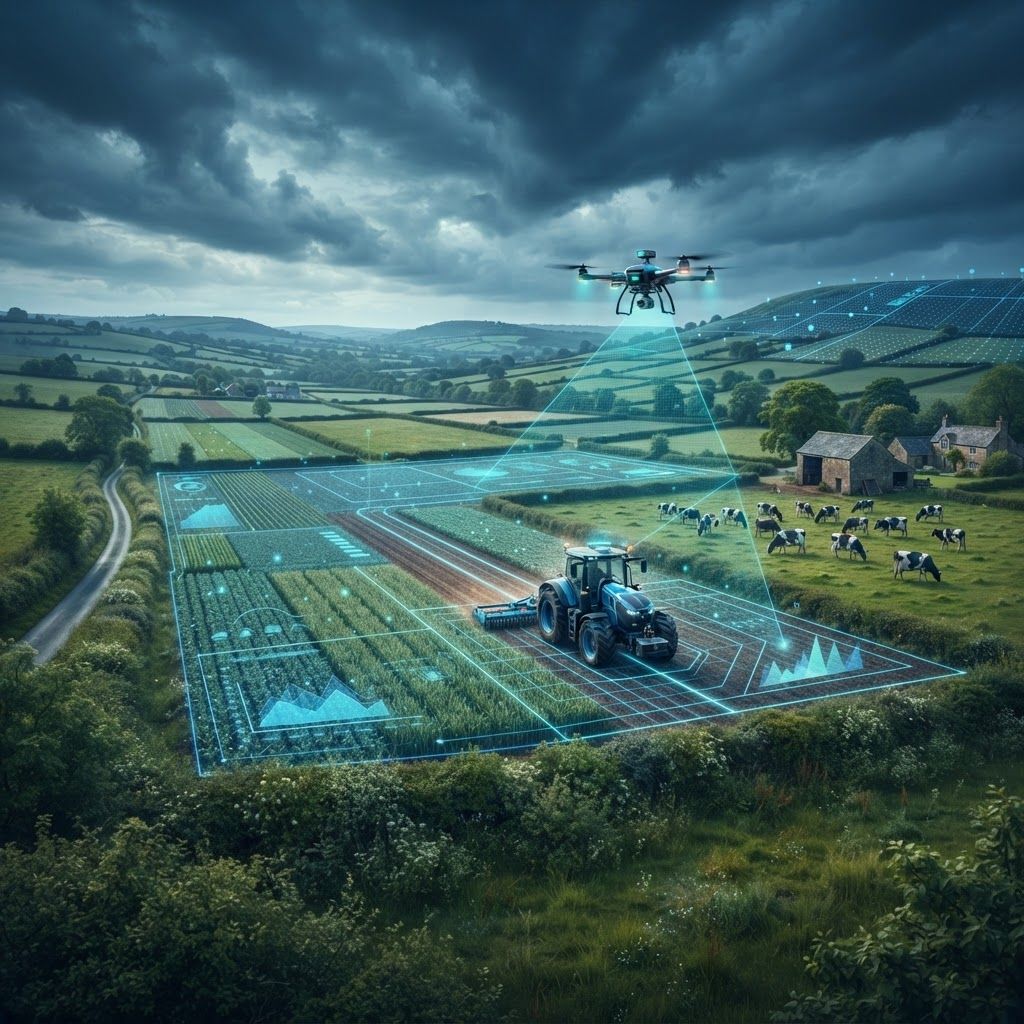
Agriculture on Preston's Doorstep
Preston sits at the centre of one of England's more varied agricultural landscapes. To the west, the Fylde's flat, fertile silt and peat soils support intensive vegetable and salad production. To the north and east, the Ribble Valley and the fringes of the Forest of Bowland provide grassland well suited to dairy and livestock. The mild, wet maritime climate that made Lancashire ideal for cotton spinning also produces excellent grass growth, which is why dairy has been the backbone of the county's farming for generations.
Farming here operates under real pressure. The transition away from area-based subsidies towards environmental land management payments has changed farm income structures fundamentally. Input costs for fertiliser, fuel and feed have been volatile. Labour availability, particularly seasonal horticultural labour, remains difficult. Yet the businesses that have adapted through technology, diversification and direct marketing are performing strongly.
The Top 10 Farming Companies in Preston
1. Ribble Valley Dairy Farms — A dairy enterprise running a substantial milking herd on a grass-based system with rotational grazing supplemented by home-grown forage. Ribble Valley Dairy Farms has invested in robotic milking and herd monitoring collars that track rumination and activity, allowing individual cow health issues to be identified days before they would be visible to the eye.
2. Fylde Fresh Produce Growers — Large-scale growers of potatoes, brassicas, leeks, carrots and salad crops on the Fylde's productive soils. Their operation combines precision planting, controlled irrigation and cold-chain grading and packing on site, supplying supermarkets and wholesale markets with produce harvested and cooled within hours.
3. Preston Arable and Cereals — An arable business growing wheat, barley, oilseed rape and forage maize using variable rate application guided by soil sampling and yield mapping. Preston Arable and Cereals has adopted reduced-tillage establishment to protect soil structure and cut fuel use, and grows cover crops over winter to reduce nitrate leaching.
4. Broughton Beef and Sheep Enterprises — A livestock business finishing beef cattle and running a commercial breeding flock across grassland and upland grazing. Their emphasis on native and hardy breeds suited to Lancashire conditions, combined with performance recording and careful grassland management, produces consistent finished stock with lower input dependency.
5. Deepdale Poultry Farms — Producers of free-range eggs and table poultry with automated feeding, environmental control and welfare monitoring. Biosecurity has become the defining operational concern in poultry following repeated avian influenza incidents, and their housing, hygiene and range management protocols reflect that reality.
6. Lancashire Horticultural Nurseries — Growers of bedding plants, herbaceous perennials, shrubs and protected crops under glass and polythene. Lancashire Horticultural Nurseries supplies garden centres, landscapers and local authorities, and has invested in biological pest control and water recycling to reduce chemical and water use in a sector where both are heavily scrutinised.
7. Penwortham Mixed Farming Company — A mixed enterprise integrating arable rotation with livestock, using manure to build soil organic matter and reduce purchased fertiliser. Mixed farming has returned to favour precisely because it internalises fertility, spreads market risk across several outputs and supports the biodiversity outcomes environmental schemes now reward.
8. Guild Organic Farming — A certified organic producer of vegetables, milk and beef supplying box schemes, independent retailers and specialist wholesalers. Organic conversion is demanding, requiring a transition period and rigorous record keeping, but Guild Organic Farming has built a loyal direct customer base around Preston that provides pricing stability conventional commodity markets cannot.
9. Northern Contract Farming Services — Providing contract arable operations, silage making, muck spreading, hedge cutting and whole-farm contract management for landowners without their own machinery. Contract farming allows smaller holdings to access modern equipment and agronomic expertise without the capital cost, and has become an important structural feature of Lancashire agriculture.
10. Avenham Farm Diversification Group — A farming business combining traditional production with diversified income from farm shop retail, holiday accommodation, glamping, educational visits and a wedding venue. Diversification has become essential for many family farms, and this operation demonstrates how a working farm can capture consumer spending directly while continuing to produce food.
Technology Transforming Lancashire Farming
Precision agriculture is now mainstream rather than experimental. Satellite-guided machinery reduces overlap and input waste. Variable rate fertiliser application matches nutrient supply to soil analysis and crop need. Yield mapping identifies underperforming areas for targeted intervention. Soil moisture sensing improves irrigation timing in horticulture. Collectively these technologies reduce input costs while improving environmental outcomes, which is a rare alignment of commercial and ecological interest.
Livestock technology has progressed equally quickly. Automatic milking systems, activity and rumination monitoring, electronic identification and automated weighing allow individual animal management within large herds. Early disease detection reduces both antibiotic use and production losses.
Sustainability and Policy Pressures
Environmental land management schemes now reward soil health, hedgerow management, water quality protection, species-rich grassland and habitat creation. Farms that treat these payments as a genuine enterprise rather than an afterthought have replaced a meaningful portion of lost subsidy income.
Carbon is the emerging pressure. Milk processors, supermarkets and grain buyers increasingly request carbon footprint data from suppliers, and farms that have completed carbon audits are better placed in those supply chains. Practical mitigation includes improving feed conversion efficiency, extending herd longevity, using clover and legumes to reduce nitrogen fertiliser, and improving slurry management to capture nutrients and reduce emissions.
Direct Marketing and Local Food
One of the most encouraging developments around Preston is the strength of local food demand. Farm shops, farmers markets, vegetable box schemes, milk vending machines and direct meat sales all allow producers to capture retail margin rather than accepting commodity prices. Customers gain provenance and freshness, and farms gain resilience against volatile wholesale markets. Building this requires marketing skills quite different from production, but the businesses that have invested in it report stronger and more stable returns.
Looking Ahead
Farming around Preston faces genuine challenges in climate variability, policy transition, labour supply and market volatility. The businesses profiled here share common characteristics: they measure performance carefully, invest in technology where it pays, treat environmental management as a business activity, and stay close to their customers. Those principles, more than farm size or enterprise type, appear to determine which Lancashire farms are thriving through this period of change.
Want your brand featured in front of decision-makers? Publish a guest post or get a link insertion in our guides through AAMAX's guest post and link insertion service.
Helpful Links
 SponsoredAAMAX — Full-Service Digital Agency
Write for Us
Share your expertise with our readers. We welcome guest contributions from industry specialists.
Pitch your idea

