

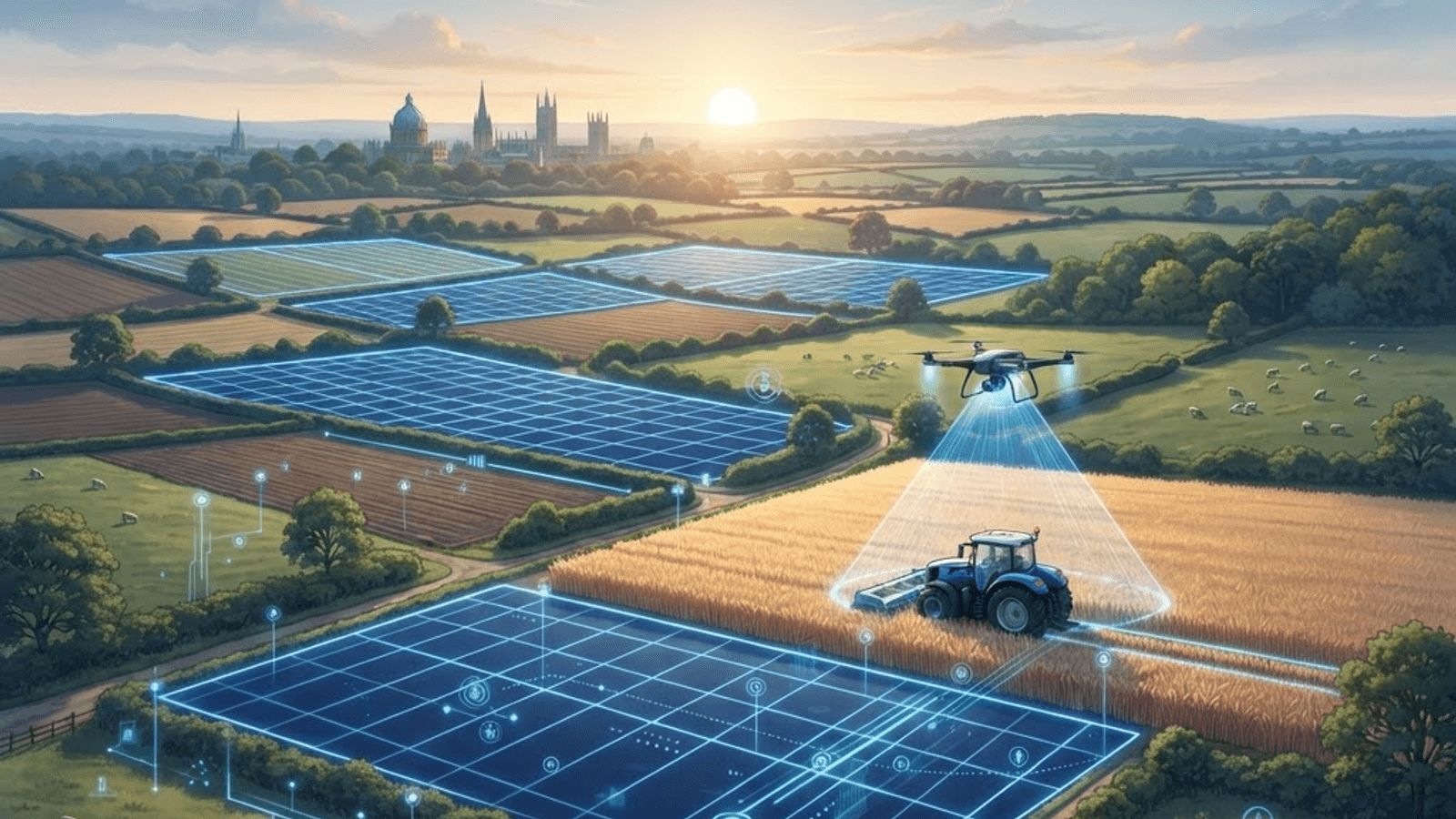
Farming on Oxford's Doorstep
Oxford is often pictured as a city of libraries and laboratories, but drive fifteen minutes in almost any direction and the landscape becomes emphatically agricultural. The Thames floodplain, the clay vales to the north and west, and the chalk downland to the south support a mixture of arable cropping, livestock grazing, dairying and horticulture that has been worked continuously for centuries.
The farming businesses operating here are more sophisticated than the pastoral imagery suggests. Many run to several thousand acres with precision agriculture systems, contract farming arrangements and diversified income from renewable energy, tourism and direct sales. Others are deliberately small, intensive market gardens supplying the city's restaurants and box schemes. Both models thrive because Oxford provides an affluent, food-conscious market immediately adjacent to the land.
The Agricultural Character of Oxfordshire
Soil dictates enterprise. The heavier clay soils of the vale favour grassland, livestock and combinable crops such as wheat and oilseed rape. Lighter chalk and limestone brash to the south suit barley, and the downland has a long tradition of sheep. River valley meadows support grazing and hay, and increasingly form part of environmental schemes. Market gardening concentrates on the more workable soils close to the city where labour and markets are accessible.
Farm size varies enormously, from smallholdings of a few acres to estates managing land on behalf of institutional owners, including several Oxford colleges which have held agricultural land for centuries.
The Ten Best Farming Companies Around Oxford
1. Thames Valley Arable Farms. A large-scale arable business growing wheat, barley, oilseed rape and pulses using controlled traffic farming and variable rate application. Its investment in soil mapping and data-led agronomy is among the most advanced in the county.
2. Cherwell Valley Dairy. A modern dairy operation combining grazing with housed production, supplying liquid milk and cheese-making cream. Herd health monitoring and methane reduction through feed management are central to its current programme.
3. Oxfordshire Livestock Company. Beef and sheep production across grassland and downland, with native breeds finished on pasture. It supplies local butchers and restaurants that market provenance actively, and manages significant areas under environmental stewardship.
4. Isis Market Gardens. An intensive horticultural business growing salads, vegetables and herbs for Oxford restaurants, box schemes and farmers' markets. Short supply lines and rapid succession planting allow it to deliver produce harvested the same morning.
5. Cotswold Edge Regenerative Farming. A mixed farm practising minimum tillage, cover cropping, diverse rotations and integrated livestock grazing to rebuild soil organic matter. It hosts research trials and farmer discussion groups, making it influential well beyond its own acreage.
6. Botley Organic Farms. Certified organic arable and vegetable production with on-farm packing, supplying wholesalers, retailers and direct customers. Organic certification and rotational fertility building define its system.
7. Kidlington Poultry and Egg Producers. Free-range egg production with on-site grading and packing, alongside table poultry. Biosecurity, welfare standards and range management are managed to the assurance schemes retailers require.
8. Headington Fruit and Soft Fruit Growers. Orchards and soft fruit under protection, producing apples, plums, strawberries and raspberries for local sale, juicing and pick-your-own. Seasonal labour management and pollinator habitat are key operational themes.
9. Summertown Agri-Environment Land Management. A business specialising in managing farmland for environmental outcomes alongside food production, including wildflower meadows, hedgerow restoration, wetland creation and carbon measurement. It works with landowners entering environmental land management schemes.
10. Cowley Farm Contracting. A contracting business providing drilling, spraying, harvesting and baling services to farms that no longer wish to own full machinery fleets. Access to modern, well-maintained equipment without capital outlay is its core proposition.
Policy, Payments and the Post-Subsidy Landscape
English agriculture has been through the most significant policy transition in fifty years. Area-based direct payments have been phased down, replaced by schemes paying for environmental outcomes: soil health, habitat creation, water quality, hedgerow management and species recovery. For Oxfordshire farms, this has changed business planning fundamentally, making environmental delivery a genuine income stream rather than an obligation.
The practical consequence is that many local farms now operate as land managers producing both food and ecosystem services. Businesses that engaged early with soil testing, habitat mapping and scheme applications have generally fared better than those that delayed.
Technology and Innovation
Oxfordshire farms benefit from proximity to agricultural research and technology development. Satellite and drone imagery guide variable input application. Soil moisture and weather stations inform irrigation and spray timing. Livestock wearables monitor health and fertility. Autonomous and lightweight robotic platforms are being trialled for weeding and data collection.
The economics are increasingly persuasive. Reducing fertiliser use through precise application saves money and emissions simultaneously, which is why adoption has accelerated even among traditionally cautious operators.
Diversification and the Oxford Market
Proximity to a wealthy city with strong food culture creates opportunities most rural farms lack. Farm shops, box schemes, farmers' markets and direct restaurant supply all capture more value than commodity selling. Beyond food, diversification includes renewable energy generation, farm buildings converted to commercial units, camping and event hosting, and educational visits.
These enterprises have become essential to resilience. Few Oxfordshire farms now rely on a single income stream, and the most robust businesses balance commodity production, environmental payments and direct sales.
Looking Ahead
The pressures on farming near Oxford are real: development pressure on land, water resource constraints, volatile input costs and increasingly erratic weather. But the advantages are equally real, including good soils, excellent market access, research connections and a public that understands and values local food production. The farming companies that continue to invest in soil, data and direct relationships with customers are the ones best placed for the decades ahead.
Want your brand featured in front of decision-makers? Publish a guest post or get a link insertion in our guides through AAMAX's guest post and link insertion service.
Helpful Links
 SponsoredAAMAX — Full-Service Digital Agency
Write for Us
Share your expertise with our readers. We welcome guest contributions from industry specialists.
Pitch your idea

