

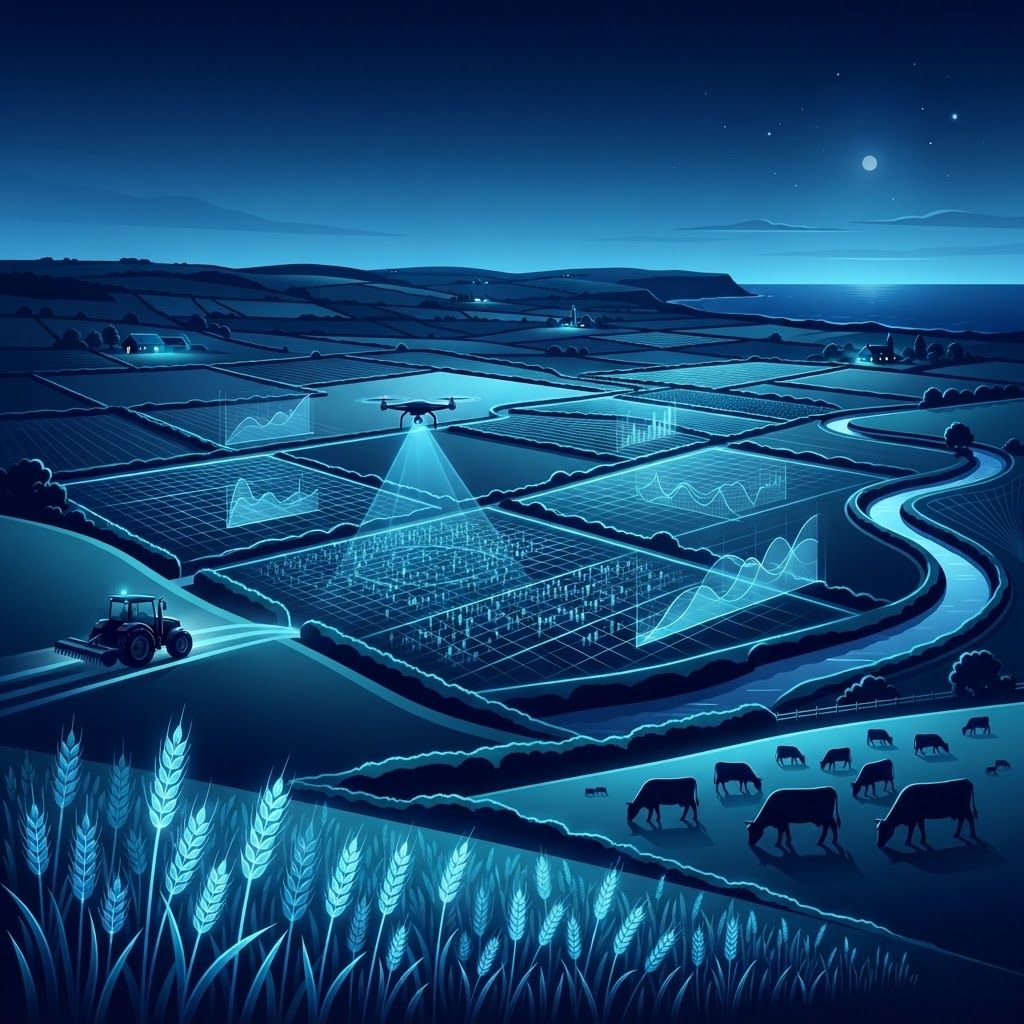
Farming in North Somerset: A Distinctive Landscape
Agriculture in North Somerset is shaped by three quite different landscapes within a small area. To the north and west lie the low-lying levels and moors behind the Bristol Channel coast, drained by rhynes and historically devoted to grassland and dairy. To the south rise the Mendip Hills, with thinner soils, mixed arable and substantial sheep grazing. Between them sits the Yeo Valley and the villages of Congresbury, Wrington and Churchill, where dairying, horticulture and increasingly diversified enterprises coexist.
This variety produces an unusually broad farming economy for a district of this size. Dairy remains foundational, supported by Somerset's cheese and yoghurt processing heritage. Beef and sheep occupy the higher and wetter ground. Arable cropping, cider orchards, market gardening, egg production and equine enterprises fill out the picture. Proximity to Bristol adds a dimension many rural areas lack: a large, affluent, food-conscious urban market within a short drive, which has made direct selling, farm shops and box schemes genuinely viable rather than marginal.
Ten Notable Farming Businesses in North Somerset
1. Yeo Valley. The district's most recognisable farming name and arguably the most influential. Rooted in the Mead family's farms in the Yeo Valley near Blagdon, the business built a national organic dairy brand while retaining a genuine farming operation. Its significance locally extends beyond its own output: it anchors a network of organic milk suppliers across Somerset and has done more than any other single business to normalise organic dairy in British retail.
2. Alvis Bros / Lye Cross Farm. Based at Redhill, this family business combines large-scale dairy farming with cheddar production, including organic and vegetarian ranges exported internationally. It represents the vertically integrated model that has protected Somerset dairy incomes: controlling milk production, processing and brand rather than selling commodity milk into a volatile market.
3. Thatchers Cider. A Sandford-based family business now four generations deep, growing cider apples across North Somerset orchards and processing them on site. Thatchers matters agriculturally as well as commercially, because its orchard programme sustains a distinctive local land use and supports a network of contract apple growers across the district.
4. Puxton Park and diversified farm attractions. Near Hewish, this operation illustrates the diversification route many North Somerset farms have taken: combining working land with visitor attractions, education and hospitality. Given the district's tourism flows toward Weston-super-Mare and the Mendips, farm-based leisure has become a legitimate primary income stream rather than a sideline.
5. Sandford Farms and Mendip livestock enterprises. A category of substantial beef and sheep operations working the Mendip fringe. These businesses are the backbone of grassland management across the hills, and increasingly participate in environmental land management schemes that pay for habitat, hedgerow and species-rich grassland outcomes alongside food production.
6. Court Farm and North Somerset farm shop operators. Farm retail has expanded significantly, with several operations combining production, on-site butchery, café trade and event hosting. The commercial logic is straightforward: capturing retail margin on a proportion of output stabilises income far more effectively than incremental yield gains.
7. Somerset Levels dairy partnerships. Large collaborative and family dairy operations across the moors and levels supply cheese and liquid milk processors. Their defining challenge is water: managing drainage, flood risk and increasingly volatile rainfall patterns while meeting nutrient management rules. Progressive operators here have become genuinely sophisticated in grazing management and slurry handling.
8. Regenerative and mixed-farming pioneers. A growing group across the district adopting minimum tillage, cover cropping, mob grazing, agroforestry and reduced input systems. Motivations are both environmental and economic, since input costs rose sharply in recent years and soil-focused systems reduce exposure to fertiliser markets. Several North Somerset farms now host trials and farmer discussion groups.
9. Horticulture and market garden enterprises. Smaller-scale vegetable and salad growers supplying Bristol restaurants, box schemes and independent retailers. Land availability near a major city and strong local demand for seasonal produce have made this a viable niche, particularly for new entrants who cannot access the capital required for livestock or arable at scale.
10. Contract farming and agricultural services businesses. Contractors providing silage, harvesting, slurry application, hedge cutting and precision agronomy services are indispensable to the district's farming structure. As machinery costs have risen, sharing capability through contractors has allowed medium-sized farms to access modern equipment and GPS-guided application they could never justify buying.
Policy and Market Forces Reshaping Local Agriculture
The transition from area-based subsidy to environmental land management payments is the defining change of the decade. Farms are being paid for soil health, habitat creation, hedgerow management and nutrient reduction rather than simply for occupying land. In North Somerset, where much farmland lies within sensitive coastal, levels and Mendip landscapes, these schemes have significant income potential but demand record keeping and planning capability that some smaller operations find burdensome.
Water and nutrient management is the second pressure. Phosphate and nitrate concerns affecting catchments in the region influence both farming practice and, in some cases, planning decisions for development. Farms that can demonstrate robust nutrient budgeting are better placed commercially and reputationally.
Input volatility is the third. Fertiliser, fuel and feed price swings have made resilience a strategic priority, accelerating interest in clover-rich swards, home-grown protein, slurry nutrient recovery and renewable energy on farm. Solar arrays and anaerobic digestion now feature in the business plans of several district operations.
Finally, market structure continues to favour differentiation. Commodity producers remain price takers, while those with brand, processing capability, organic certification or direct customer relationships retain far more value. This explains why so many of North Somerset's most successful farming names are also food businesses.
What This Means for Buyers and Partners
Food businesses sourcing locally should look for producers with genuine certification and traceability rather than vague provenance claims, and should recognise that seasonality is real in a district with this mix of enterprises. Landowners and new entrants should study the diversification and direct-selling models that have worked here, because proximity to Bristol is a structural advantage that pure production farming does not fully exploit.
Final Thoughts
North Somerset farming is a working landscape rather than a museum piece, combining substantial dairy and livestock production with cider, horticulture, farm retail and environmental land management. The businesses thriving here share a common trait: they capture value beyond the farm gate, whether through processing, brand, visitor income or environmental payments, and they manage soil and water as carefully as they manage cash.
Want your brand featured in front of decision-makers? Publish a guest post or get a link insertion in our guides through AAMAX's guest post and link insertion service.
Helpful Links
 SponsoredAAMAX — Full-Service Digital Agency
Write for Us
Share your expertise with our readers. We welcome guest contributions from industry specialists.
Pitch your idea

