

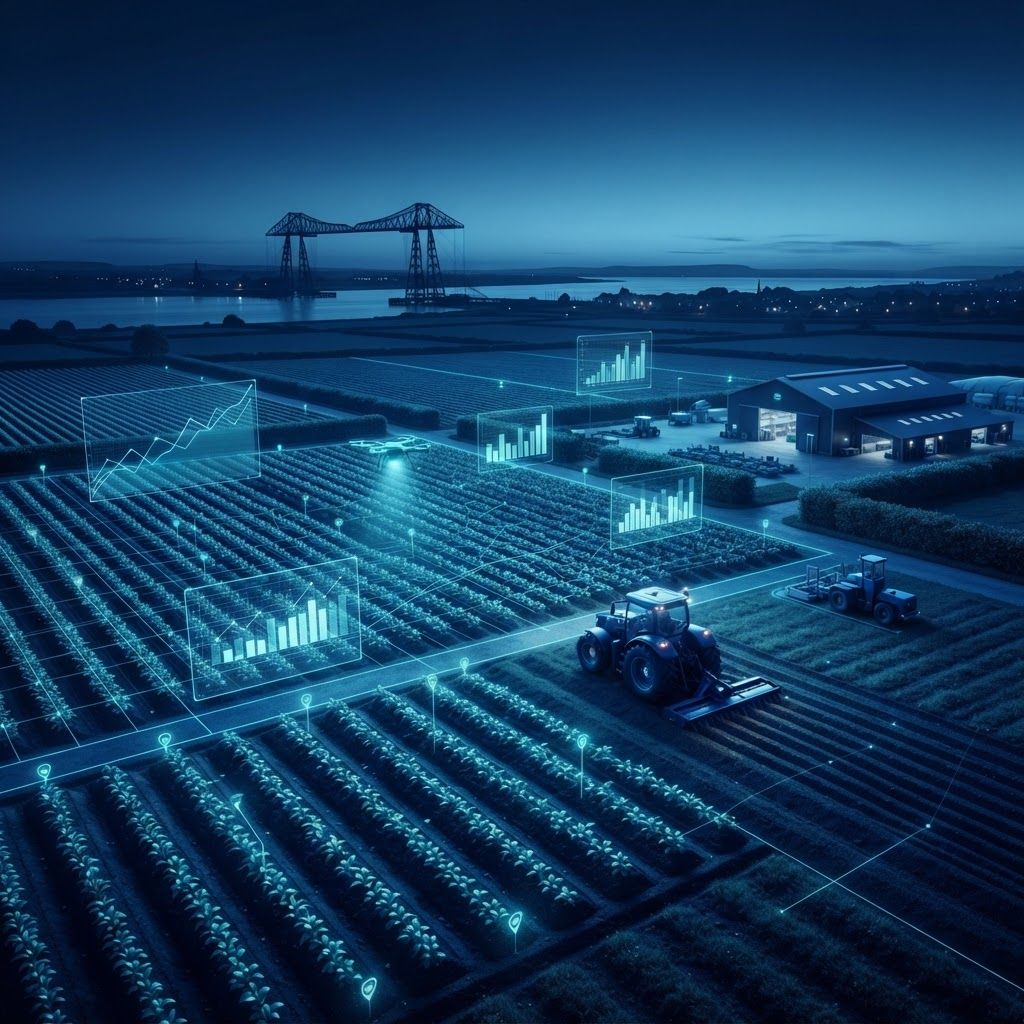
Farming on the Edge of a Welsh City
Newport is often described in industrial terms, yet agriculture remains a defining feature of its wider landscape. The Gwent Levels to the south form one of the most distinctive grazing landscapes in Britain, a network of reens and drainage ditches supporting livestock and remarkable biodiversity. To the north and east, the land rises toward Monmouthshire with mixed arable, beef and dairy enterprises on more sheltered ground.
Farming close to a city brings both advantage and pressure. Advantage comes from immediate access to consumers, restaurants, farm shops and processing facilities. Pressure comes from land values, development interest, public access and the need to manage nutrient and water quality carefully in a sensitive catchment.
What Distinguishes a Well Run Farm Business
Modern farm businesses are judged on more than yield. Soil health management, nutrient planning, animal welfare standards, water protection, carbon accounting and diversification income all shape resilience. Welsh agricultural policy has moved decisively toward sustainable land management, rewarding habitat maintenance, tree cover and water quality alongside food production.
The strongest operations tend to share several habits: they measure carefully, they invest in soil before inputs, they diversify without losing focus on their core enterprise, and they build direct relationships with buyers rather than relying entirely on commodity markets.
1. Levels Grazing Livestock Company
A beef and sheep enterprise working the low lying pasture of the Gwent Levels, combining traditional grazing with habitat management of reens and field margins. Notable for careful stocking rates that maintain both animal condition and the wet grassland ecology the area is known for.
2. Usk Vale Dairy Farms
A dairy business on the better drained land north of the city, focused on grass based production and herd longevity. Invests in cow comfort, milk quality monitoring and slurry management infrastructure that protects local watercourses.
3. Caerleon Arable Enterprises
Cereals and break crops grown with a strong emphasis on soil structure, cover cropping and reduced cultivation. Rotational planning is used to manage weed pressure and reduce reliance on inputs, with yield mapping guiding variable application.
4. Wentlooge Market Garden Growers
Horticultural production of vegetables and salad crops supplying local retailers, box schemes and restaurants. Short supply chains and rapid harvest to sale timing give a freshness advantage that national distribution cannot match.
5. Gwent Mixed Farming Partnership
A mixed livestock and arable operation using integrated rotation, where cropping and grazing support each other through manure cycling and grass leys. A resilient structure that spreads risk across enterprises and market cycles.
6. Severn Estuary Sheep Company
Sheep production combining lowland flocks with conservation grazing agreements on sensitive sites. Recognised for lambing management, flock health planning and careful selection of hardy, efficient breeding stock.
7. Malpas Poultry and Egg Producers
Free range egg production with strong biosecurity and welfare practices, supplying local retailers and food service. Range management, including tree planting for shelter, improves both bird welfare and land use.
8. Newport Agroecology Farm Collective
A group of smaller producers practising agroecological methods, including no dig horticulture, agroforestry and diverse cropping. Focused on community food supply, education and demonstrating lower input systems in a Welsh context.
9. Coedkernew Fodder and Forage Company
Specialises in silage, hay and forage crop production for other livestock businesses, plus contracting services. Quality analysis and timing discipline are what make forage genuinely valuable rather than simply bulky.
10. Rogerstone Farm Diversification Group
Combines core farming with diversification including farm shop retail, holiday accommodation and educational visits. A practical model for how peri urban farms can capture value from proximity to a city population.
Trends in Welsh Agriculture
Sustainable land management payments are reshaping planning, encouraging habitat, hedgerow and tree investment alongside production. Technology adoption is accelerating, with soil scanning, precision application, livestock monitoring and farm management software now common on mid sized holdings. Direct selling continues to grow, and water quality in sensitive catchments has become a central compliance issue requiring accurate nutrient budgeting.
Advice for Local Buyers and New Entrants
Buyers seeking local produce should build relationships around a realistic seasonal calendar rather than expecting year round uniformity. New entrants should focus on land in good heart, honest cash flow forecasting and a clearly defined market before scaling. Contract rearing, share farming and cooperative machinery arrangements all lower the capital barrier that otherwise makes entry near a city extremely difficult.
Water, Drainage and the Levels Landscape
No account of farming around Newport is complete without discussing water. The Gwent Levels exist only because of centuries of drainage work, and the reen network requires continuous maintenance to keep land productive. Farmers here carry responsibilities that go beyond their own fields, since blocked or poorly managed channels affect neighbours and settlements alike. Coordinated ditch clearance, careful timing of works and sensitivity to wildlife breeding seasons are all part of the annual calendar.
Climate variability has raised the stakes. Heavier winter rainfall increases waterlogging and delays spring turnout, while occasional summer dry spells reduce grass growth on shallow soils. Successful businesses respond by building forage reserves, improving soil organic matter to hold moisture, and maintaining flexible stocking so that numbers can be adjusted before a difficult season becomes a crisis.
Final Thoughts
Farming around Newport blends a historic drained grazing landscape with modern mixed and horticultural enterprises serving a nearby urban market. The businesses succeeding are those treating soil, water and habitat as productive assets rather than constraints, while staying commercially disciplined.
Want your brand featured in front of decision-makers? Publish a guest post or get a link insertion in our guides through AAMAX's guest post and link insertion service.
Helpful Links
 SponsoredAAMAX — Full-Service Digital Agency
Write for Us
Share your expertise with our readers. We welcome guest contributions from industry specialists.
Pitch your idea

