

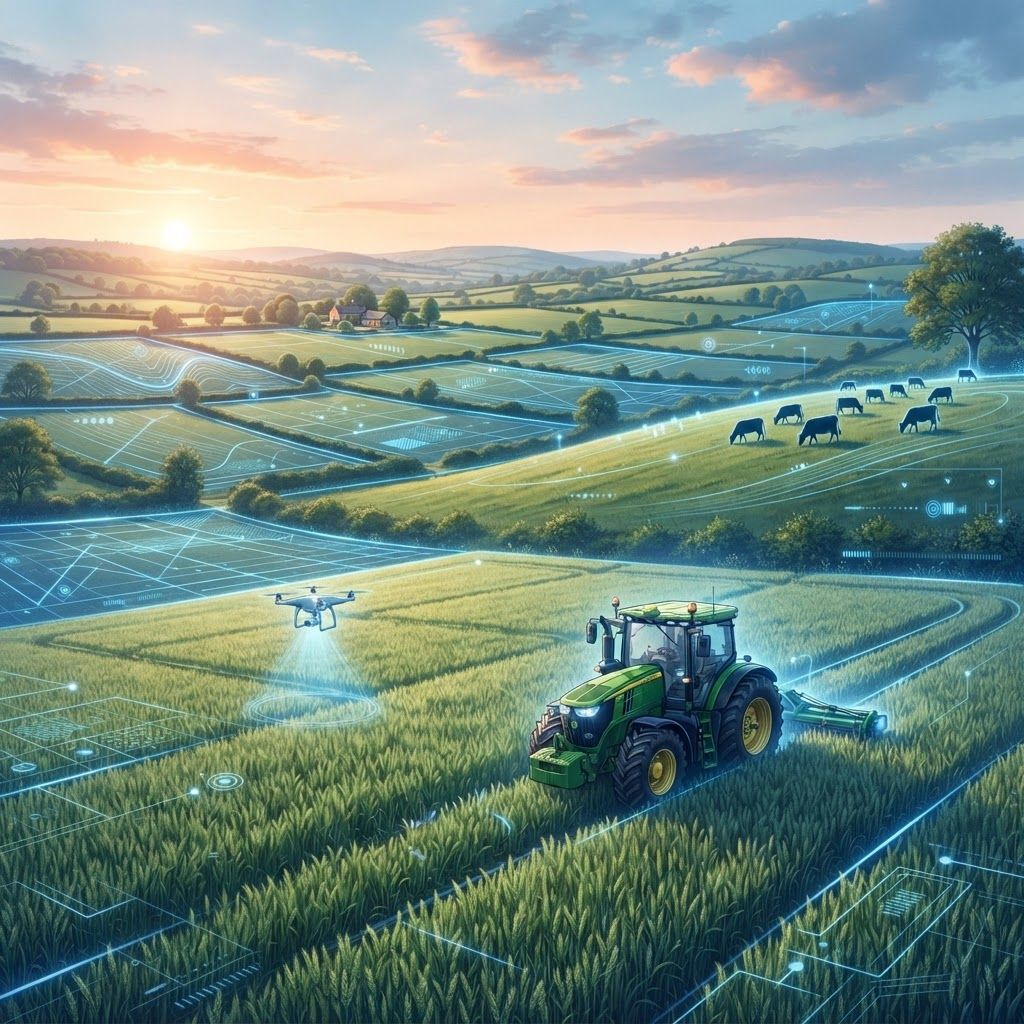
Farming in the Newcastle-under-Lyme Countryside
Although Newcastle-under-Lyme is best known as a market town, the borough extends well beyond its urban core into a broad rural hinterland. Parishes such as Madeley, Betley, Balterley, Maer, Whitmore, Loggerheads and Audley contain some of the most attractive and productive farmland in North Staffordshire. The landscape here is characterised by heavy clay soils, undulating pasture, hedgerow field boundaries and scattered woodland, conditions that have historically favoured grassland farming over intensive arable cropping.
Dairy has been the backbone of the local farming economy for generations. The region's reliable rainfall and grass-growing potential suit milk production, and North Staffordshire retains a substantial dairy herd despite decades of consolidation. Alongside dairy, beef finishing, sheep grazing on the higher and wetter ground, and arable rotations of wheat, barley, oilseed rape and forage maize make up the rest of the picture.
The Structure of Local Agriculture
The typical holding in the area is a family farm, often tenanted or part-tenanted, operating somewhere between one hundred and five hundred acres. Larger contract farming arrangements have grown as older farmers step back and neighbours or contractors take on additional land, a pattern seen across the Midlands. Diversification is widespread: farm shops, holiday lets, livery yards, wedding venues, renewable energy installations and contracting services now contribute meaningfully to farm incomes.
That diversification is not simply opportunism. It reflects the reality that commodity farming margins are volatile and that resilience comes from having more than one income stream. Farms within easy reach of Newcastle-under-Lyme, Stoke-on-Trent and the M6 have a genuine advantage in accessing consumers directly.
Ten Notable Farming Businesses and Organisations
1. Hollybush Garden Centre and Farm Shop operates in the wider Staffordshire area and exemplifies the modern diversified farming business, combining horticulture, retail and food with a working land base. It demonstrates how direct-to-consumer trade can transform farm economics.
2. Trentham Estate and its associated farming operations represent the large estate model found across North Staffordshire, where agricultural land sits alongside leisure, retail and conservation activity. Estates of this kind are significant local landowners and employers.
3. Madeley Estate farms and the tenanted holdings around the Madeley and Betley parishes form a cluster of traditional mixed and dairy farms that have supplied milk and livestock into regional markets for generations. Their continuity is a notable feature of the borough's agricultural character.
4. Betley and Balterley dairy farms collectively make up one of the more concentrated dairy areas near the Cheshire border. Many supply major processors on aligned contracts, which provides price stability compared with the spot market.
5. Whitmore and Maer livestock farms specialise in beef and sheep production on the higher ground west of the town. The grassland here supports suckler herds and breeding flocks, with stock moving through regional livestock markets.
6. Audley area mixed farms combine arable cropping with livestock, taking advantage of the slightly lighter land in parts of the parish. Rotational cropping of cereals and forage supports both grain sales and on-farm feed.
7. Loggerheads and Ashley farming businesses sit on the Staffordshire and Shropshire fringe and include several progressive arable and dairy units that have invested in precision agriculture and improved slurry management.
8. Reaseheath College, just over the Cheshire border, is a major agricultural education provider whose training, research and knowledge transfer work directly benefits farms across North Staffordshire. Many local farm staff and successors train there.
9. Harper Adams University in nearby Shropshire is one of the leading agricultural universities in Europe and a significant influence on farming practice in the region, particularly in precision agriculture, agri-robotics and sustainable soil management.
10. The National Farmers Union Staffordshire branch provides representation, technical guidance and lobbying support for farmers across the county. Its role in navigating policy change has become increasingly important to local businesses.
Policy Change and Farm Incomes
The most consequential shift for farmers around Newcastle-under-Lyme has been the phasing out of the Basic Payment Scheme and its replacement with environmental land management schemes. Direct area payments, which for many farms represented the difference between profit and loss, have been progressively reduced. In their place, farmers are paid for delivering public goods such as soil health, water quality, biodiversity and carbon storage.
The transition has been challenging. Environmental schemes require different planning, record keeping and often capital investment, and payment rates do not always replace lost income pound for pound. Farms that have engaged early and integrated schemes into their rotation have generally fared better than those that delayed.
Sustainability and Environmental Practice
Soil management has become a central concern on the heavy clays of North Staffordshire, where compaction and winter waterlogging reduce yields and increase runoff. Practices such as reduced tillage, cover cropping, controlled traffic and improved drainage are being adopted steadily. Herbal leys and diverse grass mixtures are increasingly used in dairy and livestock systems to improve drought resilience and reduce fertiliser dependence.
Slurry and nutrient management is another priority, driven both by regulation and by the cost of bought-in fertiliser. Covered stores, precision application equipment and nutrient management planning reduce losses and protect the watercourses that feed into the Trent catchment. Several local farms have also installed solar arrays and anaerobic digestion capacity, turning waste streams into energy and reducing exposure to volatile utility prices.
Technology on Local Farms
Precision agriculture has moved from novelty to normality. GPS-guided tractors, variable rate fertiliser application, yield mapping and soil scanning are now common on arable units of moderate size. In dairy, robotic milking, automatic feeders, heat detection collars and herd management software have improved both productivity and animal welfare while reducing labour dependence, a critical factor given persistent recruitment difficulties in agriculture.
Challenges Ahead
Labour availability, succession planning and volatile input costs remain the most frequently cited pressures. Bovine tuberculosis continues to affect cattle farms in parts of Staffordshire, with significant financial and emotional consequences. Development pressure around the urban fringe of Newcastle-under-Lyme and Stoke-on-Trent also removes land from production and complicates farm layouts.
Against that, there are real opportunities. Consumer interest in local, traceable food is strong, farm retail continues to grow, and payments for environmental delivery offer a genuine new income stream for farms with the right land and appetite.
Final Thoughts
Agriculture around Newcastle-under-Lyme is in a period of significant change, but the fundamentals remain sound: good grass-growing land, established markets, strong educational institutions nearby and a population that increasingly values local produce. The farms that thrive will be those that combine technical excellence with diversified income and a clear environmental strategy.
Want your brand featured in front of decision-makers? Publish a guest post or get a link insertion in our guides through AAMAX's guest post and link insertion service.
Helpful Links
 SponsoredAAMAX — Full-Service Digital Agency
Write for Us
Share your expertise with our readers. We welcome guest contributions from industry specialists.
Pitch your idea

