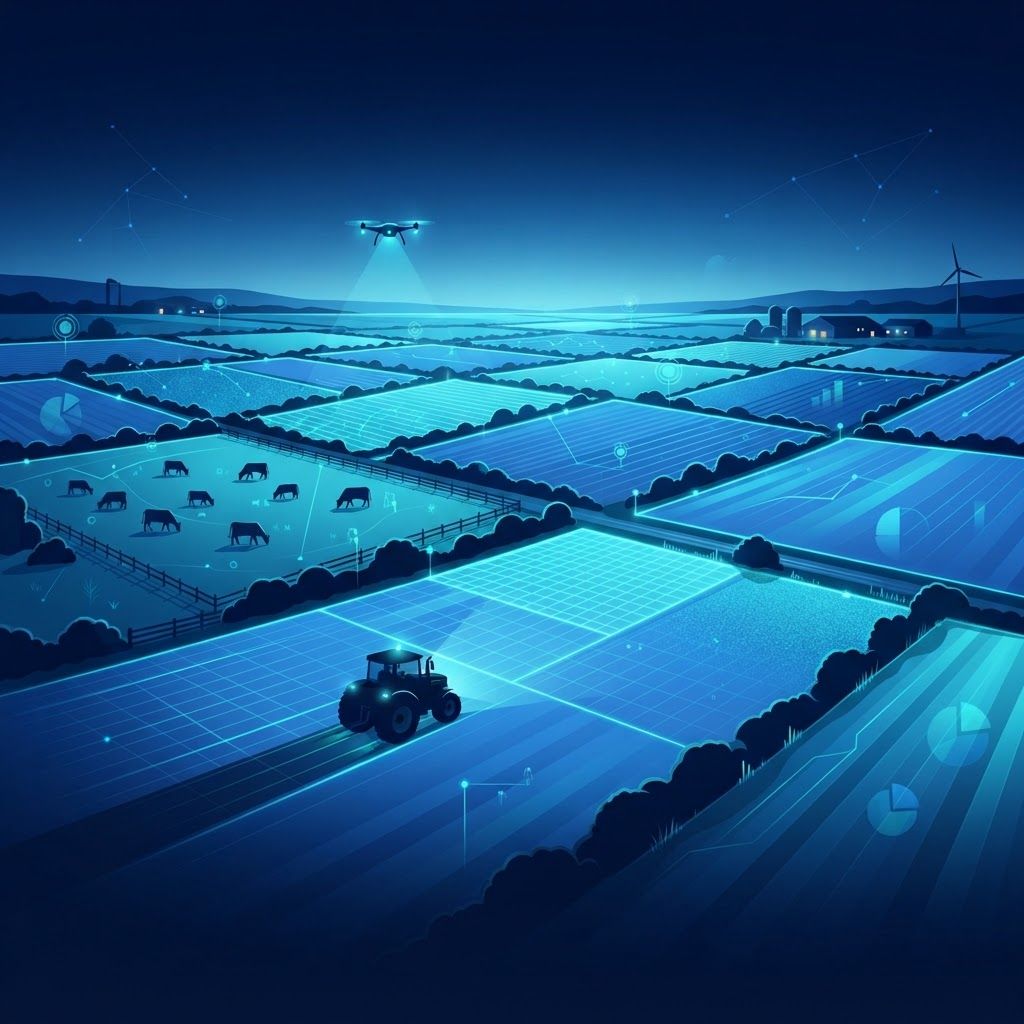
Farming in the Lagan Valley and Beyond
The countryside surrounding Lisburn and Castlereagh is some of the most productive farmland in Northern Ireland. Fertile lowland soils, reliable rainfall and a temperate climate support intensive grassland systems, while drier, better-drained ground allows for cereals and vegetable production. Within a short drive of Belfast, this landscape sustains a farming economy that supplies processors, retailers and restaurants across the island.
Farm structure here is typically family-based, with holdings passed through generations and increasingly operated as limited companies with formal business planning. Average farm size has grown steadily as smaller units are amalgamated, and diversification into contracting, renewable energy, farm shops and agri-tourism is now common rather than unusual.
The Main Production Systems
Dairy is the dominant enterprise in value terms. Grass-based systems, supplemented with silage and concentrate feeding, support herds producing milk for local processing into cheese, butter, powders and liquid milk. Investment in robotic milking, cow comfort housing and precision feeding has increased significantly, driven by both efficiency and labour availability.
Beef and sheep production remains widespread, particularly on heavier or more marginal ground where grazing is the most sensible land use. Suckler herds, store cattle finishing and lowland flocks all feature. Breeding decisions increasingly use genomic data, and carcass feedback from processors now shapes management far more directly than in previous decades.
Arable and horticultural enterprises complete the picture. Barley, wheat, oats and forage crops supply feed and human consumption markets, while protected and field horticulture produces vegetables, soft fruit and ornamental plants. Poultry, both broiler and egg production, is also significant, supported by the region's strong processing sector.
The Top 10 Farming Companies in Lisburn and Castlereagh
1. Lagan Valley Dairy Farms operates a substantial grass-based dairy enterprise with strong herd health management, robotic milking installations and detailed nutritional monitoring across its units.
2. Castlereagh Beef Company finishes cattle to processor specification, using genomic selection and carcass data feedback to improve conformation and consistency year on year.
3. Hillsborough Arable Enterprises grows cereals and forage crops across the district, employing controlled traffic farming, variable-rate fertiliser application and cover cropping to protect soil structure.
4. Moira Poultry Group manages broiler and layer units with a focus on welfare standards, biosecurity discipline and energy efficiency in housing systems.
5. Dundonald Horticultural Growers produces field vegetables and protected salad crops, supplying wholesalers and retailers with short-chain, locally grown produce.
6. Carryduff Sheep Farming Company runs lowland flocks with careful attention to grassland rotation, parasite management and lamb finishing performance.
7. Maze Mixed Farming Partnership combines livestock and cropping in an integrated rotation, using home-grown feed and returning organic matter to the soil to reduce input dependency.
8. Ravenhill Organic Farms operates certified organic land, focusing on clover-based swards, extended rotations and premium market channels for milk and meat.
9. Drumbo Soft Fruit Producers grows strawberries and other soft fruit under protection, extending the season and supplying regional retailers and farm shops.
10. Lisburn Agricultural Contracting and Farming combines its own production with a substantial contracting operation, providing silage harvesting, slurry application and cultivation services to neighbouring farms.
Sustainability and Technology
Environmental performance now shapes farm decision-making profoundly. Nutrient management planning, slurry storage capacity, low-emission spreading equipment, hedgerow retention and riparian buffer strips have all become standard elements of good practice. Many producers are also measuring carbon footprint at farm level, partly because processors and retailers increasingly request it.
Technology adoption has accelerated. GPS guidance reduces overlap and input waste, soil sampling with variable-rate application targets fertiliser precisely, and sensor-based livestock monitoring detects health issues earlier than visual observation alone. Renewable generation, particularly solar on shed roofs and anaerobic digestion of slurry, is turning what were once waste streams and idle assets into income.
Diversification and Rural Enterprise
Many farming businesses in the district now generate meaningful income from activities beyond primary production. Agricultural contracting is the most common, allowing farms to spread the cost of expensive machinery across a larger workload. Others have developed farm shops, butchery, ice cream and cheese production, converting raw commodities into retail products with far higher margins.
Tourism and leisure provide another route. Glamping sites, event barns, riding facilities and educational farm visits all make use of existing buildings and land while connecting the public with food production. Renewable energy, particularly rooftop solar and anaerobic digestion, adds a further income stream that also reduces on-farm energy costs.
Diversification is not automatically profitable, and each venture demands skills that differ from farming itself. The businesses that succeed generally start small, test demand carefully and scale only once the concept has proved itself commercially.
Pressures and Prospects
Farming in the district faces genuine challenges: volatile input costs, changing support arrangements, labour scarcity, disease risk and increasing regulatory complexity around water quality and ammonia emissions. Weather variability adds further uncertainty, making silage timing and harvest windows harder to plan.
Yet the outlook contains real strengths. Northern Ireland's grass-growing capability is a durable natural advantage, its processing infrastructure is well developed, and consumer interest in traceable, locally produced food continues to grow. The farming companies of Lisburn and Castlereagh that combine technical excellence with sound business management and genuine environmental stewardship are well placed to remain productive for generations to come.
Want your brand featured in front of decision-makers? Publish a guest post or get a link insertion in our guides through AAMAX's guest post and link insertion service.
Helpful Links
 SponsoredAAMAX — Full-Service Digital Agency
Write for Us
Share your expertise with our readers. We welcome guest contributions from industry specialists.
Pitch your idea