

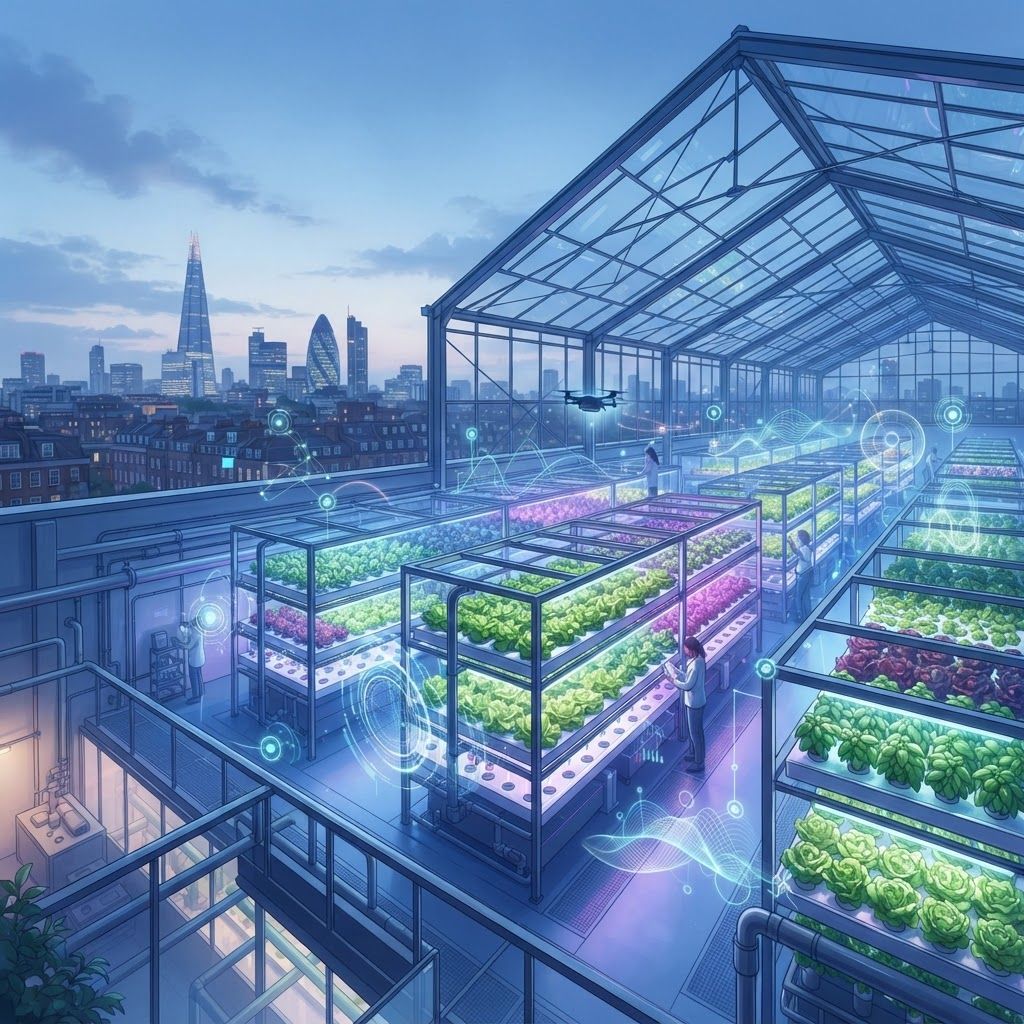
Rethinking What Farming Means in Inner London
Islington is one of the most densely populated boroughs in the United Kingdom, with very little open land and property values that would make conventional agriculture unthinkable. Yet farming here is real, growing and increasingly sophisticated. It takes place on rooftops, in converted warehouses, in basements, in community gardens, on housing estate plots and inside climate-controlled growing rooms where lighting, humidity and nutrient delivery are managed to the decimal point.
The drivers are practical. Restaurants and retailers want produce harvested hours rather than days before service. Residents want access to fresh food and to the experience of growing it. Landlords want productive uses for underused roofs and vacant industrial units. And a generation of food entrepreneurs has recognised that proximity to millions of consumers is itself a competitive advantage that rural producers cannot replicate.
The Technologies Behind Urban Farming
Modern urban farming in the borough rests on a handful of techniques. Hydroponics grows plants in nutrient solution without soil, dramatically reducing water use and eliminating the weight problems that soil creates on rooftops. Aquaponics couples fish rearing with plant growing so that nutrients circulate between the two systems. Aeroponics mists roots suspended in air, achieving fast growth in very compact footprints.
Vertical farming stacks these systems in tiers under LED lighting tuned to specific wavelengths, multiplying yield per square metre many times over compared with a flat bed. Environmental control systems manage temperature, carbon dioxide and humidity, while sensors and software track growth and flag problems before they spread. Because these environments are enclosed, pesticide use is typically minimal or absent, which is a strong selling point for chefs and health-conscious consumers.
Ten Notable Farming Operations Serving Islington
1. Islington City Farm Collective operates as a community-focused urban farm with animals, growing beds, orchards and an extensive education programme. Its value lies as much in connecting residents, particularly children, to food production as in the produce itself.
2. Angel Vertical Farms runs a controlled-environment facility producing leafy greens, herbs and micro-crops year round. Consistent quality, predictable volumes and delivery within hours of harvest have made it a reliable supplier to local restaurants.
3. Holloway Rooftop Growers converts flat commercial roofs into productive growing space using lightweight substrate and container systems, supplying salad crops and herbs to nearby cafés while improving building insulation and rainwater retention.
4. Finsbury Park Community Allotments Association coordinates allotment and community plot growing across the borough's north, supporting hundreds of households with training, seed sharing, composting facilities and seasonal produce swaps.
5. Clerkenwell Hydroponics supplies both produce and systems, designing and installing compact hydroponic units for restaurants, schools and offices that want to grow herbs and salad on site. Its consultancy work has spread urban growing well beyond its own facility.
6. Old Street Urban Agriculture specialises in high-value crops for the hospitality sector, including edible flowers, microgreens and unusual herb varieties that chefs struggle to source consistently from conventional wholesalers.
7. North London Aquaponics operates an integrated fish and plant system, producing freshwater fish alongside vegetables in a closed loop that recycles nutrients and water. It is also a frequent host for research visits and technical demonstrations.
8. Upper Street Mushroom Farm cultivates gourmet mushrooms in a converted basement, using spent coffee grounds and other waste streams as substrate. It is a widely cited example of circular urban food production.
9. Archway Green Estates Project works with housing estates to turn neglected communal land into productive gardens, combining food growing with wellbeing, skills training and volunteering opportunities for residents.
10. Islington AgriTech Innovation Hub supports early-stage urban farming ventures with growing space, sensors, monitoring software and business mentoring, functioning as an incubator for the next generation of city food producers.
Benefits and Genuine Challenges
The advantages of urban farming are substantial. Food miles collapse to almost nothing, which improves freshness and cuts transport emissions. Enclosed systems use a fraction of the water conventional field agriculture requires and are largely immune to weather volatility, allowing year-round production. Local supply chains are shorter and more transparent, and the social benefits, from education to community cohesion to mental health, are well documented.
The challenges are equally real. Energy consumption for lighting and climate control is significant, and the environmental case depends heavily on renewable supply. Property costs in Islington are punishing, and many operations survive only through partnerships with landlords or public bodies. The economics work best for high-value, fast-growing, delicate crops such as salad, herbs and microgreens, and far less well for staples like wheat or potatoes. Skilled labour is scarce, since the work sits between horticulture and systems engineering.
Where Urban Farming in the Borough Is Heading
Several developments look likely. Renewable-powered facilities and waste-heat recovery from neighbouring buildings will improve the carbon arithmetic. Automation and machine learning will reduce labour costs and optimise growing recipes crop by crop. Integration into new developments, where growing space is designed in from the outset rather than retrofitted, will lower entry costs. And closer partnerships with restaurants, schools and retailers will provide the guaranteed offtake that makes investment viable.
For residents, businesses and investors in Islington, the practical takeaway is that farming in the borough is no longer a curiosity. It is a functioning part of London's food system, producing genuinely excellent crops, creating skilled jobs and demonstrating what food production can look like in a city that has almost no spare land but a great deal of ingenuity.
Want your brand featured in front of decision-makers? Publish a guest post or get a link insertion in our guides through AAMAX's guest post and link insertion service.
Helpful Links
 SponsoredAAMAX — Full-Service Digital Agency
Write for Us
Share your expertise with our readers. We welcome guest contributions from industry specialists.
Pitch your idea

