Agriculture in the Gedling Countryside
Beyond the suburban edges of Arnold and Carlton, Gedling borough opens into genuinely productive farmland. The Trent Valley to the south provides fertile alluvial soils suited to arable and horticultural production, while the gently rolling land around Woodborough, Lambley, Calverton and Oxton supports mixed farming, livestock and a growing number of diversified rural businesses. Agriculture remains a real economic activity here, not merely a scenic backdrop.
Nottinghamshire farming has always been varied, and Gedling reflects that. Cereal production, oilseed rape, field vegetables, soft fruit, beef and sheep, poultry, equestrian enterprises and increasingly renewable energy and rural tourism all feature within a relatively compact area. The proximity of Nottingham provides a substantial local market, supporting farm shops, direct sales and box schemes that would be harder to sustain in more remote regions.
Types of Farming Enterprise in the Borough
Arable farms grow wheat, barley, oilseed rape and pulses, typically on larger holdings using contractors for specialist operations. Horticultural businesses produce field vegetables, salads and soft fruit, often labour-intensive and increasingly using protected cropping. Livestock farms run beef cattle and sheep, with some dairy in the wider county. Poultry enterprises produce eggs and meat, both free range and housed. Mixed farms combine arable and livestock, offering rotational and risk-spreading benefits. Diversified rural businesses add farm shops, holiday accommodation, equestrian facilities, events venues and renewable energy to core agricultural income. Contracting businesses provide machinery, labour and agronomy services to other farms.
The Top 10 Farming Companies Serving Gedling
1. Trent Valley Arable Farms
A substantial arable enterprise on the fertile valley soils, growing combinable crops with precision farming technology including variable rate application and yield mapping.
2. Woodborough Fruit and Vegetable Growers
A horticultural business producing field vegetables and soft fruit, supplying regional wholesalers, farm shops and a local box scheme direct to households.
3. Lambley Livestock Farms
Runs beef cattle and sheep on permanent and rotational pasture, with an emphasis on grass-fed production and direct sales of boxed meat to local customers.
4. Calverton Poultry Enterprises
Produces free range eggs and poultry for regional retailers and food service customers, with welfare accreditation and on-site packing facilities.
5. Gedling Agricultural Contracting
Provides contract cultivation, drilling, spraying, harvesting and baling services to farms across the borough, giving smaller holdings access to modern machinery without the capital cost.
6. Oxton Mixed Farming Company
Operates a traditional mixed system combining arable rotation with livestock, using manure and grass leys to maintain soil health and reduce input dependency.
7. Burton Joyce Equestrian and Land Management
Combines livery, grazing management and hay production with paddock maintenance services for the borough's substantial equestrian community.
8. Mapperley Farm Shop and Direct Sales
A farm retail enterprise selling own-produced and locally sourced meat, vegetables, dairy and preserves direct to consumers, capturing far more value than commodity supply.
9. Ravenshead Renewable Energy Farming
Integrates solar generation, anaerobic digestion and biomass alongside conventional farming, diversifying income and improving on-farm energy resilience.
10. Gedling Agronomy and Soil Services
Provides independent agronomy advice, soil testing, nutrient planning and environmental scheme support to farms across the borough.
Policy Change and Its Local Impact
British agriculture is undergoing its most significant policy transition in half a century. The replacement of area-based direct payments with schemes that pay for environmental outcomes has fundamentally altered farm business planning. Support now flows towards soil health, water quality, habitat creation, hedgerow management and public access rather than simply land occupation.
For Gedling farms, this creates both challenge and opportunity. Businesses reliant on direct payments to underpin profitability have had to find productivity gains or new income streams. Those with land suited to environmental delivery, particularly along watercourses and on less productive ground, have found that environmental schemes can pay better than marginal cropping.
Proximity to Nottingham adds further options. Biodiversity net gain requirements on development create demand for habitat creation on nearby farmland, and natural capital markets for carbon and nutrient offsetting are developing. These represent genuinely new income possibilities for landowners close to urban growth.
Technology and Precision Agriculture
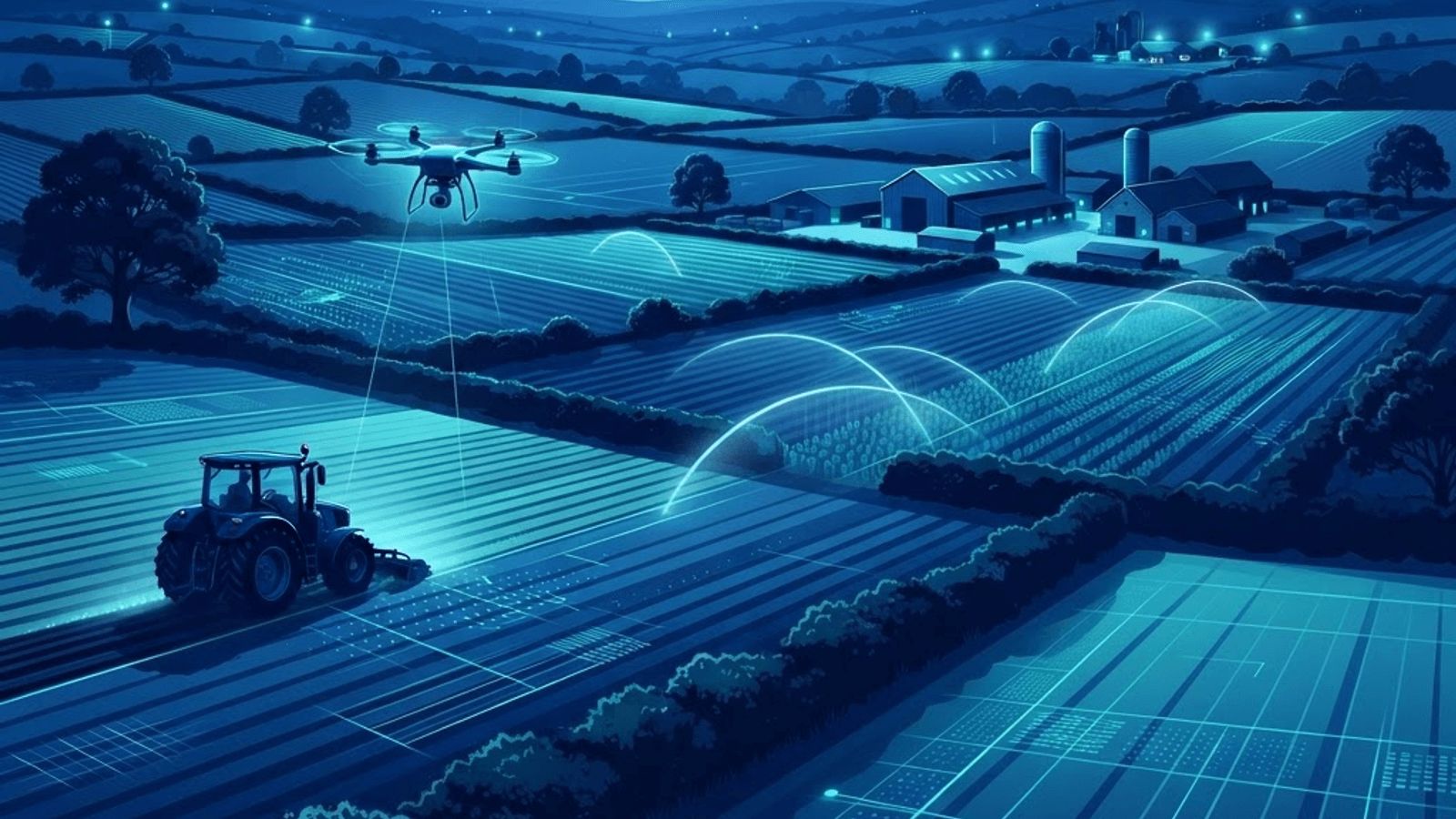
Modern farming is data-intensive. GPS guidance reduces overlap and input waste. Variable rate application matches seed, fertiliser and chemical inputs to soil variation within a single field. Soil scanning and detailed sampling inform nutrient planning. Drones and satellite imagery monitor crop health and identify problems early.
Livestock producers use electronic identification, automated weighing and health monitoring to improve performance and meet traceability requirements. Robotic milking, while more common on larger dairy units, illustrates the direction of travel.
These technologies deliver both economic and environmental benefits, reducing input use while maintaining or improving output. Adoption is uneven, generally correlating with farm scale, but contracting services allow smaller holdings to access precision techniques without owning the equipment.
Diversification and the Local Market
Few farms now rely solely on agricultural production. Farm shops, cafes, holiday lets, glamping, weddings, storage lettings, equestrian facilities and renewable energy all appear across Gedling's rural businesses, and for many these enterprises now contribute more profit than the farming itself.
Direct selling is particularly attractive given Nottingham's population. Selling beef at retail rather than commodity prices transforms the economics of a small livestock enterprise, though it demands skills in marketing, food safety and customer service that traditional farming does not require.
Challenges Facing Local Farmers
Input cost volatility, particularly fertiliser and fuel, has squeezed margins severely. Labour availability, especially seasonal horticultural labour, remains a persistent constraint. Weather volatility has increased, with wetter autumns and drier summers complicating establishment and harvest. Development pressure on land near the urban edge creates both opportunity and uncertainty.
Despite these pressures, Gedling farming shows genuine adaptability, with businesses combining production efficiency, environmental delivery and direct market engagement in ways that would have been unfamiliar a generation ago.
Conclusion
Farming in Gedling remains a working, evolving industry rather than a preserved landscape. The borough's farms feed local markets, manage a substantial share of its land and increasingly deliver environmental benefits alongside food. Supporting them through local purchasing and understanding the pressures they face helps sustain both the countryside and the rural economy of Nottinghamshire.
Want your brand featured in front of decision-makers? Publish a guest post or get a link insertion in our guides through AAMAX's guest post and link insertion service.
Helpful Links
 SponsoredAAMAX — Full-Service Digital Agency
Write for Us
Share your expertise with our readers. We welcome guest contributions from industry specialists.
Pitch your idea