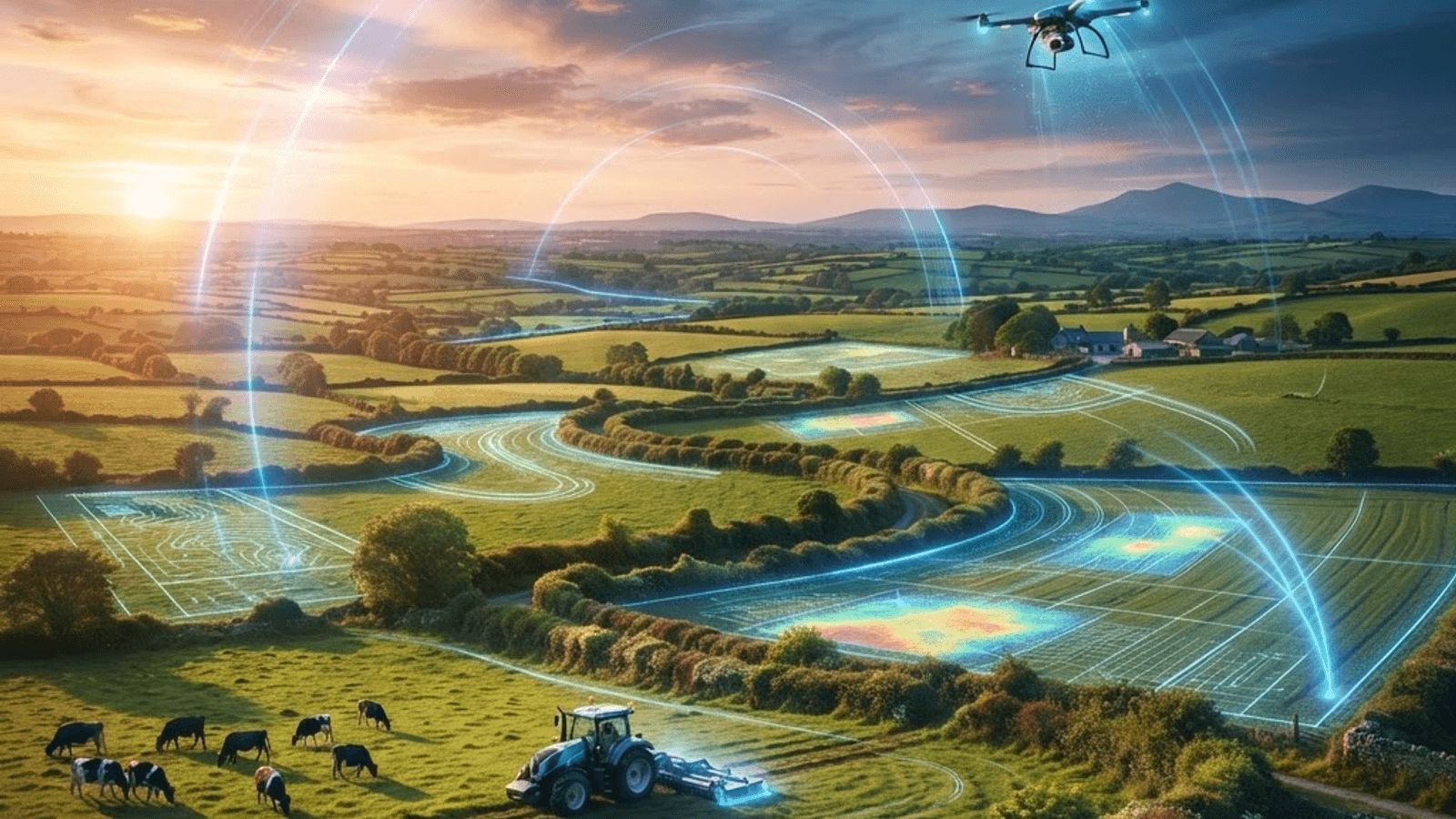
Farming as the Foundation of the District
No sector defines Fermanagh and Omagh more completely than agriculture. The district contains a very high proportion of Northern Ireland's grassland, and its climate, high rainfall and mild temperatures, produces grass growth that is among the most reliable in Europe. That natural advantage has shaped a farming economy built overwhelmingly on grass based livestock production rather than arable cropping.
Farm structure here is distinctive. Holdings are generally smaller than the United Kingdom average, family owned and often worked across multiple generations. Fragmentation is common, with many farms operating across several parcels of land. Much of the district is classified as less favoured area, reflecting heavy soils, drumlin topography and rushy ground that constrain productivity but also create the hedgerow rich landscape that supports tourism and biodiversity.
The Principal Farming Enterprises
Suckler beef production dominates, with cows kept to produce calves that are either finished locally or sold as stores. Dairy is significant and has intensified over recent decades, with larger herds, improved genetics and substantial investment in parlours and slurry infrastructure. Sheep farming concentrates on the higher ground of the Sperrins and the upland fringes. Pigs and poultry are present but more localised, often integrated with processing contracts. Arable is limited, mostly silage, cereals for on farm feed and forage crops.
Diversification has become widespread. Farm tourism, renewable energy, contracting services, direct sales of meat and farmhouse food production all supplement core farm income, and several of the district's best known food businesses began as farm diversifications.
Ten Leading Farming Companies and Agri Businesses
1. Erne Valley Dairy Farms represents the district's modern dairy sector, operating expanded herds with grass based systems, precision feeding and substantial investment in slurry storage and low emission spreading equipment.
2. Sperrin Hill Sheep Enterprises manages extensive upland flocks across the Sperrin foothills, combining hardy hill breeds with lowland finishing, and contributing to habitat management on designated upland sites.
3. Fermanagh Premium Beef Producers operates suckler and finishing units supplying quality assured beef into processors and premium retail supply chains, with strong emphasis on breeding, health planning and carcass performance.
4. Tyrone Agricultural Contracting Group provides silage harvesting, slurry spreading, reseeding, hedge cutting and baling services, giving smaller farms access to modern machinery without the capital burden of ownership.
5. Lakeland Grassland Management Services specialises in soil sampling, nutrient management planning, reseeding programmes and grazing infrastructure, helping farms convert grass into livestock output more efficiently.
6. Clogher Valley Mixed Farming Company operates a combined beef, sheep and forage cropping enterprise, using rotation and integrated management to spread risk and improve soil condition across varied land types.
7. Drumquin Poultry Enterprises runs broiler and free range egg production units supplying regional processors, with significant investment in ventilation, biosecurity and welfare standards.
8. Omagh Farm Machinery and Support Services supports the wider farming community with machinery supply, maintenance, welding repair and parts, keeping equipment operational through demanding silage and slurry seasons.
9. Westside Organic and Regenerative Farming applies rotational grazing, reduced input systems and diverse swards, appealing to a market segment that values certified organic and demonstrably regenerative production.
10. Enniskillen Agri Food Producers represents the farm to food end of the chain, processing local milk and meat into artisan dairy products and cured meats sold through regional retail and hospitality outlets.
Sustainability and Environmental Pressure
Northern Irish agriculture faces serious environmental challenges, particularly around water quality and greenhouse gas emissions. Phosphorus and nitrogen loading in Lough Erne and other waterways has become a central policy issue, driving tighter nutrient management rules, restrictions on spreading periods and requirements for greater slurry storage capacity. Farmers in the district have invested heavily in covered storage, low emission spreading and nutrient planning as a result.
Methane from ruminant livestock is the other major issue. Practical responses include improved animal health, earlier finishing ages, better genetics, feed additives and grassland management that increases output per animal. Anaerobic digestion has expanded, converting slurry and silage into renewable energy while producing digestate that displaces manufactured fertiliser.
Technology and Precision Agriculture
Technology adoption on local farms has accelerated. Electronic identification and weighing systems track livestock performance. Heat detection collars improve dairy fertility. Satellite and drone imagery informs grassland measurement. Global positioning guidance on tractors reduces overlap in spreading and spraying. Farm management software consolidates compliance records that would once have filled several filing cabinets.
Robotic milking has grown particularly quickly, addressing the labour shortage that many dairy farms face while improving milking frequency and cow comfort.
The Outlook for Family Farming
Succession remains the central long term question. The average age of farmers is high and younger family members increasingly pursue careers off farm. Support schemes, share farming arrangements, contract rearing and partnership structures are all being used to bring new entrants into the industry without requiring impossible capital outlay.
Market conditions have been volatile but broadly supportive for livestock in recent seasons, while input costs for fertiliser, fuel and feed have remained a pressure. Farms with lower cost, grass based systems have generally proved most resilient, which suits the natural strengths of this district.
Final Thoughts
Farming in Fermanagh and Omagh remains a genuinely productive, technically capable industry rooted in family enterprise and exceptional grass growing conditions. The businesses succeeding are those combining traditional stockmanship with serious attention to nutrient management, animal performance data and environmental responsibility.
Want your brand featured in front of decision-makers? Publish a guest post or get a link insertion in our guides through AAMAX's guest post and link insertion service.
Helpful Links
 SponsoredAAMAX — Full-Service Digital Agency
Write for Us
Share your expertise with our readers. We welcome guest contributions from industry specialists.
Pitch your idea