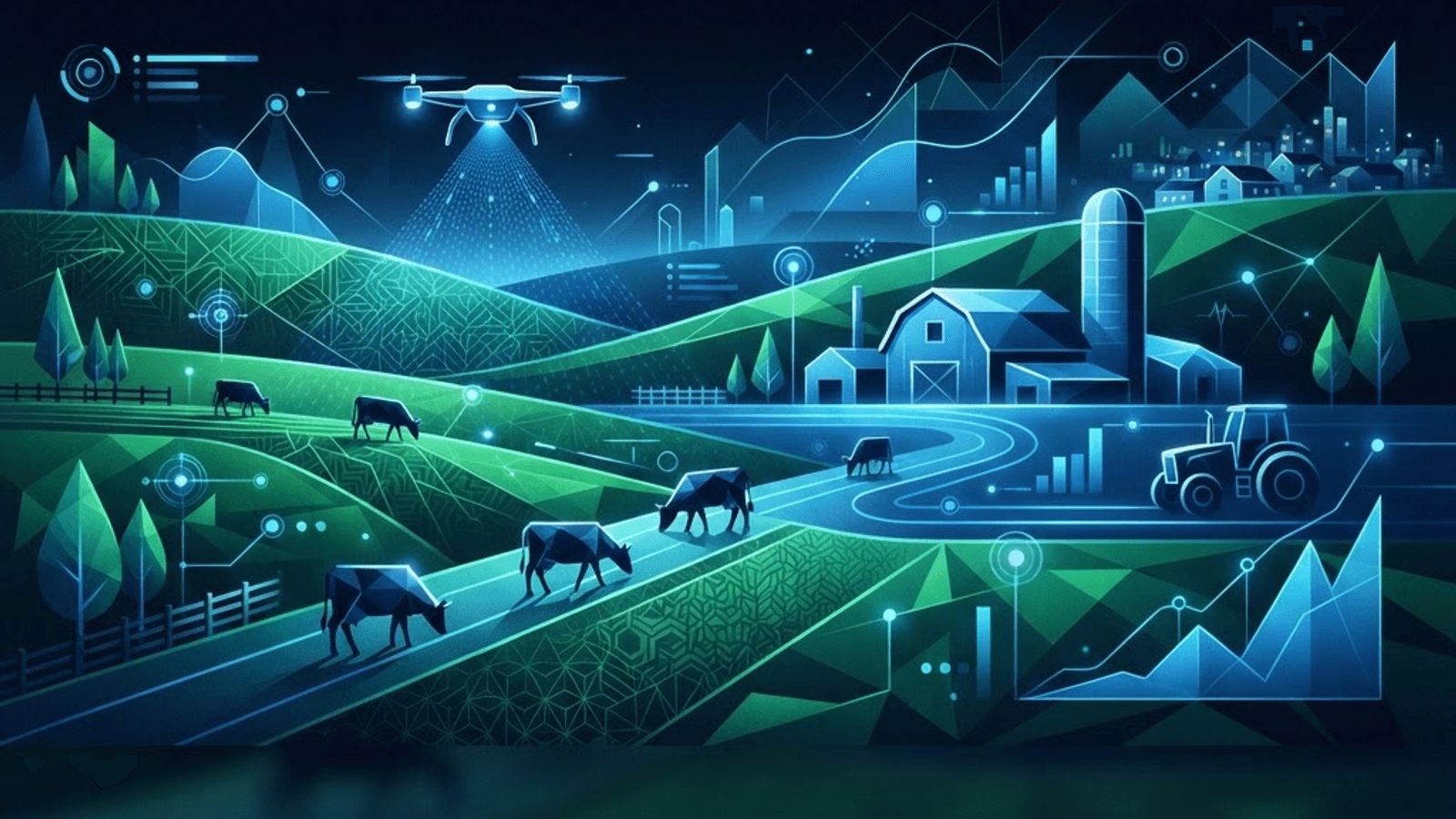
Agriculture at the Heart of East Ayrshire
Drive through East Ayrshire in any direction and the landscape tells its own story. Rolling pasture, hedged fields, grazing dairy herds and the distinctive silhouettes of silage clamps and slurry stores define much of the countryside between Kilmarnock, Stewarton, Mauchline, Cumnock and out toward the Galloway hills. This is grassland country, and the mild, wet climate that Ayrshire is famous for produces grass in abundance.
That natural advantage created one of Scotland's most significant dairy regions. The Ayrshire breed itself originated here, developed over generations for hardiness and the ability to convert grass efficiently into high-quality milk. Alongside dairy, the region supports beef and sheep enterprises, some arable production on better ground, and an increasingly diverse set of farm businesses incorporating renewable energy, food processing and tourism.
The Structure of Farming in the Region
East Ayrshire agriculture is predominantly family-run, with many holdings passing through several generations. Farm sizes vary considerably, from modest upland units to substantial dairy operations milking several hundred cows. What unites them is a dependence on grassland management, and the skill of an Ayrshire farmer is frequently measured in how well they grow, conserve and utilise grass.
Diversification has become a defining feature. Rising input costs, volatile commodity prices and the shift in agricultural support policy have pushed many businesses to develop additional income streams. Farm shops, holiday accommodation, contracting services, renewable energy generation and on-farm processing all feature across the region.
Leading Farming Companies and Enterprises in East Ayrshire
Ayrshire Dairy Farms Group represents the scale end of the regional dairy sector, operating substantial milking enterprises with modern parlour technology and careful attention to herd health and grassland productivity. Investment in cow comfort, precision feeding and data-driven herd management underpins consistently strong yields.
Irvine Valley Livestock Company runs beef and sheep enterprises across the eastern uplands, focusing on quality Scotch beef and lamb production. Breeding decisions, grassland rotation and careful stock management support a reputation for consistent finishing quality that is valued by processors.
Mauchline Mixed Farming Enterprise operates a combined arable and livestock system, growing cereals and forage crops alongside a beef finishing operation. Mixed farming offers genuine agronomic advantages, with manure returning nutrients to the soil and rotation breaking disease cycles.
Stewarton Pedigree Breeders focuses on pedigree cattle breeding, supplying quality genetics to commercial farms across Scotland and beyond. The Ayrshire and other dairy breeds developed here have influenced herds internationally, and breeding enterprises remain an important part of the region's agricultural identity.
Cumnock Upland Farming Partnership works the more challenging ground toward the eastern hills, running hardy sheep and suckler cattle suited to the conditions. Upland farming plays an important role in landscape and habitat management as well as food production, and these enterprises increasingly participate in environmental schemes.
Galston Organic Farms operates to certified organic standards, producing milk, beef and vegetables without synthetic inputs. Organic conversion demands patience and system redesign, but established organic producers benefit from premium pricing and strong consumer demand.
Loudoun Agricultural Contracting provides silage harvesting, slurry spreading, reseeding and cultivation services to farms across the region. Contracting allows individual farms to access expensive modern machinery without owning it, and skilled contractors are essential during the narrow weather windows that determine silage quality.
Auchinleck Farm Produce Company combines primary production with on-farm processing and direct sales, operating a farm shop and supplying local retailers and restaurants. Capturing more of the retail value of what is grown has proved an effective response to margin pressure at the farm gate.
Hurlford Poultry and Egg Producers supplies free-range eggs and poultry to regional wholesalers and retailers. Welfare standards and biosecurity are central concerns in this sector, and producers operating to higher welfare specifications access better markets.
Kilmarnock Agricultural Holdings manages land across several sites with a focus on grassland productivity, silage production and sustainable soil management. Soil health has emerged as a central concern in modern agriculture, and enterprises investing in organic matter, drainage and careful nutrient management are seeing measurable returns.
Trends Shaping Scottish Agriculture
Agricultural policy is undergoing significant change as Scotland develops its own framework linking support payments more directly to environmental outcomes, biodiversity and emissions reduction. Farm businesses are adapting by measuring carbon footprints, planting trees and hedgerows, and improving nutrient efficiency.
Precision agriculture has moved from novelty to practical tool. GPS-guided machinery reduces overlap and input waste. Soil mapping enables variable-rate fertiliser application. Sensors and collars monitor livestock health and fertility, catching problems days earlier than observation alone. These technologies improve both margin and environmental performance simultaneously.
Renewable energy has become an established part of the farm business model. Wind turbines, solar arrays on shed roofs and anaerobic digestion using slurry and crop residues all generate income while reducing on-farm energy costs. Ayrshire's wind resource is particularly favourable.
Labour availability remains a persistent constraint. Dairy farming in particular requires skilled, reliable staff willing to work unsociable hours, and robotic milking has been adopted partly in response, allowing herds to be managed with fewer people while often improving cow welfare.
Finally, consumer interest in provenance continues to benefit Scottish producers. Scotch beef and lamb carry protected geographical status, and Ayrshire dairy products enjoy a strong regional reputation. Farms able to tell their story credibly find markets willing to pay for it.
Challenges and Opportunities
Input cost volatility, particularly in fertiliser, feed and energy, has squeezed margins severely in recent years. Businesses that reduced dependence on bought-in inputs by improving grassland utilisation, incorporating clover and improving slurry management have weathered this considerably better.
Weather variability presents an ongoing challenge. Wetter autumns and more frequent extreme events affect grazing seasons, silage quality and soil condition. Improved drainage, flexible grazing infrastructure and greater forage reserves all build resilience.
The opportunities are equally real. Demand for high-quality, traceable, locally produced food remains strong, environmental payments create new income streams, and technology continues to improve what is achievable from the same land.
Final Thoughts
Farming in East Ayrshire remains the backbone of the rural economy and a central part of the region's identity. The businesses working this land combine generations of accumulated knowledge with genuine openness to new technology and new markets. Their continued success matters not only economically but for the landscape, communities and food supply of the wider region.
Want your brand featured in front of decision-makers? Publish a guest post or get a link insertion in our guides through AAMAX's guest post and link insertion service.
Helpful Links
 SponsoredAAMAX — Full-Service Digital Agency
Write for Us
Share your expertise with our readers. We welcome guest contributions from industry specialists.
Pitch your idea