

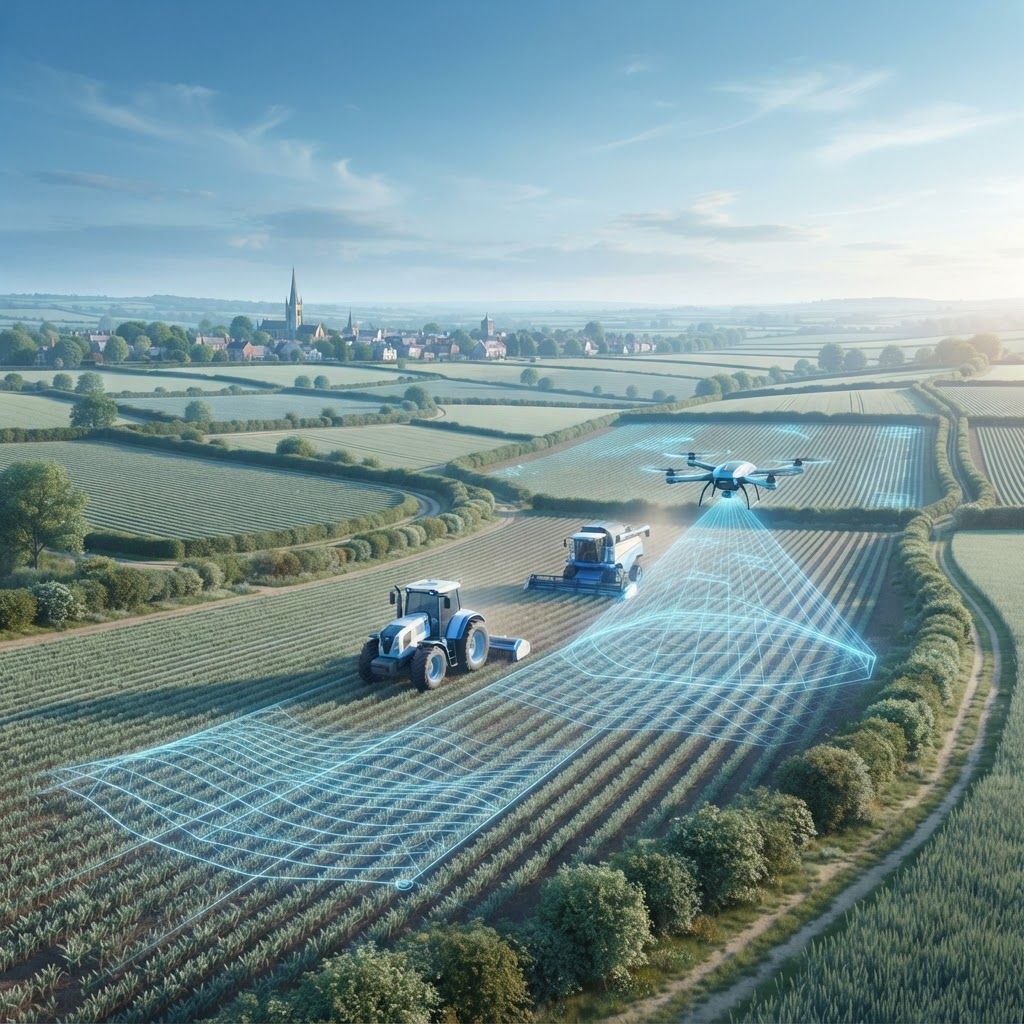
Farming Around Colchester: A Productive Landscape
North Essex is serious farming country. The land around Colchester combines relatively flat topography, workable clay and loam soils and one of the lowest rainfall profiles in the United Kingdom. That combination has made the area strongly arable, with wheat, barley, oilseed rape, field beans and sugar beet forming the backbone of production, alongside significant horticulture, orchards, livestock enterprises and, closer to the coast, oyster and shellfish operations.
Low rainfall is both an advantage and a constraint. It supports quality grain and reliable harvest conditions, but it makes water availability a central strategic question. Reservoir construction, winter abstraction and precision irrigation have all become normal considerations for farms in this district rather than specialist concerns.
How Modern Farm Businesses Operate
The image of farming as a simple annual cycle of planting and harvesting understates how commercially sophisticated these businesses have become. A typical medium-sized arable enterprise around Colchester runs a machinery fleet worth more than many factories, uses satellite guidance and variable-rate application to place inputs precisely, forward-sells grain against futures markets and manages environmental schemes across a portion of its land.
Diversification is equally important. Farm shops, holiday accommodation, event venues, contracting services for neighbours, renewable energy generation and storage lettings all help smooth income in a sector where a single dry spring can remove a year's margin.
Ten Notable Farming Companies in the Colchester Area
1. Colne Valley Farms
A large arable operation growing combinable crops across several holdings in the river valley. Colne Valley Farms is known for careful rotation planning and investment in grain storage and drying, which gives it flexibility on when to sell rather than being forced into harvest-time markets.
2. Roman River Agricultural Company
A mixed enterprise combining cereals with beef cattle and permanent pasture. The integration of livestock into an arable rotation improves soil organic matter and provides an outlet for forage crops, and the business markets grass-fed beef locally.
3. Stanway Estate Farming
An estate-based business balancing commercial cropping with substantial environmental land management, including field margins, wild bird cover and hedgerow restoration. Estate farming of this kind is increasingly a model for how production and biodiversity can share the same landscape.
4. Mersea Horticultural Growers
Field vegetables and salad crops on the lighter coastal soils, supplying wholesale markets and regional retailers. Labour planning and precise harvest scheduling dominate management here, since quality windows for salad crops are measured in days.
5. Dedham Vale Orchards
Apples, pears and soft fruit grown in the sheltered land towards the Suffolk border, with juice and cider production adding value to fruit outside premium grade. Direct sales and farm gate retailing form a meaningful share of income.
6. Layer Arable Partnership
A farming partnership pooling machinery and management across multiple family holdings. This structure spreads the capital cost of modern equipment and provides resilience that individual small farms struggle to achieve alone.
7. Tiptree Regenerative Farming Group
Practising reduced tillage, cover cropping, companion planting and controlled traffic farming to rebuild soil structure and cut input dependence. Yields under regenerative systems can take several seasons to stabilise, but reduced fuel, cultivation and fertiliser costs often improve margins sooner.
8. Wivenhoe Livestock and Grazing
Sheep and cattle grazing on marshland and less productive ground, including conservation grazing on sites managed for habitat value. This is a good example of livestock delivering environmental outcomes alongside food production.
9. Abberton Poultry and Egg Producers
Free range egg production supplying regional packers and local retailers. Biosecurity has become the defining operational discipline in poultry following avian influenza pressures, and well-run units invest heavily in it.
10. Colchester Contract Farming Services
Providing drilling, spraying, harvesting, baling and grain haulage for landowners who no longer farm themselves. Contract farming keeps land in productive use and allows expensive modern machinery to achieve the annual hours needed to justify it.
Forces Reshaping Local Agriculture
Agricultural policy has shifted decisively from area-based support towards payments for environmental outcomes. Farms are now paid for soil health measures, habitat creation, water quality improvement and public access rather than simply for occupying land. This has changed farm business planning fundamentally, and businesses that engaged early have generally adapted better.
Climate variability is the second pressure. Dry springs, intense summer rainfall and shifting pest pressures all complicate a system built around predictable seasons. Responses include water storage, drought-tolerant varieties, earlier drilling decisions and greater rotational diversity.
Technology adoption continues to accelerate. Satellite imagery, soil scanning, variable rate application, autosteer and farm management software are standard on larger units. Robotics and precision weeding are moving from trials towards commercial reality, driven partly by labour availability and partly by pressure to reduce chemical use.
Why Local Farming Matters to Colchester
Beyond food, these businesses maintain the landscape residents value, support rural employment and feed a local food economy of butchers, bakers, farm shops and restaurants that market provenance seriously. Buying regionally shortens supply chains and keeps money circulating in the district.
Final Thoughts
Farming around Colchester is productive, technically advanced and adapting quickly to policy and climate change. From large arable operations and regenerative pioneers to horticultural growers and conservation graziers, the district's agriculture is more varied than the flat fields suggest. Its future depends on water management, soil health and continued investment in both technology and the people who run these businesses.
Want your brand featured in front of decision-makers? Publish a guest post or get a link insertion in our guides through AAMAX's guest post and link insertion service.
Helpful Links
 SponsoredAAMAX — Full-Service Digital Agency
Write for Us
Share your expertise with our readers. We welcome guest contributions from industry specialists.
Pitch your idea

