

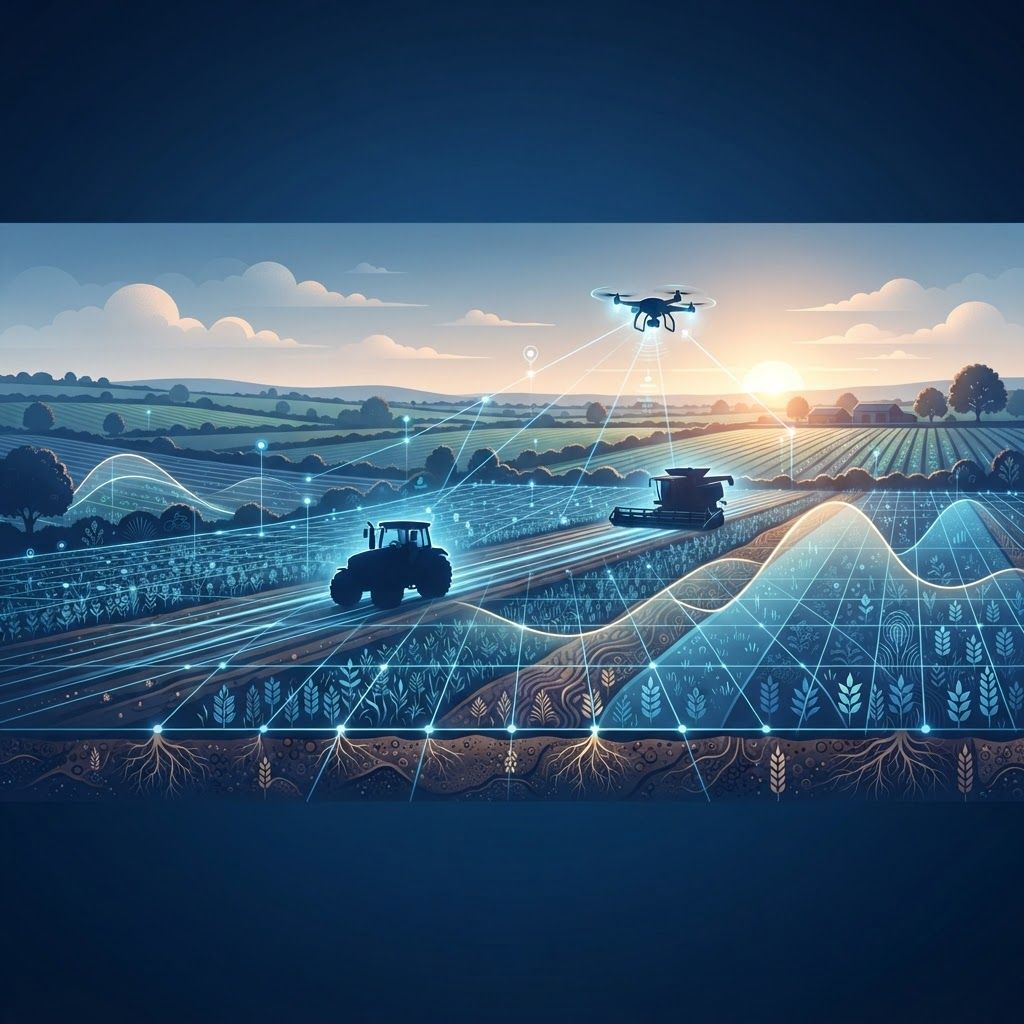
Agriculture in the Charnwood Landscape
Away from Loughborough's industrial estates, Charnwood is emphatically rural. The borough encompasses the ancient upland of Charnwood Forest, the fertile floodplain of the River Soar and a patchwork of mixed farmland stretching between villages such as Woodhouse, Newtown Linford, Wymeswold, Hoton and Cotes. Farming here has shaped hedgerows, drystone walls, woodland and grazing pasture over centuries, and it remains an active economic force rather than merely a scenic backdrop.
The mix of land types supports genuine agricultural diversity. Heavier clay soils and rolling upland suit livestock and grassland, while better draining land supports cereals, oilseeds and root crops. Proximity to Leicester, Loughborough and the wider Midlands market has also encouraged direct selling, farm shops, and leisure diversification on farms close to popular walking country.
What Marks Out a Well Run Farm Business
Modern farming is a technically demanding business. The strongest operations combine agronomic knowledge with careful financial management, environmental stewardship and, increasingly, data. Soil health monitoring, nutrient planning, integrated pest management and rotational grazing all indicate a business managing for the long term rather than season by season.
Assurance schemes matter commercially, since most buyers require certification covering animal welfare, food safety and environmental practice. Participation in environmental land management schemes, hedgerow and woodland maintenance, and buffer strips along watercourses all signal a farm engaging seriously with its wider responsibilities.
Diversification is another marker of resilience. Farm shops, livery, holiday accommodation, contracting, renewable energy and event hosting spread risk across income streams that do not all depend on commodity prices and weather in the same way.
The Top 10 Farming Companies in Charnwood
1. Charnwood Forest Livestock Farms
A grassland livestock business running beef cattle and sheep on the upland pastures of the forest area. Rotational grazing, native breed suitability to the terrain and careful hedgerow management define its approach.
2. Soar Valley Arable Farming Company
An arable enterprise producing cereals, oilseed rape and pulses on the more productive land near the river. Precision drilling, variable rate nutrient application and detailed yield mapping support both efficiency and environmental compliance.
3. Wymeswold Dairy Enterprises
A dairy business focused on herd health, milk quality and efficient grass utilisation. Careful breeding decisions, robust housing ventilation and consistent milk hygiene results underpin its performance.
4. Quorn Mixed Farming Estates
A mixed arable and livestock operation using integrated rotations that build soil fertility and reduce reliance on purchased inputs. Manure management, cover cropping and long rotations demonstrate sound agronomic thinking.
5. Barrow Market Garden Produce
A horticultural grower producing vegetables and salad crops for local shops, box schemes and restaurants. Short supply chains, staggered planting for continuity and genuinely fresh produce are its market advantages.
6. Woodhouse Poultry and Egg Producers
A free range egg and poultry business emphasising welfare, range management and biosecurity. Consistent egg quality and reliable supply to local retailers and caterers are consistently noted.
7. Shepshed Agricultural Contracting
A contracting business providing cultivation, drilling, spraying, harvesting and hedge cutting services to farms across the borough. Modern machinery, trained operators and flexible scheduling around weather windows are its principal strengths.
8. Anstey Equestrian and Livery Farms
A diversified enterprise combining forage production with livery, grazing and equestrian facilities. Good pasture management and well maintained facilities serve the substantial local equestrian community.
9. Cotes Regenerative Agriculture Partnership
A farming partnership adopting regenerative practices including minimum tillage, diverse cover crops, integrated grazing and reduced synthetic input use. Improving soil organic matter and water infiltration are measurable outcomes of its programme.
10. Charnwood Farm Shop and Direct Sales
A farming business selling its own meat, vegetables, eggs and preserves directly through an on-farm shop. Transparent provenance, seasonal ranging and a genuine connection between producer and customer characterise the operation.
Pressures and Opportunities in Farming
The transition away from area based subsidy towards payments for environmental outcomes has fundamentally changed farm business planning in England. Income now depends more heavily on productivity, market prices and participation in stewardship schemes, which rewards businesses that measure performance carefully and plan several years ahead.
Input volatility remains a significant challenge. Fertiliser, fuel and feed costs have moved sharply, encouraging investment in nutrient efficiency, home grown protein, cover cropping and soil biology to reduce dependence on purchased inputs. Weather variability compounds this, making drainage, soil structure and resilient rotations more valuable than ever.
Technology offers real opportunity. Satellite imagery, soil scanning, variable rate application, livestock monitoring and farm management software allow more precise decisions with less waste. Renewable energy, from solar on farm buildings to anaerobic digestion, provides additional income and reduces exposure to energy prices.
Public interest in food provenance also works in local farmers' favour. Consumers in Loughborough and surrounding villages increasingly seek local meat, vegetables and dairy, and farms able to sell directly capture considerably more of the retail value.
Working with Local Farm Businesses
For buyers, whether restaurants, retailers or caterers, engaging directly with local farms brings freshness and a credible story, but requires flexibility around seasonality and volume. Agree specifications, delivery arrangements and pricing periods clearly, and plan menus or ranges around what the land actually produces at that time of year.
For neighbours and visitors, respecting the working landscape matters: keeping to footpaths, controlling dogs around livestock, closing gates and avoiding blocked farm accesses all help maintain good relations in a borough where recreation and agriculture share the same countryside.
Final Thoughts
Farming in Charnwood combines centuries of land management with modern agronomy, environmental stewardship and entrepreneurial diversification. The businesses profiled here reflect a sector adapting thoughtfully to policy change, cost pressure and shifting consumer expectations. Supporting local farms sustains both the rural economy and the distinctive landscape that makes the borough such an appealing place to live.
Want your brand featured in front of decision-makers? Publish a guest post or get a link insertion in our guides through AAMAX's guest post and link insertion service.
Helpful Links
 SponsoredAAMAX — Full-Service Digital Agency
Write for Us
Share your expertise with our readers. We welcome guest contributions from industry specialists.
Pitch your idea

