

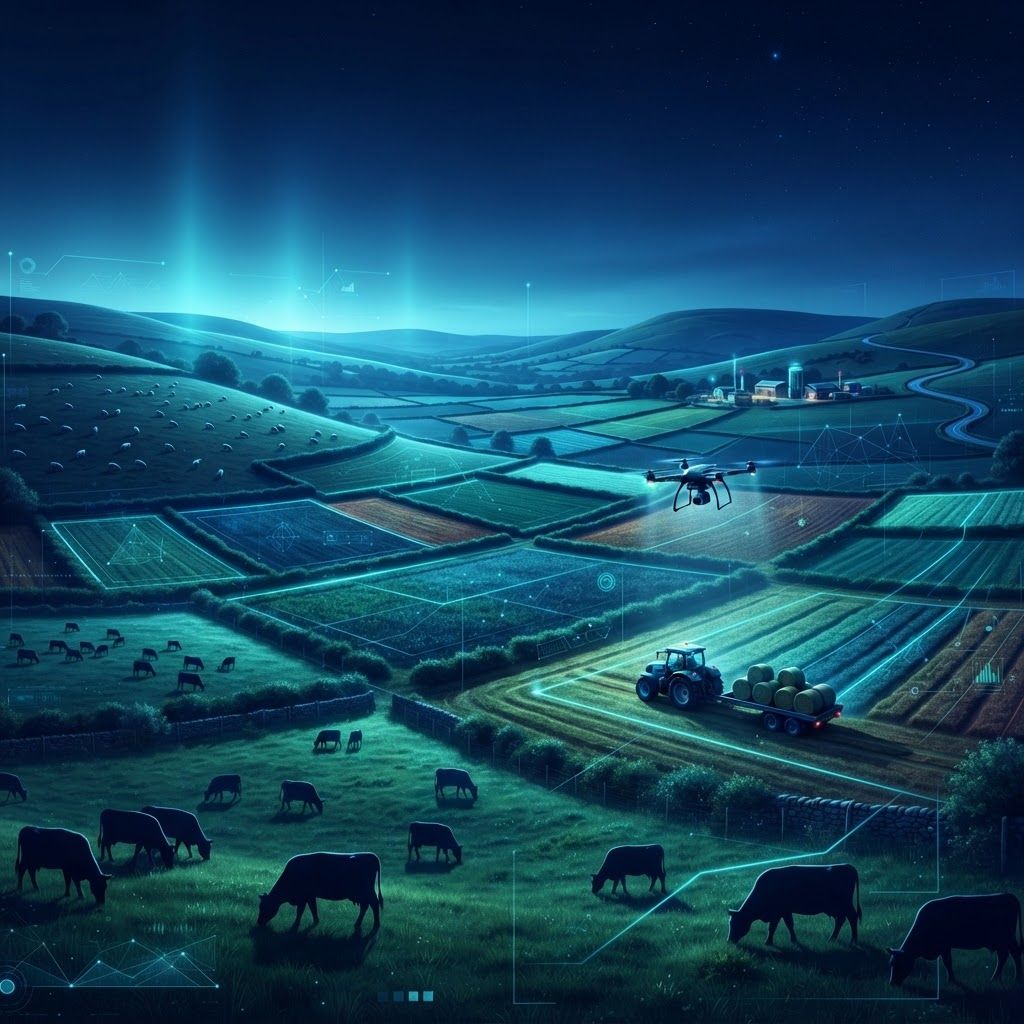
The Agricultural Heart of West Wales
Carmarthenshire is farming country in a way few English counties still are. Agriculture is not a picturesque backdrop here but the dominant land use and a major employer, shaping settlement patterns, language, community life and landscape. Around four-fifths of the county's land area is agricultural, and the Welsh language remains strongly rooted in its farming communities.
The county's geography creates distinct farming zones. The fertile river valleys of the Tywi, Cothi, Gwendraeth and Teifi support intensive dairy production, benefiting from high rainfall, long grass-growing seasons and good quality soils. The rising ground towards the Brecon Beacons and the Cambrian foothills supports beef and sheep on permanent pasture and rough grazing. Coastal areas around the Loughor and Taf estuaries include marshland grazing that produces distinctive saltmarsh lamb.
Dairy is the county's signature enterprise. Carmarthenshire consistently ranks among the leading milk-producing areas in Wales, and its milk feeds creameries, cheesemakers and liquid processors across the region. Alongside dairy sit substantial beef and sheep enterprises, a growing number of diversified businesses and an increasing focus on environmental land management.
Farming Systems Across the County
Dairy ranges from grass-based spring-calving block systems designed to match milk production to grass growth, through to housed all-year-round calving herds with high yields per cow. Robotic milking has spread noticeably, easing labour pressure on family farms.
Beef includes suckler herds producing calves for finishing and dedicated finishing units buying store cattle. Welsh Black cattle remain culturally significant, alongside continental breeds bred for growth and conformation.
Sheep covers lowland flocks producing early lambs, upland flocks on hardier breeds, and saltmarsh grazing that commands premium prices.
Mixed and arable enterprises grow forage maize, cereals for feed, and grass for silage, mostly supporting livestock rather than for direct sale.
Diversified enterprises include farm shops, holiday accommodation, contracting, renewable energy, equestrian facilities and educational visits.
Ten Leading Farming Companies in Carmarthenshire
1. Tywi Valley Dairy Farms — A substantial grass-based dairy operation running spring block calving across several units, focused on maximising milk from forage. Notable for detailed grassland measurement, rotational grazing infrastructure and low-cost production that stays resilient through price cycles.
2. Cothi Livestock Company — A beef and sheep enterprise combining a suckler herd with an upland flock, running across improved pasture and hill grazing. Strong emphasis on genetics, recording performance data and selecting for maternal traits and feed efficiency.
3. Gwendraeth Farming Partnership — A high-output housed dairy business with robotic milking, precision feeding and comprehensive herd health monitoring. Invests heavily in cow comfort and preventative veterinary planning, achieving strong longevity and fertility figures.
4. Carmarthen Agricultural Contractors — A contracting business providing silaging, slurry application, reseeding, hedge cutting and harvesting across the county. Its scale allows investment in low-emission slurry spreading equipment that individual farms could not justify.
5. Dinefwr Estate Farming — A mixed estate enterprise combining livestock production with woodland management, environmental schemes and heritage grassland conservation, demonstrating how food production and habitat management can operate together.
6. Taf Estuary Saltmarsh Farming — Specialises in saltmarsh lamb grazed on tidal marshland, producing distinctively flavoured meat that commands premium pricing from butchers and restaurants seeking genuine regional provenance.
7. Teifi Organic Farms — Certified organic dairy and livestock production using clover-rich swards, extended rotations and no synthetic nitrogen, supplying organic milk and meat markets with full certification traceability.
8. Llanelli Marsh Grazing Company — Manages coastal and marshland grazing for beef cattle, combining livestock production with wetland habitat management and flood plain water management.
9. Cross Hands Diversified Farming — A family farming business combining dairy with a farm shop, holiday accommodation and educational visits, illustrating how diversification spreads risk and adds value to primary production.
10. Cambrian Uplands Sheep Company — An upland flock enterprise running hardy breeds on extensive grazing, participating in environmental land management and producing store and breeding stock for lowland finishers.
Policy, Support Schemes and Regulation
Welsh agriculture is undergoing its most significant policy change in decades. The Agriculture (Wales) Act established sustainable land management objectives, and support has been shifting from area-based payments towards schemes rewarding environmental outcomes alongside food production. Farmers are being asked to demonstrate habitat maintenance, carbon management, water quality protection and public access alongside productive output.
Water quality regulation has been particularly consequential. Rules covering nutrient management apply across Wales, imposing requirements on slurry storage capacity, closed periods for spreading nitrogen, nutrient management planning and field risk mapping. Compliance has driven substantial investment in slurry stores, covered yards and low-emission spreading equipment, and it remains one of the most discussed issues in Carmarthenshire farming.
Animal health regulation also shapes daily practice. Bovine tuberculosis control involves regular herd testing, movement restrictions and biosecurity requirements, and it has significant financial and emotional impact on affected farms. Livestock traceability through electronic identification and movement reporting is now standard.
Farm assurance schemes provide market access. Red Tractor and Welsh assurance standards cover animal welfare, medicine recording, environmental practice and food safety, and most commercial buyers require certification as a condition of purchase.
Technology and Innovation on Welsh Farms
Agricultural technology adoption in Carmarthenshire has accelerated markedly. Robotic milking allows cows to be milked voluntarily, improving flexibility and reducing labour dependency on family farms where finding staff is genuinely difficult.
Precision grassland management has become mainstream. Plate meters, satellite-based grass measurement and grazing planning software let farmers match stocking to grass growth week by week, improving utilisation substantially. Given that grazed grass is by far the cheapest feed available, this directly improves margin.
Genomic testing has changed breeding decisions, allowing selection on traits including feed efficiency, fertility, health and methane output rather than appearance alone. Sexed semen has reduced unwanted dairy bull calves considerably.
Sensor technology monitors rumination, activity, mastitis indicators and calving onset, catching problems earlier and reducing losses. Slurry analysis and variable rate application allow nutrients to be applied where needed rather than uniformly, cutting fertiliser purchase.
Renewable energy is widespread, with solar arrays on farm buildings, small-scale wind, anaerobic digestion and biomass heating providing both income and resilience against energy costs.
Challenges Facing Carmarthenshire Farming
Volatility is the constant. Milk prices, store cattle values, fertiliser costs and fuel prices all move sharply, and farms with high fixed costs are most exposed. Businesses that keep production costs low and maintain financial headroom weather these cycles better than those chasing maximum output.
Succession remains a serious structural issue. Average farmer age is high, entry costs are prohibitive, and many farms lack a clear successor. Share farming, contract farming and joint ventures are being used to bring younger entrants in without requiring land purchase.
Labour availability constrains growth, particularly for skilled roles in dairy. Automation helps, but relationships, housing and training all matter in retaining good staff.
Climate variability is increasingly evident, with wetter winters affecting grazing seasons and slurry storage, and drier summer spells affecting grass growth. Building resilience through forage diversity, water storage and flexible stocking is becoming standard practice rather than innovation.
Final Thoughts
Farming in Carmarthenshire remains a genuinely productive, technically sophisticated industry rather than a nostalgic remnant. Its dairy sector is nationally significant, its livestock enterprises supply premium markets, and its farmers are adopting technology and environmental practice at pace while navigating substantial policy change. The businesses that thrive are those combining low-cost production, good stockmanship, environmental credibility and diversified income — a combination that this county produces in unusual abundance.
Want your brand featured in front of decision-makers? Publish a guest post or get a link insertion in our guides through AAMAX's guest post and link insertion service.
Helpful Links
 SponsoredAAMAX — Full-Service Digital Agency
Write for Us
Share your expertise with our readers. We welcome guest contributions from industry specialists.
Pitch your idea

