

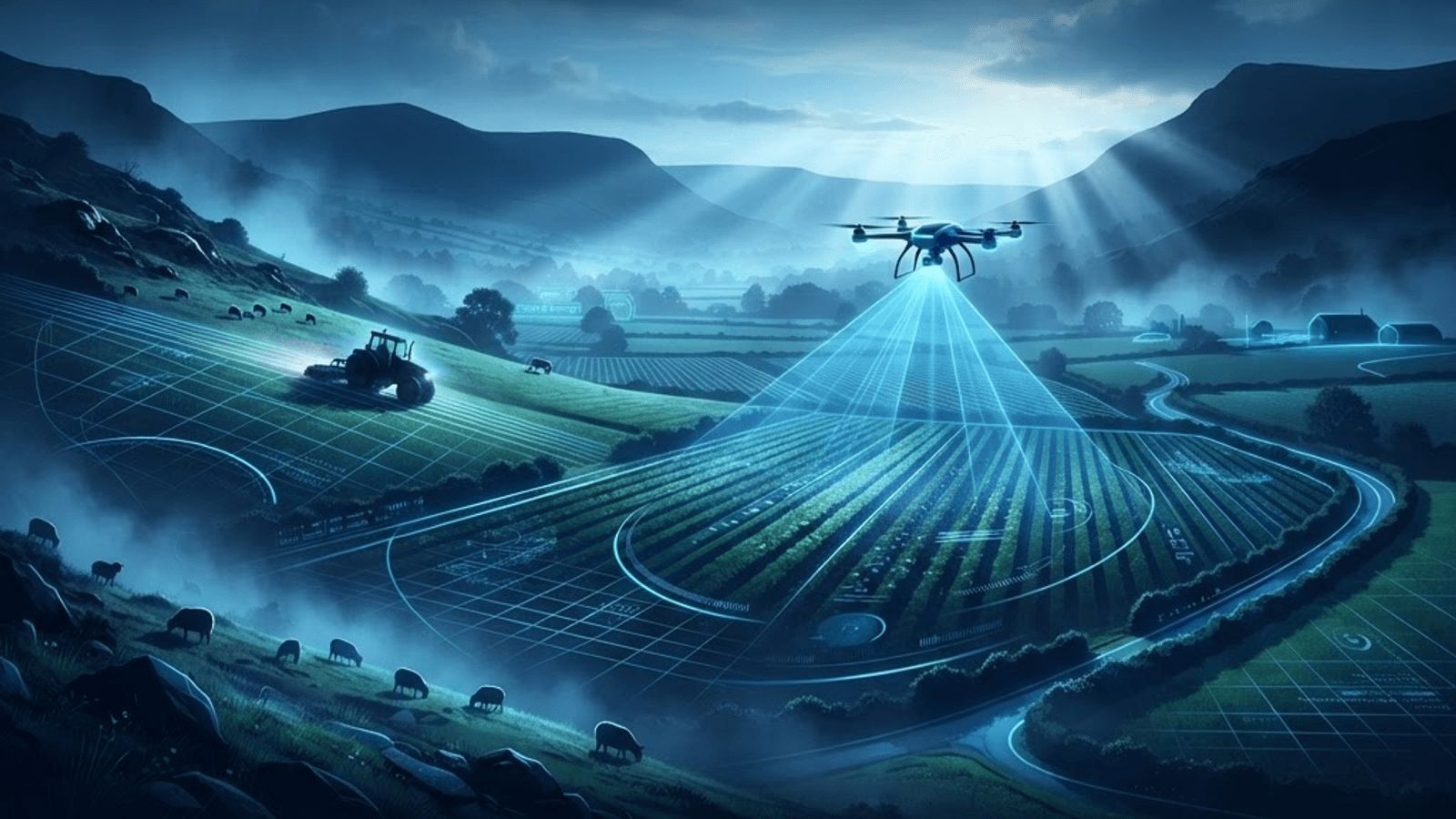
Agriculture in Bridgend County Borough
Bridgend's agricultural character is defined by geography. The county borough stretches from the Bristol Channel coast near Porthcawl inland and northward into the Llynfi, Garw and Ogmore valleys, climbing toward the uplands beyond Maesteg. That range of altitude, soil and exposure within a relatively compact area produces genuinely varied farming.
The lowland areas toward the Vale of Glamorgan support mixed farming with productive grassland, dairy, beef finishing and some arable cropping. The valley sides and upland fringes are dominated by sheep and suckler beef, working land that is less productive but ecologically significant. Along the coast, sandy soils and mild conditions favour horticulture and early grass growth.
Farming here is overwhelmingly a family business. Holdings tend to be modest by national standards, frequently passed through generations, and the people running them typically combine deep local knowledge with an increasingly commercial and technical outlook.
Livestock Farming
Sheep farming is the backbone of Welsh agriculture and prominent throughout the Bridgend uplands. Welsh Mountain ewes and their crosses graze land that could support little else, converting rough grazing into lamb. Welsh Lamb holds Protected Geographical Indication status, a designation that recognises the distinctive quality arising from breed, feeding and environment, and it commands premium recognition in domestic and export markets.
Beef production follows a similar pattern, with suckler herds on the hills producing store cattle that are finished on better lowland ground. Welsh Beef also carries PGI protection. Many farms operate integrated systems, breeding and finishing on the same holding to capture more of the value chain.
Dairy farming occupies the more productive lowland areas. Welsh dairy has consolidated significantly over recent decades, with fewer but larger herds and substantial investment in milking technology, including robotic systems that have transformed labour patterns on some units. Grass-based production remains the foundation, and Wales's reliable rainfall and long growing season give a genuine competitive advantage in forage production.
Arable, Grassland and Forage
Cereal cropping is limited compared with eastern England but present on suitable lowland ground, principally producing feed grain and straw for the livestock sector. Maize has expanded as a forage crop, providing high-energy silage that complements grass in dairy rations.
Grassland management is where the real agronomic sophistication lies in Welsh farming. Rotational and paddock grazing systems that move stock frequently to allow proper recovery periods can substantially increase grass utilisation, reducing bought-in feed costs and improving margins. Multi-species swards incorporating clovers, chicory and plantain alongside grasses are gaining ground, offering drought resilience, reduced nitrogen fertiliser requirement and animal health benefits.
Policy Change and the Sustainable Farming Scheme
Welsh agriculture is navigating the most significant policy transition in decades. The departure from the Common Agricultural Policy has ended area-based direct payments, and Welsh Government is implementing a new framework built around sustainable land management.
The Sustainable Farming Scheme centres on the principle of public money for public goods, rewarding farmers for outcomes including carbon sequestration, biodiversity, water quality, flood mitigation and landscape maintenance alongside food production. Proposed requirements have included habitat maintenance thresholds and tree cover targets, and the development process has involved substantial and sometimes difficult consultation with the farming community.
Whatever the final detail, the direction is clear. Income that was previously tied to area will increasingly be tied to environmental delivery, and farm businesses that understand and can evidence their environmental performance will be better positioned than those that cannot.
Regulation and Environmental Management
Water quality regulations have had significant practical impact. Rules governing nutrient management, slurry storage capacity, closed periods for spreading and record keeping have required capital investment on many holdings, particularly for slurry storage infrastructure.
Bovine TB remains one of the most difficult issues in Welsh livestock farming, imposing testing requirements, movement restrictions and severe emotional and financial consequences on affected farms. Biosecurity, herd health planning and veterinary partnership have become central to farm management.
These pressures are real, but many Bridgend farmers have responded by integrating environmental management into their businesses rather than treating it as an imposition. Hedgerow restoration, tree planting, buffer strips along watercourses, wildflower margins and improved soil management deliver environmental outcomes while frequently improving farm productivity and resilience.
Diversification and Added Value
Diversification has become widespread, driven by both necessity and opportunity. Bridgend's location, close to Cardiff and Swansea with substantial tourism at Porthcawl and along the Heritage Coast, creates genuine markets on the doorstep.
Common diversification routes include holiday accommodation in converted farm buildings, glamping and camping, farm shops selling own and local produce, livery and equestrian facilities, contracting services for neighbouring farms, renewable energy through solar and anaerobic digestion, and educational visits.
Direct selling has grown particularly strongly. Farms selling meat boxes directly to consumers capture retail rather than commodity prices, build customer relationships and gain control over how their product is presented. Local food networks and farmers markets across South Wales support this, and consumer interest in provenance provides a receptive audience.
Technology on Welsh Farms
Agricultural technology adoption has accelerated considerably. GPS guidance improves accuracy and reduces overlap in field operations. Electronic identification of livestock, mandatory for sheep, enables individual animal performance recording that supports better breeding decisions. Soil sampling and variable rate application target nutrients precisely where needed.
Robotic milking has changed dairy labour patterns fundamentally, allowing cows to be milked on demand and generating detailed data on yield, conductivity and activity that flags health problems early. Estimated breeding values and increasingly genomic testing allow producers to select for maternal traits, growth rates, carcase quality and health characteristics with far greater precision than visual assessment permitted.
Connectivity remains a genuine constraint in upland areas, and rural broadband and mobile coverage improvements are prerequisites for realising the full potential of these technologies.
Succession, Skills and the Next Generation
The age profile of Welsh farming is a recognised concern, with a substantial proportion of holders past normal retirement age and succession frequently unresolved. Barriers for new entrants are formidable, principally land price and capital requirement.
Positive developments include structured farm business tenancies and share farming arrangements that give new entrants access to land without outright purchase, mentoring programmes, and agricultural education through Welsh colleges and universities. Young Farmers Clubs remain vigorous across the region, providing skills development and a social framework that sustains rural community.
The Outlook for Bridgend Farming
Welsh farming faces genuine challenges: policy transition, market volatility, input cost inflation, disease pressure and climate variability. Yet the sector's fundamentals are sound. Wales grows grass exceptionally well, and grass-based livestock production is among the more efficient and lower-impact ways of producing protein from land unsuitable for cropping.
The farm businesses likely to prosper in Bridgend are those combining production efficiency with environmental credibility, diversified income streams and a clear understanding of where their output sits in the market. The county borough's proximity to urban markets, its landscape quality and its farming skills base provide a foundation worth building on.
Want your brand featured in front of decision-makers? Publish a guest post or get a link insertion in our guides through AAMAX's guest post and link insertion service.
Helpful Links
 SponsoredAAMAX — Full-Service Digital Agency
Write for Us
Share your expertise with our readers. We welcome guest contributions from industry specialists.
Pitch your idea

