

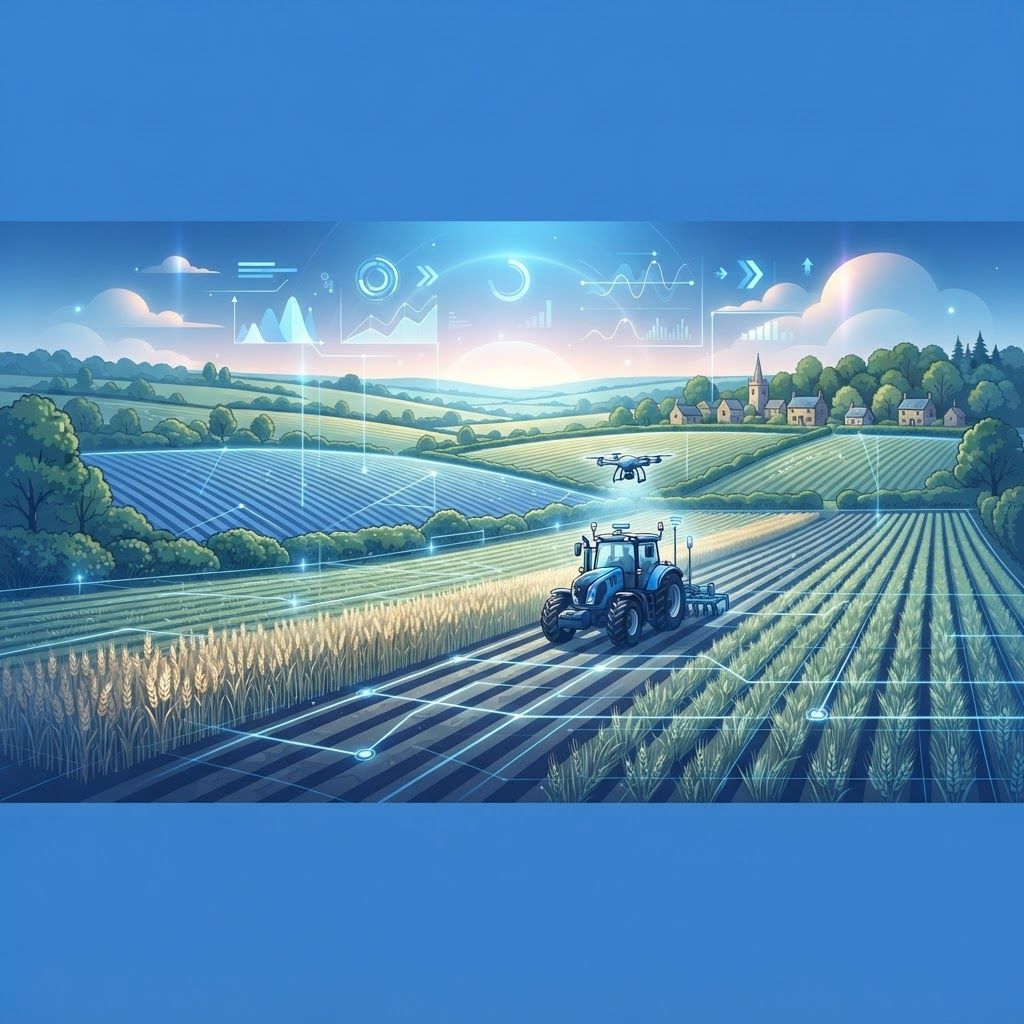
Farming on Basildon's Doorstep
Basildon is often described purely as a new town, but the borough is ringed by working agricultural land. The green belt separating Basildon, Billericay, Wickford and the Crouch valley supports arable cropping, horticulture, livestock grazing and equestrian enterprises. Essex is among the driest counties in the United Kingdom, with relatively low rainfall and heavy clay soils in many areas, and that combination shapes what farms here grow and how they manage risk.
Proximity to London is the defining commercial advantage. Farms within an hour of the capital can supply fresh produce to wholesale markets, restaurants and box schemes with minimal transport time, and can generate additional income through farm shops, pick-your-own operations, events and educational visits. That diversification has become central to the business model of many local holdings.
The Agricultural Profile of the Area
Cereals dominate the arable rotation, with wheat, barley and oilseed rape widely grown alongside beans and other break crops. Horticultural production is significant on lighter and better-drained soils, supplying salads, brassicas and root vegetables. Livestock is present but less dominant, with sheep grazing marginal and marshland areas and some beef finishing. Increasingly, holdings combine food production with environmental land management, renewable energy and rural enterprise lettings.
The Top 10 Farming Companies in Basildon
1. Crouch Valley Arable Farms
A substantial cereals business running wheat, barley, oilseed rape and pulses across a well-structured rotation. Precision agriculture is embedded in the operation, with variable-rate application, yield mapping and soil sampling used to target inputs where they generate return. A benchmark local example of technically disciplined arable management.
2. Essex Fresh Produce Growers
Horticultural specialists supplying salads, brassicas and root vegetables into wholesale and retail supply chains. Cold-chain handling, grading and packing are managed on site, allowing produce harvested in the morning to reach London markets the same day. Assurance scheme membership supports supermarket supply.
3. Billericay Livestock & Grassland
A mixed livestock enterprise combining sheep and beef with grassland management and conservation grazing. Rotational grazing improves sward quality and soil carbon, and the business supplies both local butchers and direct-to-consumer customers seeking traceable, locally reared meat.
4. Pitsea Marsh Farming Company
Farming marshland and coastal grazing on the Thames-side fringe, this operation balances productive grazing with wetland habitat management. Involvement in environmental stewardship and flood management demonstrates how agricultural land can deliver public benefits alongside food output.
5. Wickford Family Farms
A multi-generational family business combining arable cropping with a farm shop, seasonal pick-your-own and educational visits. The diversified model spreads risk across food production and rural retail, and the direct customer relationship provides valuable insight into consumer demand.
6. Great Burstead Agricultural Holdings
Combinable crops managed with a strong focus on soil health, including reduced tillage, cover cropping and organic matter building. Long-term soil investment has improved water infiltration and workability on heavy clay, a significant advantage in an increasingly variable climate.
7. Basildon Organic Growers
Certified organic vegetable and salad production supplying box schemes, independent greengrocers and restaurants. Rotation, composting and mechanical weeding replace synthetic inputs, and the premium market position rewards the additional labour and management intensity required.
8. Vange Poultry & Egg Producers
Free-range egg production with strong welfare standards, supplying local retailers, caterers and farm shops. Short supply chains mean exceptional freshness, and on-farm packing gives the business direct control over grading and presentation.
9. Thameside Agri Services
A contract farming and machinery operations business providing cultivation, drilling, spraying, harvesting and baling for landowners who do not wish to hold their own equipment. Modern machinery and skilled operators allow smaller holdings to access capability they could not justify buying.
10. Nevendon Estate Farming
An estate-scale operation integrating arable production with woodland, environmental schemes, renewable energy and rural property lettings. Its layered income model illustrates how larger holdings are building resilience as agricultural support payments shift towards environmental outcomes.
Trends Reshaping Local Agriculture
The transition of agricultural support from area-based payments towards environmental land management has fundamentally changed farm business planning, with soil health, habitat creation and water quality now capable of generating income directly. Regenerative practices including reduced tillage, cover crops and diverse rotations are being adopted widely, driven by both agronomic and economic logic. Water management is a growing priority given the dry Essex climate, with reservoir construction and irrigation efficiency high on the agenda. Technology adoption continues, with satellite imagery, soil scanning, GPS guidance and farm management software now standard on larger holdings. Finally, direct sales, farm shops and agri-tourism are helping farms capture more of the retail value of what they produce.
Challenges Facing Basildon's Farmers
Development pressure on green belt land creates uncertainty for long-term investment. Input cost volatility, particularly in fertiliser and fuel, compresses margins unpredictably. Labour availability for horticultural harvesting remains a persistent constraint. Extreme weather, from summer drought to intense rainfall events, increases production risk. Successful businesses respond by diversifying income, improving soil resilience and building closer relationships with buyers.
Final Thoughts
Farming around Basildon combines commercial ambition with real environmental responsibility, operating at the edge of one of the largest consumer markets in Europe. The businesses profiled here demonstrate that productive agriculture and land stewardship can advance together, and that proximity to London remains a genuine strategic asset for Essex farmers willing to build direct routes to market.
Want your brand featured in front of decision-makers? Publish a guest post or get a link insertion in our guides through AAMAX's guest post and link insertion service.
Helpful Links
 SponsoredAAMAX — Full-Service Digital Agency
Write for Us
Share your expertise with our readers. We welcome guest contributions from industry specialists.
Pitch your idea

