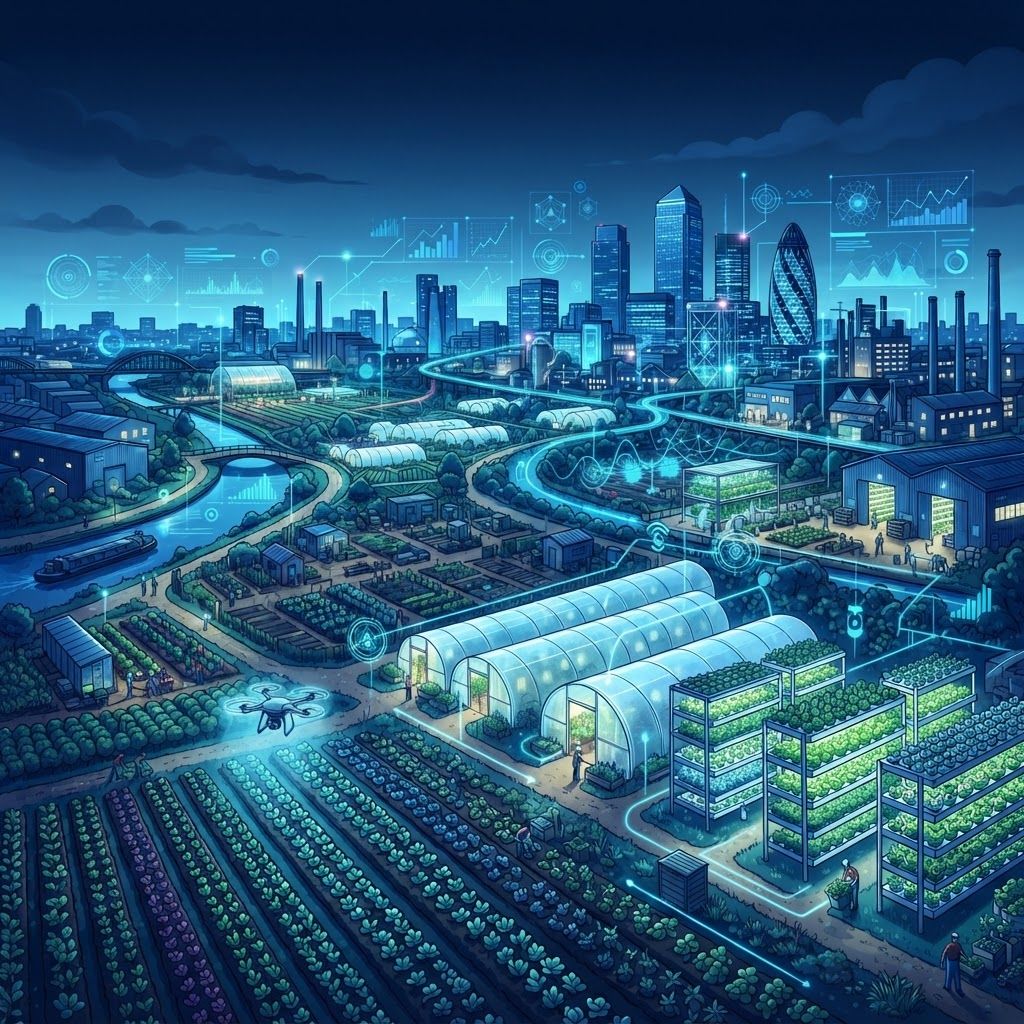
Farming in a London Borough: An Unexpected Story
Barking and Dagenham is rarely the first place that comes to mind when discussing British agriculture, yet the borough occupies a genuinely interesting position. It sits at the edge of the capital where the built environment gives way to the market gardens and arable land of south Essex, and it contains substantial green space, allotment provision, and former industrial land now being reclaimed for productive use.
The borough's agricultural character is shaped by three distinct strands. There is traditional field-scale farming on the eastern fringes, where soils along the Thames terrace have supported cereals and vegetables for generations. There is community and allotment growing, which in Barking and Dagenham has deep roots and unusually strong participation. And there is the newer wave of controlled environment agriculture — vertical farms, hydroponic units, and insect and mushroom production housed in industrial buildings that once served manufacturing.
Why Peri-Urban Farming Is Gaining Momentum
Proximity to consumers is the defining commercial advantage. A grower in Barking and Dagenham can harvest in the morning and deliver to a restaurant, retailer, or box scheme in central London the same day. That compresses the supply chain dramatically, reduces waste from transit and storage, and supports premium pricing for freshness that longer-distance producers cannot match.
There is also a policy tailwind. London-wide strategies encouraging local food production, growing interest in food security after years of supply chain disruption, and increasing consumer willingness to pay for provenance have all improved the economics of small-scale urban agriculture. Meanwhile, the borough's stock of affordable industrial space has made it viable to run indoor growing operations that would be prohibitively expensive closer to the centre.
The Top 10 Farming Companies in Barking and Dagenham
1. Eastbrookend Market Garden
Operating on land at the borough's eastern edge, Eastbrookend Market Garden is among the most established field-scale growers in the area. It produces seasonal vegetables including brassicas, root crops, salad leaves, and squashes, supplying wholesale markets, independent greengrocers, and a local box scheme. The business has invested steadily in soil health through cover cropping and reduced tillage, and it is often cited locally as an example of how conventional horticulture can remain viable on London's edge.
2. Dagenham Vertical Farms
Housed in a converted industrial unit, Dagenham Vertical Farms grows leafy greens, herbs, and microgreens under LED lighting in stacked hydroponic systems. Year-round production, minimal water use through closed-loop recirculation, and complete independence from weather make it a reliable supplier to restaurants and retailers that need consistent volume and specification. Its output travels only a short distance to market, giving it a genuine freshness advantage.
3. Thames View Urban Agriculture
Thames View Urban Agriculture combines commercial growing with training and community engagement. The organisation cultivates vegetables and soft fruit on reclaimed land while running horticultural skills programmes for local residents. Its dual purpose — producing food and producing growers — has made it an important part of the borough's food economy and a frequent partner for schools and community groups.
4. Rippleside Hydroponics
Focused on the technology side, Rippleside Hydroponics designs, builds, and operates soilless growing systems. It runs its own production of tomatoes, peppers, cucumbers, and salad crops while also supplying and installing systems for other growers. For anyone in the region considering controlled environment agriculture, the company functions as both producer and practical technical resource.
5. Becontree Community Farm
Rooted in the Becontree estate's long allotment tradition, Becontree Community Farm operates a mixed holding with vegetable plots, fruit trees, poultry, and small livestock. It supplies produce locally and provides volunteering, education, and therapeutic horticulture placements. The farm demonstrates how agricultural activity can deliver social value alongside food, which has helped it secure sustained community and institutional support.
6. Chadwell Heath Mushroom Growers
Mushroom cultivation suits urban settings because it requires darkness and controlled humidity rather than sunlight. Chadwell Heath Mushroom Growers produces oyster, shiitake, chestnut, and lion's mane varieties in insulated growing rooms, using substrate derived from agricultural and coffee waste. Chefs across east London value the range and the ability to order specialist varieties at short notice.
7. River Roding Aquaponics
River Roding Aquaponics integrates fish farming with crop production, using nutrient-rich water from tilapia and trout tanks to feed hydroponic vegetable beds and returning filtered water to the tanks. The closed-loop design produces both protein and vegetables from a single system with very low water consumption. It represents one of the more technically sophisticated operations in the borough.
8. Barking Riverside Agri-Tech Collective
A collaborative venture bringing together several small growers, the Barking Riverside Agri-Tech Collective shares infrastructure, cold storage, packing facilities, and distribution capacity. Pooling resources allows individually small operations to supply commercial customers who require consistent volume — a model that has proved effective at overcoming the scale disadvantage facing urban producers.
9. Dagenham East Insect Protein Farm
Working in an emerging sector, Dagenham East Insect Protein Farm rears black soldier fly larvae and mealworms on food-industry by-products, producing protein meal for animal feed and pet food alongside a nutrient-rich frass fertiliser. The operation converts waste streams into valuable output with a small land footprint, illustrating how agriculture in dense urban areas increasingly means processing rather than field cultivation.
10. Eastbrook Livery & Grazing Farm
Grassland management remains a real agricultural activity in the borough, and Eastbrook Livery & Grazing Farm maintains pasture for horses and grazing animals alongside hay and haylage production. Beyond its commercial function, the farm plays a role in maintaining open landscape character and supporting biodiversity on land that would otherwise be at risk of neglect.
Trends Shaping Local Agriculture
Controlled environment agriculture continues to attract investment, though the sector has matured past its initial hype. Successful operators now focus tightly on crops where freshness commands real premiums — herbs, salads, microgreens, specialist mushrooms — rather than attempting to compete with field production on staples.
Circularity is another strong theme. Several borough operations are built explicitly around waste conversion, whether that means growing mushrooms on spent substrate, rearing insects on food processing by-products, or returning compost to soil-based growing. Regenerative practices such as cover cropping, minimal tillage, and integrated pest management are also gaining ground among field-scale growers responding to both environmental pressure and rising input costs.
Direct-to-consumer routes have become increasingly important. Box schemes, farmers' market presence, and supply agreements with independent restaurants let growers capture more of the retail margin than wholesale channels allow, which matters considerably at small scale.
Working With Local Producers
Buyers approaching borough farms should be realistic about scale and seasonality. Small urban producers cannot always guarantee year-round volume for every line, but they can offer freshness, variety, and flexibility that larger suppliers struggle to match. Establishing a forward-planning conversation about what will be available and when generally produces better results than placing spot orders.
For residents, allotment associations, community farms, and volunteering schemes offer accessible entry points into growing. Barking and Dagenham has stronger provision in this area than many London boroughs, and demand for plots reflects that.
Final Thoughts
Farming in Barking and Dagenham is neither a nostalgic remnant nor a novelty. It is a working sector that blends traditional horticulture with genuinely innovative production methods, sustained by unmatched proximity to one of the world's largest food markets. As land use in outer London continues to evolve, the borough offers a useful demonstration that agriculture and urban development can occupy the same map.
Want your brand featured in front of decision-makers? Publish a guest post or get a link insertion in our guides through AAMAX's guest post and link insertion service.
Helpful Links
 SponsoredAAMAX — Full-Service Digital Agency
Write for Us
Share your expertise with our readers. We welcome guest contributions from industry specialists.
Pitch your idea