

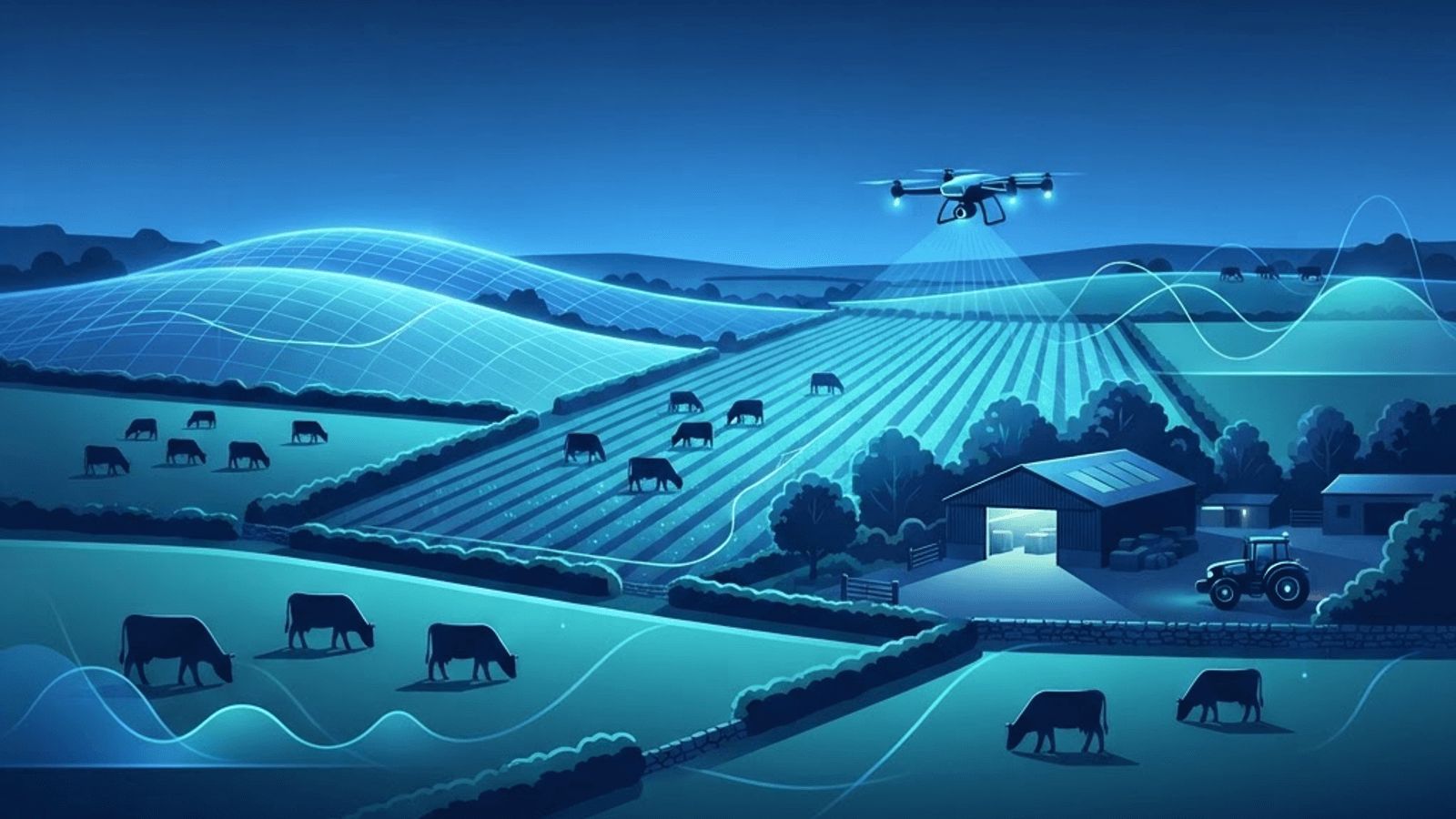
Farming in the Heart of County Antrim
Behind the retail parks and industrial estates of Antrim and Newtownabbey lies some of Northern Ireland's most productive farmland. The borough's landscape ranges from the fertile lowlands along the Lough Neagh shore through the drumlin country around Randalstown and Templepatrick to the higher, wetter ground rising toward the Antrim plateau near Ballyclare and Doagh. That variety supports a genuinely mixed agricultural economy rather than a single dominant enterprise.
Dairy is the largest sector by value, benefiting from a temperate climate and reliable grass growth. Beef and sheep occupy the higher and more marginal ground. Poultry production, both broiler and egg, is significant and closely integrated with processing capacity elsewhere in Northern Ireland. Arable cropping, principally cereals and forage, supports livestock enterprises, while horticulture, potatoes and soft fruit occupy pockets of particularly suitable land. Increasingly, farm businesses also generate income from renewable energy, agri-tourism, farm shops and contracting.
What Makes a Farming Business Successful Today
Modern farming is a capital-intensive, technically demanding business operating on narrow margins and exposed to weather, disease and commodity price cycles. The farm businesses that perform consistently well tend to share several traits: rigorous attention to grassland and soil management, accurate financial and physical record-keeping, disciplined animal health planning, willingness to adopt proven technology, and diversification that spreads risk without diluting focus.
Regulatory competence has also become a core skill. Nutrient management planning, slurry storage capacity and spreading windows, animal traceability, farm assurance scheme requirements and environmental designations all demand documentation and planning. Farms that treat compliance as an integrated part of management rather than an annual scramble are consistently more profitable.
The Top 10 Farming Companies in Antrim and Newtownabbey
1. Lough Neagh Dairy Farms
Operating on the fertile lowlands near the Lough Neagh shore, Lough Neagh Dairy Farms is recognised for high-output dairying built on grassland productivity. The business invests in rotational grazing measurement, robotic and parlour milking technology and detailed herd health planning, and it is frequently cited locally as a benchmark for milk quality and cow longevity.
2. Randalstown Agricultural Enterprises
A mixed farming business combining beef finishing, cereals and forage production, Randalstown Agricultural Enterprises demonstrates how integrated systems reduce input costs. Home-grown feed, careful rotation and soil sampling underpin its performance, and it also provides contracting services to neighbouring farms, spreading fixed machinery costs across more hectares.
3. Ballyclare Poultry Producers
Poultry is a cornerstone of Northern Irish agriculture, and Ballyclare Poultry Producers operates modern, environmentally controlled housing with strong emphasis on biosecurity, ventilation and welfare standards. Its investment in energy efficiency and litter management reflects the sector's focus on reducing both cost and environmental impact.
4. Templepatrick Beef and Sheep Company
Working the mixed and higher ground around Templepatrick and Doagh, this business runs suckler beef alongside a commercial sheep flock. It is known for careful breeding selection, performance recording and grassland reseeding programmes that lift stocking capacity without additional land. Its participation in environmental schemes supports hedgerow and habitat management.
5. Antrim Arable and Grain Growers
Specialising in cereals, this business grows barley, wheat and oats for feed and, where quality allows, for milling and distilling markets. Precision agriculture is central to its approach: variable rate fertiliser application, soil mapping and targeted crop protection reduce input use while protecting yield, an increasingly important balance as input costs remain elevated.
6. Crumlin Horticultural Growers
Crumlin Horticultural Growers produces field vegetables, potatoes and protected crops for local retail, wholesale and food service markets. Its emphasis on rotation, cover cropping and integrated pest management supports soil health, and its short supply chains into Belfast and County Antrim retailers give it a freshness advantage over imported produce.
7. Glengormley Farm Fresh Produce
Operating close to the urban edge, this business has built a direct-to-consumer model through farm shop retail, vegetable box schemes and supply to independent grocers and restaurants. Its proximity to a large population makes local provenance commercially valuable, and it has developed a strong seasonal calendar that customers follow closely.
8. Antrim Coast Agri-Tourism and Estate Farming
Combining traditional livestock farming with visitor accommodation, farm experiences and event hosting, this enterprise illustrates the diversification route taken by many farms near the Antrim coast and Causeway tourism corridor. The additional income streams support conservation grazing and habitat work that pure production farming would struggle to fund.
9. Nutts Corner Organic Farming Collective
This collective of organically certified producers supplies vegetables, eggs, beef and lamb to specialist retailers and box schemes. Organic certification requires long conversion periods and rigorous documentation, and the collective model allows individual farms to share marketing, logistics and administrative capacity while maintaining independent management.
10. Doagh Renewable and Regenerative Farming
Completing the list, this business integrates anaerobic digestion, solar generation and regenerative grazing practices into a livestock enterprise. Nutrient recycling through digestate, reduced synthetic fertiliser use and multi-species swards have improved both soil condition and energy self-sufficiency, offering a practical model for lower-carbon farming in the borough.
Trends Shaping Local Agriculture
Sustainability and carbon accounting now sit at the centre of agricultural policy across the United Kingdom. Farmers in Antrim and Newtownabbey are being asked to quantify emissions, improve nutrient efficiency and demonstrate environmental delivery alongside food production. Practical measures gaining ground include multi-species swards, protected urea and slurry additives, improved slurry storage, low-emission spreading equipment and precision nutrient application.
Technology adoption has accelerated. Robotic milking, wearable animal health sensors, GPS-guided machinery, grass measurement platforms and farm management software are no longer confined to the largest operations. Meanwhile, water quality in Lough Neagh has become a prominent public issue, sharpening focus on phosphorus management and buffer strips across the catchment.
Labour availability, succession planning and volatile input costs remain persistent structural challenges, and the farms managing them best tend to be those with clear business structures, documented plans and a genuine willingness to collaborate with neighbours on machinery and marketing.
Final Thoughts
Agriculture in Antrim and Newtownabbey is more diverse and more technically advanced than casual observation suggests, spanning dairy, beef, sheep, poultry, cereals, horticulture, organics, agri-tourism and renewable energy. The ten businesses profiled here reflect that breadth. The sector's future will belong to operations that combine productivity with environmental credibility, and the borough already has strong examples of both.
Want your brand featured in front of decision-makers? Publish a guest post or get a link insertion in our guides through AAMAX's guest post and link insertion service.
Helpful Links
 SponsoredAAMAX — Full-Service Digital Agency
Write for Us
Share your expertise with our readers. We welcome guest contributions from industry specialists.
Pitch your idea

