

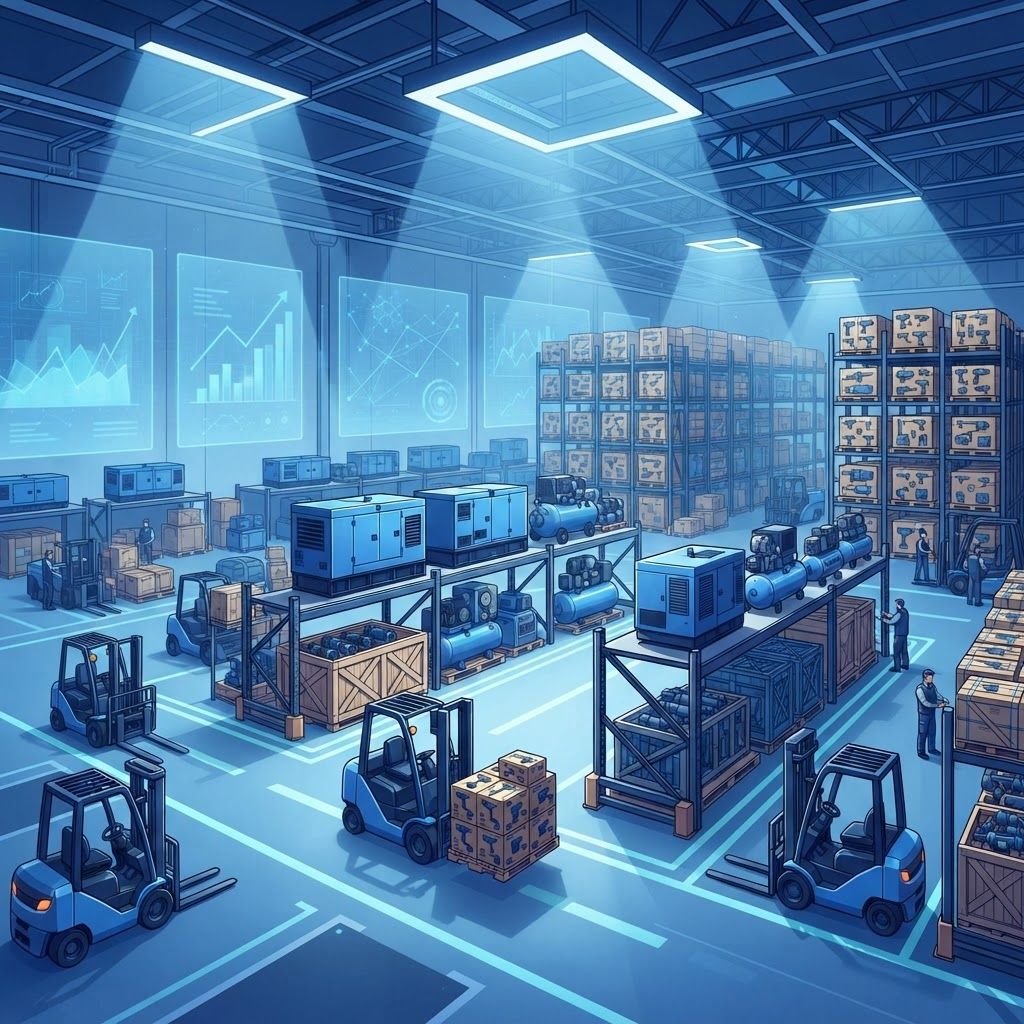
Equipment Wholesale in a Major Industrial Corridor
Equipment purchasing differs fundamentally from consumable buying. Machinery and equipment are capital investments, expected to operate for years, and their total cost of ownership depends far more on reliability, parts availability and service support than on initial purchase price. A cheap machine that stops working is expensive in the truest sense.
Warrington's position within one of England's busiest industrial and logistics corridors makes it a natural base for equipment distribution. Manufacturing plants, warehouses, construction sites, hospitality businesses and public sector facilities across the North West all require equipment supply, servicing and spares, and a Warrington-based supplier can reach them quickly — which matters enormously when a critical machine is down.
The Ten Leading Categories of Equipment Wholesalers in Warrington
1. Industrial Machinery and Plant Suppliers
These wholesalers supply production machinery, compressors, pumps, conveyors, hydraulic systems and process equipment to manufacturers. Their value lies well beyond supply: application engineering, installation, commissioning, operator training and preventive maintenance contracts all form part of the proposition. Spare parts availability over a machine's full life is the critical long-term consideration.
2. Materials Handling Equipment Distributors
Materials handling suppliers provide forklifts, pallet trucks, stackers, order pickers, conveyors, racking and lifting equipment. Given the density of warehousing along the M6 corridor, this is a major local segment. Leading suppliers offer new and refurbished options, short and long-term hire, statutory inspection services and rapid breakdown response, since a failed forklift can halt an entire operation.
3. Construction Plant and Tool Suppliers
Construction equipment distributors supply excavators, dumpers, compaction plant, generators, lighting towers, power tools and access equipment. Contractors value robust build quality, straightforward serviceability and immediate parts availability. Many suppliers combine sales with hire fleets, allowing contractors to match equipment provision to project duration.
4. Catering and Commercial Kitchen Equipment Wholesalers
Catering equipment suppliers provide ovens, ranges, fryers, refrigeration, dishwashers, food preparation machinery and stainless steel fabrication to restaurants, hotels, schools and care homes. Kitchen design and layout services, gas and electrical installation, and rapid refrigeration breakdown response are the main differentiators. Energy efficiency has become a significant selection factor given commercial energy costs.
5. Cleaning and Facilities Equipment Suppliers
These wholesalers supply floor scrubbers, sweepers, pressure washers, vacuum systems, carpet cleaning equipment and janitorial machinery to cleaning contractors, facilities managers and industrial sites. Battery technology improvements have transformed this category. Strong suppliers combine equipment with consumables, training and service contracts.
6. Medical and Laboratory Equipment Distributors
Medical and laboratory suppliers provide examination equipment, patient handling aids, sterilisation systems, laboratory instruments, centrifuges, incubators and analytical equipment. Regulatory compliance, calibration services and documented validation are essential. Given the North West's pharmaceutical and healthcare presence, this is a significant technical segment.
7. Welding, Cutting and Fabrication Equipment Suppliers
Welding equipment distributors supply welders, plasma cutters, fume extraction, consumables, protective equipment and automated welding cells. They serve fabricators, engineering firms and maintenance departments. Technical advice on process selection and consumable matching adds substantial value, as does on-site demonstration capability.
8. Agricultural and Groundcare Equipment Wholesalers
Agricultural equipment suppliers serve farms, estates, local authorities and landscaping contractors with tractors, mowers, sprayers, loaders and groundcare machinery. Seasonal demand peaks require careful stock planning, and rapid harvest-season service response is essential to farming customers.
9. Test, Measurement and Calibration Equipment Suppliers
These specialists supply electrical test instruments, dimensional measurement equipment, thermal imaging, environmental monitoring and calibration services. Their customers include electricians, engineers, quality departments and inspection bodies. Traceable calibration certification is the core requirement, and many suppliers operate accredited calibration laboratories.
10. Safety, Access and Lifting Equipment Distributors
Safety equipment suppliers provide fall protection systems, scaffolding, mobile access towers, podium steps, lifting slings, chains, hoists and load monitoring equipment. Statutory inspection and thorough examination services are integral, since lifting and access equipment carries legal inspection obligations. Compliance documentation and inspection record management are valuable services.
Why Service Support Matters More Than Price
Experienced equipment buyers understand that the purchase price typically represents a minority of lifetime cost. Energy consumption, consumables, maintenance, downtime and eventual disposal all contribute. A supplier offering a modest discount but weak service support frequently proves the more expensive choice.
Key service considerations include engineer availability and typical response times, spare parts stock holding and long-term availability commitments, preventive maintenance contract options, operator and maintenance training provision, warranty terms and what they genuinely cover, and loan or hire equipment availability during repairs. For business-critical equipment, these factors should carry more weight in the decision than the quoted price.
Trends Shaping Equipment Wholesale
Electrification is transforming multiple equipment categories. Battery-powered forklifts, construction plant, groundcare machinery and cleaning equipment have improved substantially in performance while offering lower running costs, zero local emissions and reduced noise. This matters for indoor operation, urban sites with emissions restrictions and businesses pursuing carbon reduction.
Connectivity and remote monitoring have become standard on higher-value equipment. Telemetry allows suppliers to monitor machine condition, predict failures before they occur, schedule maintenance efficiently and provide utilisation data that helps customers optimise their fleets. This shifts the relationship from transactional supply toward ongoing partnership.
Energy efficiency has risen sharply in importance as commercial energy costs increased. Buyers now routinely request consumption data and payback calculations, particularly for refrigeration, compressed air, heating and lighting equipment where running costs dominate.
Equipment-as-a-service models are also spreading. Rather than purchasing outright, businesses increasingly lease or contract for guaranteed availability, converting capital expenditure into operating expenditure and transferring maintenance risk to the supplier. Wholesalers offering flexible financial structures are winning business from those selling only outright.
Refurbishment has gained credibility too. Professionally remanufactured equipment with warranty offers genuine cost and carbon savings, and the stigma once attached to used machinery has largely faded where refurbishment quality is documented.
How to Choose an Equipment Wholesaler
Begin by assessing service infrastructure rather than product range. Ask how many engineers cover your area, what response times are contractually offered, and where spare parts are held. Request references from customers running similar equipment.
Evaluate total cost of ownership properly, requesting energy consumption figures, expected consumable costs and maintenance schedules. Compare on a multi-year basis rather than purchase price alone.
Verify compliance and certification support, particularly for lifting, access, pressure and electrical equipment where statutory inspection applies. Confirm the supplier can manage inspection scheduling and documentation.
Check parts availability commitments, asking specifically how long parts remain available after a model is discontinued. Assess training provision for operators and maintenance staff, which affects both safety and equipment longevity.
Consider financing and hire flexibility against your cash flow needs. Finally, judge technical competence during the specification stage; a supplier who asks detailed questions about your application before quoting will usually recommend the right machine.
The Outlook for Equipment Wholesale in Warrington
Demand prospects are encouraging. Warehouse automation investment continues along the North West logistics corridors, manufacturing productivity investment is supported by the need to offset labour costs, hospitality equipment replacement cycles continue, and the electrification of plant and machinery is driving substantial fleet renewal.
Warrington's central position, industrial density and transport access make it an effective base for equipment distribution and service. Suppliers who combine technically competent sales with genuinely responsive engineering support and flexible commercial models will lead the market. For manufacturers, contractors, caterers and facilities operators across the region, the local equipment supply base offers depth and service capability well matched to demanding operational requirements.
Want your brand featured in front of decision-makers? Publish a guest post or get a link insertion in our guides through AAMAX's guest post and link insertion service.
Helpful Links
 SponsoredAAMAX — Full-Service Digital Agency
Write for Us
Share your expertise with our readers. We welcome guest contributions from industry specialists.
Pitch your idea

