

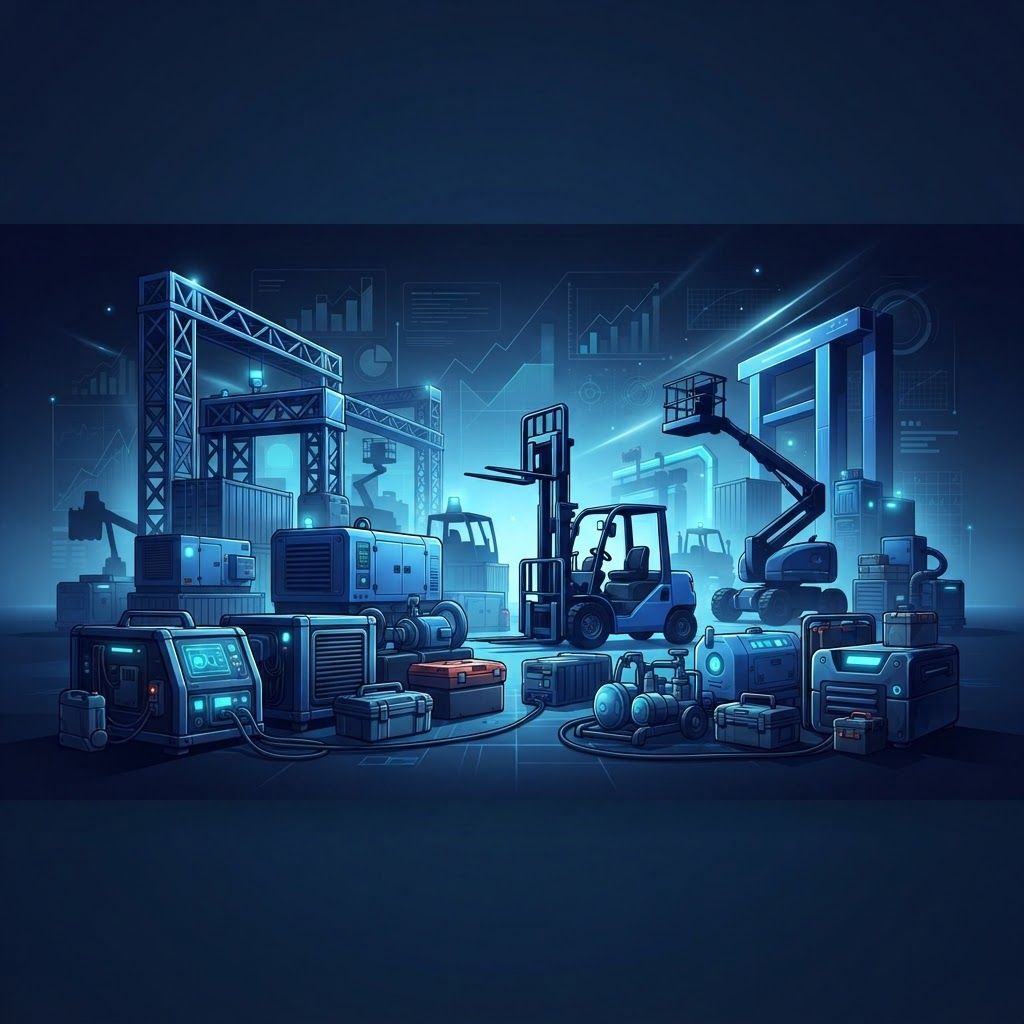
Equipment Supply as Business Infrastructure
Equipment wholesalers rarely feature in conversations about local economies, yet they underpin an enormous amount of activity. Every building site, commercial kitchen, warehouse, workshop, grounds maintenance team and cleaning contractor in Sutton depends on machinery, tools and consumables arriving reliably and working when switched on. The wholesalers who supply them sit at the point where cost, safety and productivity meet.
Sutton's mix of light industrial estates, construction activity, retail and hospitality premises, schools and care facilities creates demand across a wide spread of equipment categories. What unites these buyers is a shared set of concerns: is the machine right for the duty cycle, is it certified and safe, can it be serviced quickly, and what will it actually cost over its working life rather than at the checkout?
Categories of Equipment Wholesale
Construction and plant suppliers handle breakers, compactors, mixers, generators, lighting towers and access equipment, often alongside hire options. Power tool and hand tool distributors serve trades with drills, saws, fixings and accessories. Materials handling suppliers cover pallet trucks, stackers, trolleys, racking and lifting gear. Catering equipment specialists provide ovens, refrigeration, dishwashers and stainless fabrication for hospitality. Cleaning and janitorial equipment suppliers offer scrubber dryers, vacuums, pressure washers and chemicals. Groundcare and landscaping distributors handle mowers, strimmers, chippers and outdoor machinery. Safety equipment suppliers cover protective clothing, fall arrest, gas detection and first aid. Test and measurement distributors serve electricians, engineers and inspectors with calibrated instruments.
Ten Equipment Wholesalers Serving Sutton
1. Sutton Plant and Tool Supplies. A broad supplier of construction equipment and power tools with a local trade counter, valued for stock availability on high-wear items and for being open early enough to serve crews before site start.
2. Cheam Materials Handling. Pallet trucks, stackers, sack barrows, lifting slings, hoists and racking, with inspection and certification support. Lifting equipment requires periodic thorough examination, so suppliers who manage records are especially useful.
3. Wallington Catering Equipment. Commercial ovens, ranges, fryers, refrigeration, ice machines and warewashing, frequently with design, installation and service contracts. Kitchen downtime is expensive, so response times dominate purchasing decisions.
4. Carshalton Cleaning Machinery. Scrubber dryers, rotary machines, industrial vacuums, pressure washers, consumables and chemicals for contract cleaners, schools and property managers, usually with servicing and operator training.
5. Beddington Safety Equipment Supply. Protective clothing, gloves, eye and hearing protection, harnesses, fall arrest systems, gas detection and first aid provisions, with guidance on selection and inspection intervals.
6. Belmont Groundcare Machinery. Mowers, ride-ons, strimmers, blowers, hedge cutters and chippers for landscapers, grounds teams and estate managers, with seasonal servicing capacity that avoids spring bottlenecks.
7. Rosehill Generators and Power. Portable and standby generators, transformers, distribution boards, cables and site lighting, plus load calculation advice and fuel or hybrid battery options for lower-emission sites.
8. Sutton Test and Measurement. Electrical testers, thermal cameras, moisture meters, torque tools and calibration services. Calibration traceability is essential for anyone issuing certificates based on the readings.
9. Hackbridge Workshop Machinery. Pillar drills, bandsaws, benders, compressors, welding plant and dust extraction for fabrication shops and maintenance departments, with installation and commissioning support.
10. Sutton Access and Lifting Solutions. Ladders, podiums, scaffold towers, low-level access platforms and associated inspection services, an area where correct selection has a direct and serious safety consequence.
Safety, Certification and Legal Duties
Equipment supply carries obligations on both sides. Machinery placed on the market must meet applicable safety requirements, carry appropriate conformity marking and come with instructions in English. Employers, meanwhile, have duties to ensure equipment is suitable, maintained, inspected and used by trained people. Lifting equipment and accessories require thorough examination at defined intervals, and pressure systems, electrical equipment and certain powered machinery carry their own inspection regimes.
Good wholesalers make compliance easier rather than harder. They supply declarations of conformity, retain service and inspection histories, remind customers when examinations are due, and refuse to sell obviously unsuitable equipment for a described task. That last behaviour is a strong indicator of a supplier worth keeping.
Trends in the Equipment Market
Battery power has transformed the tool and light equipment market. Cordless systems now handle duties that once demanded petrol or mains supply, which reduces noise, emissions and cabling risk. This matters particularly in London, where low-emission requirements and residential proximity constrain what can be run on site. Suppliers increasingly advise on platform choice, since batteries lock customers into ecosystems for years.
Telematics and asset tracking are spreading from large plant into mid-range equipment, helping businesses monitor utilisation, service intervals and theft. Hire versus purchase decisions are also being reconsidered as companies weigh capital efficiency against availability. Many wholesalers now offer both, along with service contracts that convert unpredictable repair costs into a fixed monthly figure.
How to Choose an Equipment Wholesaler
Start with duty cycle honesty. Explain how many hours a week the machine will run and in what conditions, then judge whether the supplier recommends appropriately or simply upsells. Underspecified equipment fails early; overspecified equipment ties up capital.
Investigate aftercare before buying. Where is servicing carried out, what are typical turnaround times, are loan units available during repair, and how well stocked are spare parts for the models on offer? For anything business-critical, aftercare is more important than the purchase price.
Check training and documentation. Operators need instruction, and organisations need records. Suppliers who provide handover training and maintain inspection schedules save their customers considerable administrative pain.
Finally, calculate total cost of ownership: purchase price, consumables, servicing, downtime, energy or fuel, and residual value. A slightly more expensive machine with strong local support and available parts almost always wins over five years.
Final Thoughts
Sutton's equipment wholesalers cover construction plant, catering, cleaning, groundcare, safety and precision instruments, giving local businesses substantial choice without long journeys. The best of them behave as advisers, matching equipment to duty, keeping compliance paperwork straight and getting broken machines back into service fast. Choose on support and lifecycle cost, and equipment stops being a recurring frustration and becomes reliable infrastructure.
Want your brand featured in front of decision-makers? Publish a guest post or get a link insertion in our guides through AAMAX's guest post and link insertion service.
Helpful Links
 SponsoredAAMAX — Full-Service Digital Agency
Write for Us
Share your expertise with our readers. We welcome guest contributions from industry specialists.
Pitch your idea

