

The Backbone of Practical Business in West Wales
Equipment wholesale is one of the least glamorous but most consequential trades in a working county. Whether it is a groundworks contractor needing a compactor, a dairy farmer replacing a pressure washer, a café upgrading its coffee machine, or a joinery workshop buying a new planer thicknesser, the equipment supplier determines whether the job gets done and how safely.
Carmarthenshire's demand profile is distinctive. Agriculture creates year-round need for pumps, generators, pressure washers, fencing tools and livestock handling equipment. Construction and civil engineering require compaction, cutting, lifting and access equipment. The hospitality sector needs commercial catering appliances and refrigeration. Forestry and land management demand chainsaws, chippers and arboriculture kit. Add in manufacturing, marine, and a large population of smallholders and self-builders, and the market is remarkably varied.
Because much of this equipment is heavy, technical and requires servicing, local supply carries real weight. Buying a generator from a distant online seller is fine until it needs a warranty repair, at which point having a supplier twenty minutes away with a workshop and parts stock becomes worth far more than the initial saving.
The Main Equipment Categories
Power tools and hand tools cover drills, saws, grinders, fixing tools, measuring equipment and consumables, supplied to trades and industry.
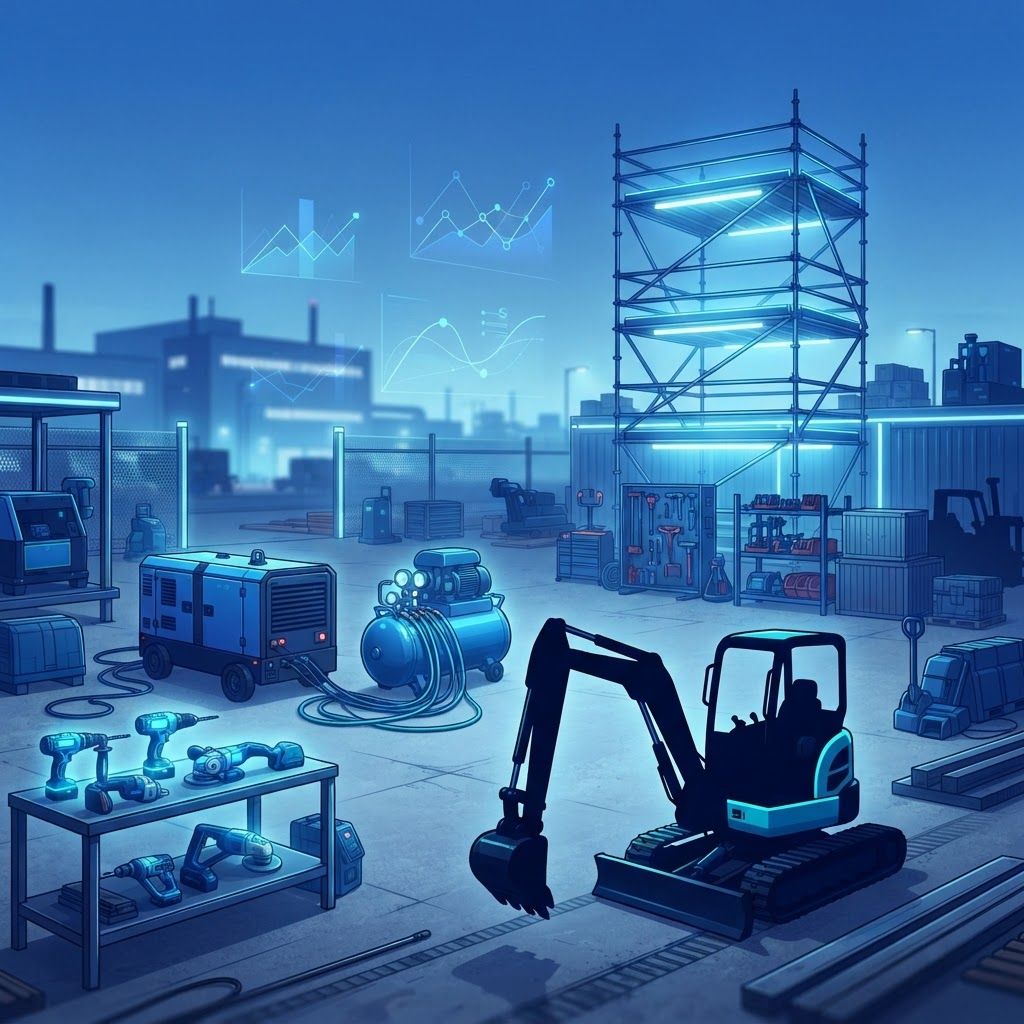
Plant and construction equipment includes compactors, breakers, mixers, dumpers, excavators, generators and lighting towers.
Access equipment spans ladders, towers, podiums and powered access platforms, all subject to strict inspection regimes.
Lifting equipment covers hoists, slings, chain blocks, jacks and shackles, requiring periodic thorough examination.
Agricultural and groundcare equipment includes mowers, chainsaws, brushcutters, chippers, pumps, sprayers and livestock handling systems.
Catering and refrigeration equipment serves hospitality with ovens, fryers, dishwashers, cold rooms and display units.
Workshop and industrial machinery covers compressors, welders, woodworking machinery, lathes and metalworking equipment.
Cleaning and hygiene equipment includes pressure washers, scrubber dryers, vacuums and steam cleaners.
Ten Leading Equipment Wholesalers in Carmarthenshire
1. Carmarthen Tool and Plant Supplies — A broad distributor covering power tools, small plant, consumables and site equipment, with an in-house service workshop for repairs and warranty work. Trade counter availability plus genuine repair capability makes it a practical single source for contractors.
2. Llanelli Industrial Equipment — Compressors, welding plant, generators, workshop machinery and material handling equipment for manufacturers and engineering businesses, including installation and planned maintenance contracts.
3. Tywi Agricultural Machinery Supplies — Pumps, sprayers, fencing equipment, chainsaws, brushcutters, livestock handling gear and dairy equipment, with seasonal readiness around lambing, silage and shearing when downtime is unaffordable.
4. Cross Hands Access and Lifting — Ladders, mobile towers, podium steps, powered access and lifting accessories, supplied with certification and periodic thorough examination services to keep customers legally compliant.
5. Ammanford Catering Equipment — Commercial ovens, ranges, fryers, dishwashers, refrigeration and stainless steel fabrication for pubs, restaurants, hotels and school kitchens, with design, installation and gas safety support.
6. Gwendraeth Cleaning Equipment — Pressure washers, scrubber dryers, industrial vacuums, steam cleaners and chemical dosing systems for farms, food processors, facilities managers and vehicle washing operations.
7. Dinefwr Forestry and Arboriculture — Chainsaws, harnesses, climbing equipment, chippers, splitters and protective clothing for tree surgeons, woodland managers and estate teams, with saw servicing and chain sharpening.
8. Teifi Woodworking Machinery — Saw benches, planers, spindle moulders, sanders, extraction systems and tooling for joinery workshops and furniture makers, with commissioning and operator guidance on guarding requirements.
9. Burry Port Marine Equipment — Outboard engines, winches, deck equipment, pumps, chandlery and safety gear for workboats, fishing vessels and leisure craft along the estuary and coast.
10. Cothi Energy and Power Solutions — Generators, battery storage, solar equipment, electric vehicle chargers and standby power systems, an area of expanding demand as rural businesses seek resilience against outages.
Safety, Certification and Legal Obligations
Equipment carries some of the clearest legal duties in business, and buyers must understand them because responsibility sits with the user, not just the supplier.
Work equipment must be suitable, maintained and used by trained people under the provider and use of work equipment regulations. Lifting equipment requires thorough examination at defined intervals under lifting operations and lifting equipment regulations — generally every twelve months, or six months for equipment lifting people. Pressure systems such as compressors and air receivers need a written scheme of examination and periodic inspection.
Portable appliance testing and electrical safety on site require attention, with reduced low voltage or battery equipment often preferable to mains tools in wet conditions. Vibration exposure from breakers, grinders and chainsaws must be assessed and controlled, and noise exposure managed with appropriate protection.
New machinery placed on the market requires UKCA marking, a declaration of conformity and instructions in English. Second-hand equipment must still be safe and adequately guarded before use, and buyers should be wary of older machinery lacking modern guarding — retrofitting is often more expensive than buying new.
Gas catering equipment must be installed and commissioned by a registered engineer with the correct commercial catering qualifications, and refrigeration containing fluorinated gases carries handling and record-keeping obligations.
Trends in Equipment Supply
Battery power has genuinely transformed the tool market. Modern lithium platforms now drive breakers, chainsaws, mowers, pressure washers and even small compaction equipment. The benefits are substantial: no fuel handling, dramatically lower noise, no exhaust emissions and reduced vibration. Platform loyalty has become a major purchasing consideration because batteries are shared across ranges.
Telematics and asset tracking have spread from large plant into smaller equipment, helping businesses monitor utilisation, prevent theft — a real problem for rural yards and farms — and schedule maintenance based on actual running hours.
Energy efficiency now drives catering and refrigeration purchases. Induction cooking, heat pump dishwashers, hydrocarbon refrigerants and better insulation reduce running costs enough to justify higher capital spend in energy-intensive kitchens.
Servitisation is growing, with suppliers offering maintenance contracts, calibration schedules and guaranteed uptime rather than simply selling boxes. For businesses where breakdown means lost production, that shift is welcome.
Hire, Buy or Lease?
The decision hinges on utilisation. As a rough guide, equipment used more than a third of available time usually justifies purchase; occasional use favours hire. But there are important nuances.
Hire removes maintenance, inspection and compliance burden, which is genuinely valuable for lifting and access equipment where examination requirements are onerous. It also avoids capital tie-up and gives access to newer, better-specified machines.
Purchase makes sense for equipment needed at unpredictable moments — a farm pump, a standby generator, a workshop compressor — where waiting for a hire delivery is unacceptable. It also suits equipment that gets specified and set up for a particular task.
Leasing and contract hire spread cost and often include servicing, which suits catering and cleaning equipment with predictable duty cycles.
Practical Buying Advice
Buy for duty cycle, not headline specification. Domestic-grade equipment used commercially fails quickly and voids warranty. Ask directly whether a machine is rated for professional continuous use.
Check parts and service availability before buying. An excellent machine with a six-week parts lead time is a poor choice for critical operations. Local service capability is worth paying for.
Consider consumable costs across the life of the machine. Blades, filters, chains, belts and chemicals frequently exceed the purchase price over several years, so compare total cost rather than initial outlay.
Standardise battery platforms and fittings where practical to reduce spares holding and simplify training.
Finally, factor in training and documentation. Ask for operator instruction, keep manuals accessible, record inspections, and ensure required examinations are diarised. Compliance failures usually stem from missing paperwork rather than genuinely unsafe equipment.
Final Thoughts
Carmarthenshire's equipment wholesalers cover a genuinely wide brief, reflecting a county where farming, construction, hospitality, forestry, marine and manufacturing all operate side by side. The suppliers that stand out combine stock availability with real service and inspection capability, because equipment that cannot be maintained locally is a liability. Buyers who match specification to duty cycle, plan compliance properly and think in total cost terms will get far better value than price comparison alone can deliver.
Want your brand featured in front of decision-makers? Publish a guest post or get a link insertion in our guides through AAMAX's guest post and link insertion service.
Helpful Links
 SponsoredAAMAX — Full-Service Digital Agency
Write for Us
Share your expertise with our readers. We welcome guest contributions from industry specialists.
Pitch your idea

