

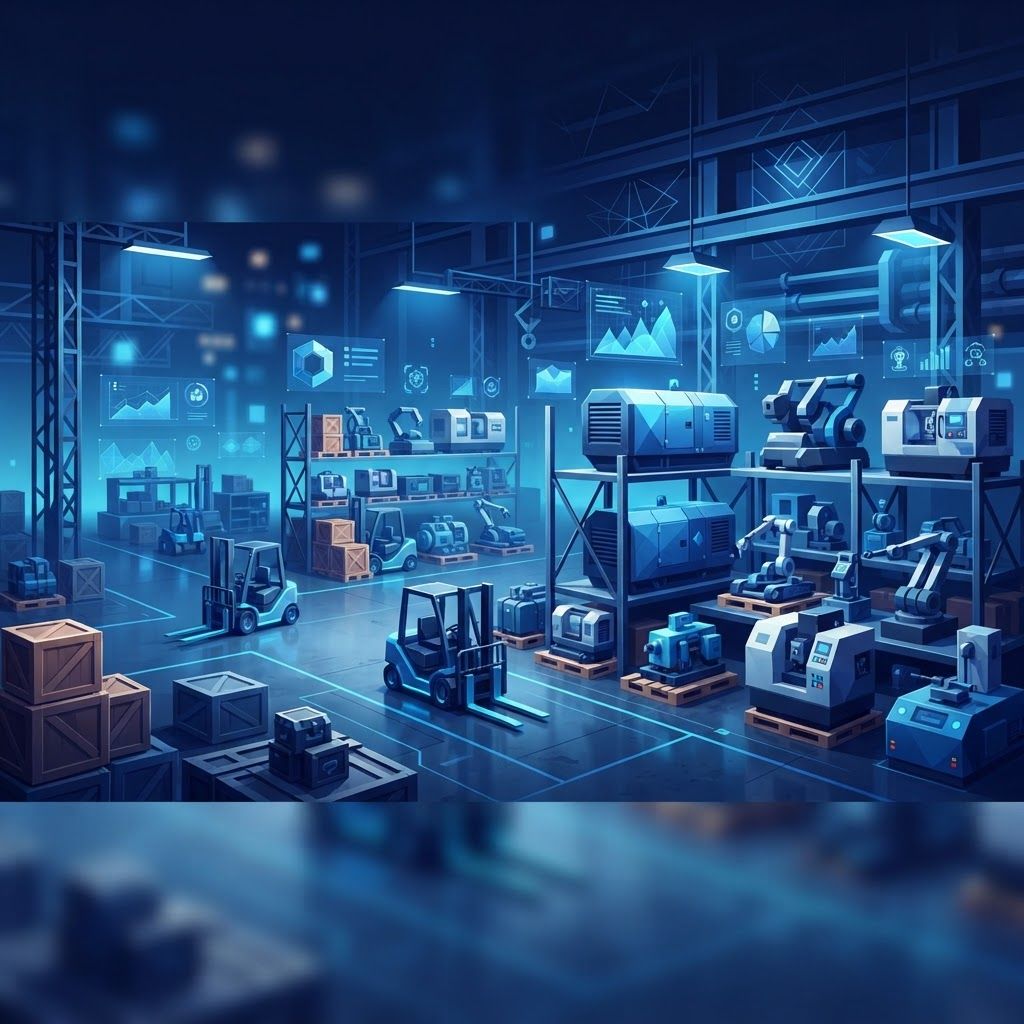
The Breadth of Equipment Supply in Broadland
Equipment wholesaling is one of the least visible but most consequential trades in the Broadland economy. Almost every business in the district depends on machinery supplied by a wholesaler: the commercial oven in a village bakery, the forklift in a distribution warehouse, the pressure washer at a boatyard, the dust extraction in a joinery workshop, the mowers maintaining school playing fields.
The district's supplier base reflects that diversity. Rather than a handful of generalists, Broadland hosts a network of category specialists, each with the technical knowledge, spares inventory and service engineers that their particular equipment demands. Understanding those categories is the fastest route to finding the right supplier.
The Main Categories of Equipment Wholesaler
Materials handling equipment suppliers lead the industrial category, providing forklifts, pallet trucks, stackers, racking, conveyors and loading bay equipment to warehouses and manufacturers. Because this equipment is safety-critical and legally requires periodic thorough examination, suppliers almost always pair sales with inspection and maintenance contracts.
Catering equipment wholesalers form a second major category, serving the district's pubs, restaurants, holiday parks, schools and care homes. Combination ovens, refrigeration, dishwashers, extraction systems and stainless steel fabrication all fall here, and gas safety certification makes installation expertise essential rather than optional.
Power tools and workshop equipment distributors form a third segment, supplying trade customers with drills, saws, compressors, welding sets, workbenches and consumables. Trade counter availability and repair services distinguish the strongest operators.
Groundcare and horticultural equipment suppliers serve a market that is prominent across Norfolk, providing mowers, tractors, brushcutters, chippers and turf maintenance machinery to landscapers, sports grounds, parks and estates.
Other important categories include cleaning and janitorial equipment wholesalers supplying scrubber dryers and industrial vacuums; agricultural equipment dealers covering handling and processing machinery; marine equipment suppliers serving the Broads boatyards and hire fleets; medical and care equipment distributors serving care homes and clinics; laboratory and testing equipment suppliers; and safety equipment wholesalers covering fall protection, lifting gear and access platforms.
Service, Spares and Total Cost of Ownership
The most common mistake in equipment buying is evaluating the purchase price in isolation. The realistic measure is total cost of ownership over the equipment's working life, which includes energy consumption, consumables, routine servicing, spare parts, downtime cost and eventual disposal or residual value.
Energy is frequently the largest hidden factor. A commercial refrigeration unit or a compressor runs continuously, and the difference between an efficient and an inefficient model can exceed the purchase price difference within two or three years. Reputable wholesalers provide realistic running cost comparisons rather than leaving buyers to guess.
Spares availability is the second critical factor. Equipment with poor parts support becomes scrap the moment a component fails. Before buying, ask how long parts will be supported, whether common wear items are held locally, and what the typical lead time is for a critical component.
Service response is the third. For equipment that halts production when it fails, a supplier with local engineers and a guaranteed response time is worth a substantial premium. Ask how many engineers cover Norfolk, what hours they work and whether loan equipment is available during extended repairs.
Safety, Certification and Legal Obligations
Equipment ownership carries legal duties that buyers should understand before purchasing. The Provision and Use of Work Equipment Regulations require that equipment is suitable, maintained and used by trained people. The Lifting Operations and Lifting Equipment Regulations require thorough examination of lifting equipment at defined intervals. Pressure systems, gas appliances and electrical equipment each carry their own inspection regimes.
Good wholesalers help customers meet these obligations by supplying compliant equipment with full documentation, offering scheduled inspection programmes and maintaining certification records. This service is particularly valuable to smaller Broadland businesses without dedicated health and safety staff.
UKCA and CE marking, declarations of conformity, and provision of instructions in English are baseline legal requirements. Buyers of imported equipment through informal channels should be especially careful, as non-compliant machinery transfers substantial liability to the user.
New, Used and Refurbished Options
The secondary equipment market is well developed in Norfolk and can offer excellent value when approached carefully. Professionally refurbished equipment from an established dealer, supplied with a warranty and recent inspection certification, often represents better value than budget new equipment of unknown provenance.
Risks arise with private or auction purchases where history is unknown, compliance documentation is missing and no warranty applies. For safety-critical equipment such as lifting gear or gas appliances, the cost of bringing an uncertified unit into compliance can exceed any saving.
Leasing and contract hire have also grown in popularity, converting capital expenditure into predictable operating cost and typically bundling maintenance. For equipment that is used intensively or becomes obsolete quickly, this can be the most sensible commercial structure.
Technology and Efficiency Trends
Connected equipment is becoming mainstream. Telematics on forklifts and groundcare machinery report usage hours, fault codes and operator behaviour, enabling predictive maintenance rather than reactive repair. Commercial catering equipment increasingly logs temperature data automatically, supporting food safety compliance without manual recording.
Electrification is reshaping several categories. Battery-powered groundcare equipment has improved dramatically, offering lower noise, no local emissions and reduced maintenance, which suits schools, parks and residential settings. Electric forklifts have largely displaced diesel in indoor applications. Battery power tools now match corded performance for most trade applications.
Water and energy efficiency improvements in cleaning and catering equipment deliver measurable operating savings and are increasingly supported by grant or finance schemes that wholesalers can help customers access.
Practical Buying Advice
Specify against your actual duty cycle rather than a general description. Equipment rated for light commercial use fails quickly under continuous operation, and this mismatch is the most frequent cause of premature failure and warranty dispute.
Arrange demonstrations wherever possible. Operator comfort, noise, ergonomics and practical usability are difficult to judge from a specification sheet, and involving the people who will actually use the equipment improves both the decision and its adoption.
Negotiate the service package alongside the purchase. Buying equipment and maintenance together gives the supplier a long-term interest in reliability and usually secures better terms than arranging service separately later.
Finally, plan the whole lifecycle at the point of purchase, including training, consumables, inspection scheduling and eventual replacement. Broadland's equipment wholesalers have deep practical knowledge of these lifecycles, and buyers who involve them early consistently achieve better reliability and lower cost than those who treat the transaction as a simple purchase.
Want your brand featured in front of decision-makers? Publish a guest post or get a link insertion in our guides through AAMAX's guest post and link insertion service.
Helpful Links
 SponsoredAAMAX — Full-Service Digital Agency
Write for Us
Share your expertise with our readers. We welcome guest contributions from industry specialists.
Pitch your idea

