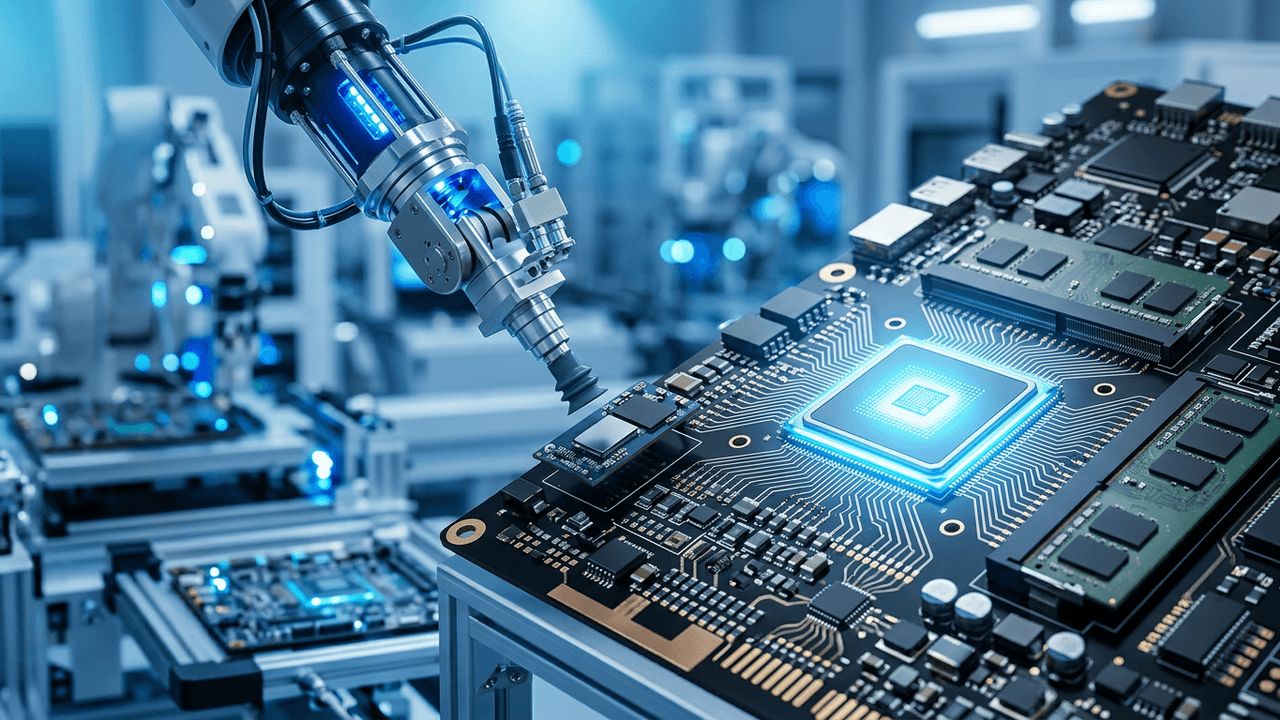
Electronics Manufacturing in the Thames Valley
Windsor and Maidenhead occupies a genuinely advantageous position within the Thames Valley technology corridor, one of the densest concentrations of technology businesses anywhere in Europe. Major software, telecommunications, semiconductor and engineering companies maintain offices along the M4 between London and Reading, and this concentration has drawn a supporting network of electronics manufacturers, design consultancies and contract assembly operations into the borough and its immediate surroundings.
The electronics manufacturing carried out here is characteristically high-mix and lower-volume. Commodity consumer electronics assembly moved offshore decades ago and is not coming back. What remains and thrives locally is the work where engineering support, rapid iteration, quality documentation and intellectual property protection matter more than unit cost: prototyping, new product introduction, industrial and instrumentation electronics, aerospace and defence subassemblies, medical devices and specialist test equipment.
Contract Electronics Manufacturers
Contract electronics manufacturers, commonly known as CEMs or EMS providers, form the backbone of the local sector. These businesses take a customer's design and handle procurement, assembly, testing and often final packaging. Services typically span surface-mount assembly, through-hole soldering, conformal coating, potting and box build.
Assessing a contract manufacturer starts with process capability. Modern surface-mount lines handle fine-pitch components, ball grid arrays and increasingly small passive component sizes, and the equipment generation directly determines what a manufacturer can reliably build. Automated optical inspection and X-ray inspection are essential for verifying joints that cannot be seen visually, particularly under BGA and QFN packages. Manufacturers investing in this inspection capability produce demonstrably lower defect rates.
Certification is the second consideration. IPC-A-610 defines acceptability criteria for electronic assemblies and is the common reference standard across the industry. Manufacturers serving aerospace customers generally hold AS9100, medical device work requires ISO 13485, and automotive supply typically demands IATF 16949. These accreditations involve substantial ongoing cost and signal genuine process maturity.
Printed Circuit Board Design and Layout Consultancies
Alongside assembly, the borough supports design consultancies specialising in schematic capture and printed circuit board layout. This discipline has become considerably more demanding as clock speeds have risen and mixed-signal designs have proliferated.
Contemporary layout work involves controlled impedance routing, differential pair matching, careful power distribution network design and deliberate management of electromagnetic emissions. Getting these fundamentals right at layout stage prevents expensive respins and compliance failures later. Consultancies that combine layout skill with signal integrity simulation and design-for-manufacture review add substantial value, catching problems before any board is fabricated.
Embedded Systems and Firmware Developers
Hardware without competent firmware is of little use, and the borough hosts capable embedded systems developers working across microcontroller platforms, real-time operating systems and connectivity stacks. This work spans bare-metal development on constrained devices through to embedded Linux on application processors.
Security has become a defining concern in this field. Connected products now face regulatory expectations around secure boot, encrypted communications, authenticated firmware updates and vulnerability disclosure. Developers who understand secure element integration, cryptographic key management and over-the-air update architecture are considerably more valuable than those who treat security as an afterthought.
Cable Assembly and Wire Harness Manufacturers
Cable assembly and wire harness manufacture is unglamorous but commercially important work, and it is well represented in the region. These businesses produce custom cables, connector assemblies, ribbon harnesses and complex looms for industrial machinery, transport, broadcast and instrumentation applications.
Quality in harness manufacture depends on crimp integrity, correct tooling, proper strain relief and thorough continuity testing. The industry standard reference is IPC/WHMA-A-620, and manufacturers working to it maintain crimp pull-test records and documented tooling calibration. For safety-critical applications, this traceability is non-negotiable.
Test and Measurement Equipment Producers
The Thames Valley's engineering density supports manufacturers of test and measurement equipment, including bespoke test fixtures, automated test systems and calibration instruments. Much of this work is genuinely bespoke, developed for a specific production line or laboratory requirement.
Automated test equipment development combines mechanical fixture design, electronics, instrumentation and software into a single deliverable. The economic case is compelling for manufacturers moving from prototype to volume, where manual testing quickly becomes the production bottleneck. Local producers of such systems work closely with customers through the specification and commissioning process, which is far easier to manage with a supplier a short drive away.
Industrial Control and Automation Electronics
Manufacturers producing industrial control electronics supply motor drives, programmable controllers, sensor interfaces, human-machine interface panels and enclosure-mounted control assemblies. Customers include machine builders, water utilities, building services contractors and process industries.
Industrial electronics carries demanding environmental requirements. Equipment must tolerate wide temperature ranges, vibration, electrical noise and often dust or moisture ingress. Ingress protection ratings, conformal coating and appropriate component derating are standard considerations. Manufacturers experienced in this segment understand these requirements instinctively rather than discovering them through field failures.
Medical Device Electronics Manufacturers
Medical device electronics represents one of the higher-value niches served from the region. Manufacturing in this field operates under ISO 13485 quality management, with rigorous design history documentation, full material traceability, validated processes and controlled change management.
The regulatory burden is genuinely substantial, encompassing risk management, biocompatibility considerations for patient-contacting parts, electrical safety to the relevant medical equipment standards and post-market surveillance obligations. Manufacturers established in this space have invested heavily in quality infrastructure, and that investment creates a meaningful barrier to entry that protects their position.
Aerospace and Defence Electronics Suppliers
Proximity to Heathrow and the wider British aerospace supply chain supports suppliers of aerospace and defence electronics in and around the borough. This work encompasses avionics subassemblies, ground support equipment, communications hardware and ruggedised computing.
Requirements are exacting. AS9100 certification, full component traceability to counter the risk of counterfeit parts, environmental qualification testing and often export control compliance all apply. Suppliers in this segment maintain long-term component obsolescence management programmes, since aerospace platforms remain in service far longer than commercial electronics component lifecycles.
Prototyping and Rapid Turnaround Services
Rapid prototyping services occupy an important role in the local ecosystem, building small quantities of assemblies quickly to support design validation. Turnaround of a few days is achievable for straightforward boards, allowing engineering teams to iterate rapidly.
The value of a local prototyping partner is difficult to overstate for development teams. Engineers can visit the shop floor, discuss assembly challenges directly with technicians and collect boards the same day. This immediacy accelerates development in ways that offshore suppliers, however capable, simply cannot match across time zones and shipping delays.
Electronics Repair and Refurbishment Specialists
Repair and refurbishment businesses extend the service life of industrial and commercial electronics, undertaking component-level fault diagnosis, board repair, obsolete equipment support and refurbishment of legacy control systems. For manufacturers running production machinery with discontinued control electronics, these specialists are often the only alternative to wholesale replacement.
This segment has grown alongside sustainability and circular economy thinking. Repairing a control board is dramatically cheaper and less carbon-intensive than replacing an entire machine, and the specialists who can diagnose down to component level provide genuinely valuable capability.
Trends Reshaping Electronics Manufacturing
Supply chain resilience has become the industry's central preoccupation following the semiconductor shortages of recent years. Manufacturers now maintain broader approved vendor lists, design in second-source alternatives from the outset and hold strategic buffer stock on long-lead components. Design-for-availability has joined design-for-manufacture as a standard engineering discipline.
Sustainability requirements continue to tighten. Restriction of hazardous substances compliance, waste electrical equipment obligations and increasingly customer-mandated carbon reporting all shape material choices and process decisions. Lead-free assembly is long established, and attention has moved to halogen-free substrates, recyclable packaging and energy efficiency in the assembly process itself.
Miniaturisation and integration continue relentlessly. Higher component densities, embedded passive components and advanced packaging place greater demands on assembly equipment and inspection capability, progressively raising the capital threshold for competitive manufacture.
How to Choose an Electronics Manufacturing Partner
Match the partner to your production stage. Prototyping specialists excel at speed and flexibility but may not scale economically, while volume-oriented manufacturers often impose minimum quantities that make early development uneconomic. Some manufacturers deliberately span both, which suits products expected to grow.
Scrutinise quality systems and inspection capability, and ask to see the shop floor. A well-organised facility with visible process controls, calibrated equipment and electrostatic discharge protection tells you more than any brochure. Discuss component sourcing openly, since procurement competence increasingly determines whether a product ships on time.
Final Thoughts
Electronics manufacturing in Windsor and Maidenhead reflects the strengths of the wider Thames Valley: engineering depth, quality discipline and responsiveness rather than low-cost volume. For companies developing electronic products, the availability of design consultancies, prototyping services, contract assembly and specialist regulated manufacture within a compact geographic area is a genuine competitive advantage. Choosing well means understanding your own requirements clearly and then matching them honestly against what each potential partner actually delivers.
Want your brand featured in front of decision-makers? Publish a guest post or get a link insertion in our guides through AAMAX's guest post and link insertion service.
Helpful Links
 SponsoredAAMAX — Full-Service Digital Agency
Write for Us
Share your expertise with our readers. We welcome guest contributions from industry specialists.
Pitch your idea