Electronics Manufacturing in the Midlands Engineering Corridor
Warwickshire sits within one of Britain's most concentrated engineering regions, and electronics manufacturing forms an increasingly important part of it. The county's traditional strength in automotive and mechanical engineering has been progressively supplemented by electronics capability, driven by the electrification of vehicles, the proliferation of embedded systems and the growth of industrial automation.
Local electronics manufacturing is characterised by technical sophistication rather than volume. High-mix, low-to-medium volume production, rapid prototyping, safety-critical assembly and specialist testing describe the sector far better than mass consumer production. This positioning suits an environment with strong engineering talent and demanding local customers.
The Ten Leading Electronics Manufacturers in Warwick
Warwick Electronics Manufacturing operates as a full-service electronics manufacturing services provider, offering printed circuit board assembly, box build, cable harness production and functional testing. Its surface mount lines handle fine-pitch and BGA components, and its quality management systems support customers in regulated sectors requiring documented traceability.
Castle Circuit Systems specialises in printed circuit board design and fabrication, including multilayer boards, flexible circuits and rigid-flex constructions. High-speed digital design, impedance control and thermal management form its technical focus, supporting customers whose products cannot rely on standard board specifications.
Avon Automotive Electronics serves the vehicle sector with electronic control units, sensor modules, battery management systems and power electronics. Automotive electronics demand exceptional reliability across wide temperature ranges and vibration conditions, and the certification requirements are among the most rigorous in any industry.
Jephson Instrumentation designs and manufactures precision measurement and test instrumentation for laboratory, industrial and research applications. Its products serve customers requiring accuracy and calibration traceability, including the region's substantial engineering research community.
Priory Embedded Systems combines hardware design with embedded firmware development, delivering complete product solutions rather than boards alone. Microcontroller selection, low-power design, wireless connectivity and real-time software are handled together, which avoids the integration problems that arise when hardware and firmware are developed separately.
Mill Street Power Electronics concentrates on power conversion, including inverters, converters, motor drives and charging systems. Electrification across transport and industry has made power electronics one of the fastest-growing electronics disciplines, and thermal design expertise is central to it.
Saltisford Prototyping Services provides rapid prototype assembly and small-batch production for development teams. Fast turnaround on prototype boards allows engineering iteration cycles measured in days rather than weeks, which materially accelerates product development.
Northgate Industrial Controls manufactures control panels, automation systems and industrial computing hardware. Its work supports manufacturing automation across the Midlands, integrating programmable controllers, human-machine interfaces and networked industrial systems.
Emscote RF and Wireless specialises in radio frequency and wireless products, including antenna design, RF module development and compliance testing support. Wireless design requires specialised measurement capability and regulatory knowledge that general electronics manufacturers typically lack.
Shire Electronics Test Services provides environmental testing, EMC pre-compliance, thermal cycling and reliability assessment. Independent testing is essential before products enter formal certification, and identifying failures during development rather than at certification saves considerable cost and delay.
Supply Chain Realities
The semiconductor shortage that disrupted global manufacturing exposed the fragility of electronics supply chains and permanently changed how the sector operates. Extended component lead times, allocation constraints and price volatility forced manufacturers to rethink assumptions built on decades of reliable just-in-time supply.
The responses have been pragmatic. Design for supply chain resilience — specifying components with multiple sources, avoiding single-source parts and creating approved alternatives at the design stage — has become standard practice. Strategic inventory holding has partly replaced pure just-in-time. Component obsolescence management has moved from an afterthought to an active discipline.
Counterfeit components emerged as a serious secondary risk during shortage periods, as buyers turned to unauthorised distributors. Reputable Warwickshire manufacturers maintain strict authorised-source purchasing and incoming inspection to prevent counterfeit parts reaching production, since the field failure consequences can be severe.
Automation and Quality Systems
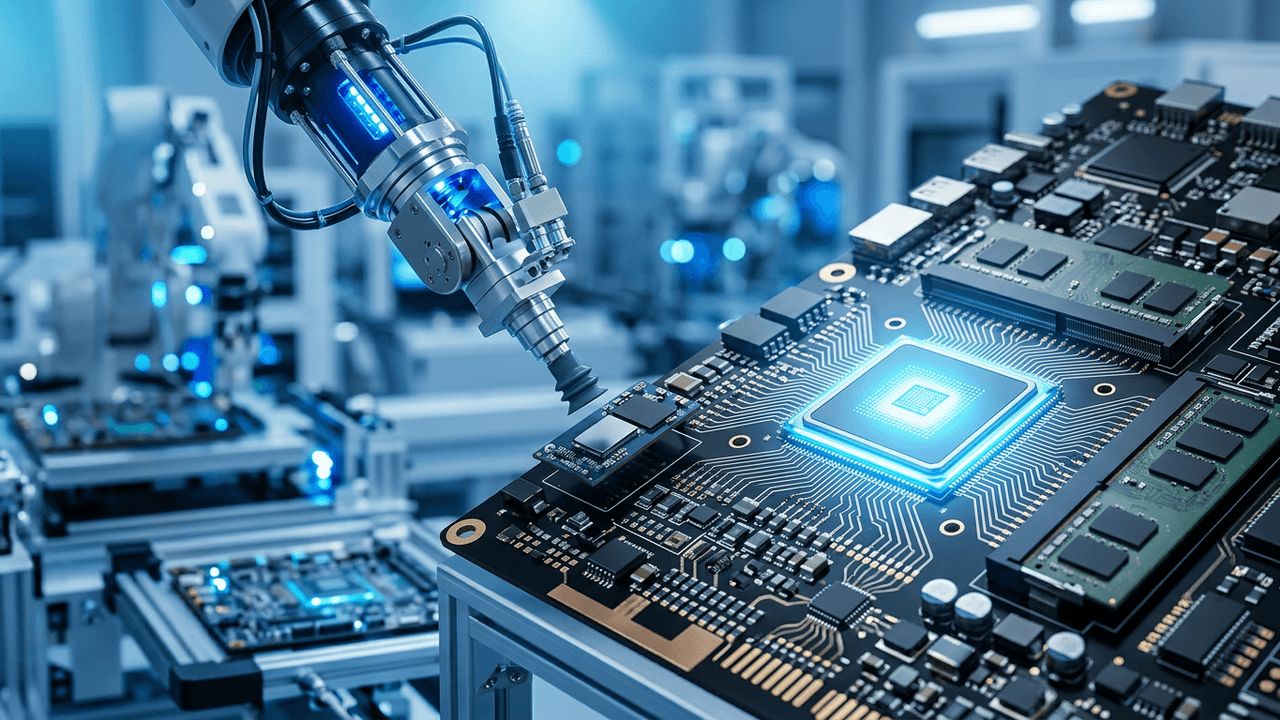
Modern electronics assembly is heavily automated, with pick-and-place machines placing components at high speed and precision, reflow ovens controlling solder profiles precisely, and automated optical inspection verifying placement and joint quality. X-ray inspection examines joints hidden beneath ball grid array packages.
Automation delivers consistency that manual assembly cannot approach, but it requires substantial capital investment and skilled process engineering. The programming, calibration and process optimisation behind automated lines is where manufacturing expertise actually resides.
Quality management systems provide the documentation framework, with sector-specific standards applying in automotive, medical and aerospace applications. Full material traceability — the ability to identify which component reel supplied which board — is now expected in safety-critical production.
Selecting an Electronics Manufacturing Partner
Match capability to your requirement honestly. A manufacturer optimised for high-volume consumer assembly will struggle with a fifty-unit run of complex instrumentation, and a prototype specialist cannot scale to tens of thousands of units. Ask about typical batch sizes and product mix.
Assess design support. Design for manufacture review before production frequently identifies issues that would cause yield problems or assembly difficulty, and manufacturers offering this input add value beyond assembly labour.
Verify certifications relevant to your sector. Automotive, medical and aerospace applications each require specific quality accreditation, and retrofitting compliance is far harder than selecting an already-certified partner.
Discuss component procurement responsibility explicitly. Turnkey arrangements where the manufacturer sources components simplify your workload but require confidence in their purchasing discipline. Consigned arrangements give you control but transfer supply risk back to you.
Finally, visit the facility and speak to the process engineers rather than only the sales team. Electronics manufacturing quality is determined by process control, and the people managing those processes will tell you far more about a manufacturer's real capability than any brochure.
Want your brand featured in front of decision-makers? Publish a guest post or get a link insertion in our guides through AAMAX's guest post and link insertion service.
Helpful Links
 SponsoredAAMAX — Full-Service Digital Agency
Write for Us
Share your expertise with our readers. We welcome guest contributions from industry specialists.
Pitch your idea