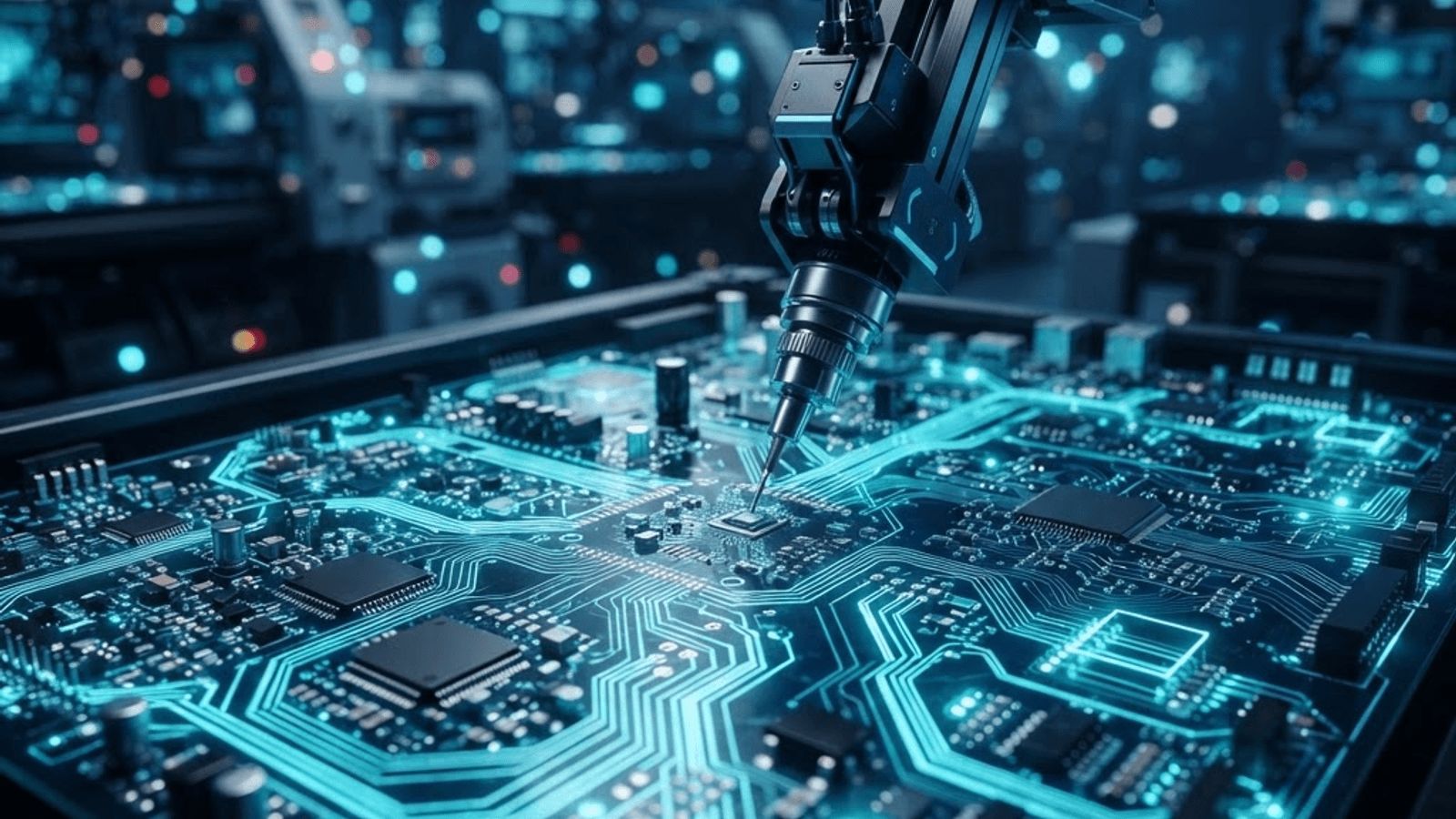
Electronics Manufacturing in Newcastle-under-Lyme
Electronics manufacturing in Newcastle-under-Lyme rarely makes headlines, but it quietly underpins a great deal of industry across the Midlands. The borough's position between the automotive and aerospace supply chains of the West Midlands, the ceramics and process industries of the Potteries, and the research activity around Keele has produced a cluster of firms specialising in electronic manufacturing services, embedded control systems, industrial instrumentation and bespoke hardware design.
The character of the sector here is business-to-business rather than consumer. Very few borough companies make products you would recognise on a shop shelf. Instead they build the control boards inside industrial ovens, the sensor assemblies monitoring kiln temperature, the telemetry units on remote pumping stations, and the ruggedised enclosures that survive factory floors. It is specialised, technically demanding work that rewards precision over scale.
Core Capabilities Available Locally
The most common service is contract electronic manufacturing, spanning surface mount and through-hole PCB assembly, conformal coating, cable and harness assembly, box build and functional testing. Around that sit design services: schematic capture, PCB layout, firmware development, EMC pre-compliance and design for manufacture reviews.
A smaller but important group of firms focus on instrumentation and control, producing panels, PLC-based systems and SCADA integration for process plants. Others specialise in test and measurement, repair and refurbishment, or obsolescence management for legacy industrial equipment that cannot economically be replaced.
The Top 10 Electronics Manufacturers Serving Newcastle-under-Lyme
1. Lymedale Electronics. A full-service contract electronics manufacturer offering prototype through to medium-volume production. Its combination of automated optical inspection, X-ray for BGA verification and in-circuit testing gives it the quality infrastructure that smaller assemblers often lack.
2. Keele Embedded Systems. Design-led rather than assembly-led, this firm develops embedded hardware and firmware for IoT, monitoring and control applications. It is a strong partner for companies with a product concept but no in-house electronics engineering.
3. Chesterton Control Panels. Building bespoke industrial control and automation panels to recognised standards, complete with PLC programming and HMI configuration. Its work is common across ceramics, food processing and water treatment sites in the region.
4. North Staffs Instrumentation. Manufacturing sensors, transmitters and measurement assemblies for temperature, pressure and flow, with calibration services supporting them. Traceable calibration is central to its value to regulated industries.
5. Silverdale Circuit Assembly. Focused on high-mix, low-volume PCB assembly, this company excels at the awkward jobs: legacy through-hole builds, mixed technology boards and short runs that larger factories decline.
6. Madeley Power Electronics. Specialists in power conversion, motor drives and battery management hardware, an area seeing rapid demand growth from electrification across transport and industry.
7. Borough Cable & Harness. Producing wiring looms, connector assemblies and custom cabling to tight tolerance, with crimp validation and pull testing. Harness quality is a frequent root cause of field failures, and specialists earn their place.
8. Trentside Test Solutions. Designing and building bespoke functional test rigs and jigs for production lines, allowing manufacturers to verify every unit rather than sampling. It also offers EMC pre-compliance screening.
9. Audley Electronic Repairs. Component-level repair and refurbishment of industrial electronics, from drives and PSUs to obsolete control boards. For plants running equipment no longer supported by its original maker, this capability prevents costly full replacements.
10. Newcastle Prototyping Lab. Rapid prototyping combining PCB fabrication sourcing, quick-turn assembly, 3D printed enclosures and mechanical integration. Useful for startups and internal innovation teams needing a working demonstrator fast.
Technology Trends Shaping the Sector
Electrification is the largest single driver. Power electronics, battery management and charging infrastructure all require the kind of thermally aware, safety-critical design that local firms are increasingly building expertise in. Demand from automotive tier suppliers and industrial equipment makers continues to grow.
Industrial IoT is the second theme. Factories across the Potteries are retrofitting sensors and edge devices onto machinery built decades ago in order to capture condition and energy data. This creates steady work for firms that can package robust, connected hardware for hostile environments.
Component obsolescence and supply chain resilience remain persistent concerns. The shortages of recent years taught manufacturers to design with second-source components, to hold strategic stock, and to build relationships with assemblers who can redesign around unavailable parts. Local partners, reachable in an afternoon, are valued precisely because of this.
Finally, compliance is tightening. UKCA and CE marking, RoHS and REACH chemical restrictions, EMC directives and product safety requirements all demand documentation discipline. Manufacturers with established technical file processes save their clients considerable pain.
Choosing an Electronics Manufacturing Partner
Match volume expectations honestly. A high-volume assembler will not enjoy your fifty-unit run, and a prototype specialist will struggle at ten thousand. Ask directly about typical batch sizes.
Inspect the quality infrastructure. Does the firm have AOI? X-ray? Are operators IPC certified? Is there a documented process for handling non-conforming product? These questions separate genuine manufacturers from assembly rooms.
Discuss design for manufacture early. A good partner will review your board layout and suggest changes that improve yield and reduce cost before the first unit is built. Firms that simply build what they are given without comment are leaving value on the table.
Finally, clarify intellectual property, tooling ownership and what happens to your design files and test fixtures if the relationship ends. Ambiguity here causes serious problems later.
Why Local Manufacturing Makes Sense
Offshore assembly can be cheaper per unit, but the hidden costs are real: shipping time, minimum orders, communication lag across time zones, and the difficulty of resolving a yield problem remotely. A borough manufacturer can have an engineer at your site the same day. For products in development or in low-volume production, that responsiveness usually outweighs the unit price difference.
Final Thoughts
Newcastle-under-Lyme's electronics manufacturers form a small but genuinely capable ecosystem spanning design, assembly, test and repair. For businesses needing reliable industrial hardware, rapid iteration, or long-term support for equipment that must keep running, the borough offers partners with the technical depth and proximity to make the relationship work.
Want your brand featured in front of decision-makers? Publish a guest post or get a link insertion in our guides through AAMAX's guest post and link insertion service.
Helpful Links
 SponsoredAAMAX — Full-Service Digital Agency
Write for Us
Share your expertise with our readers. We welcome guest contributions from industry specialists.
Pitch your idea