

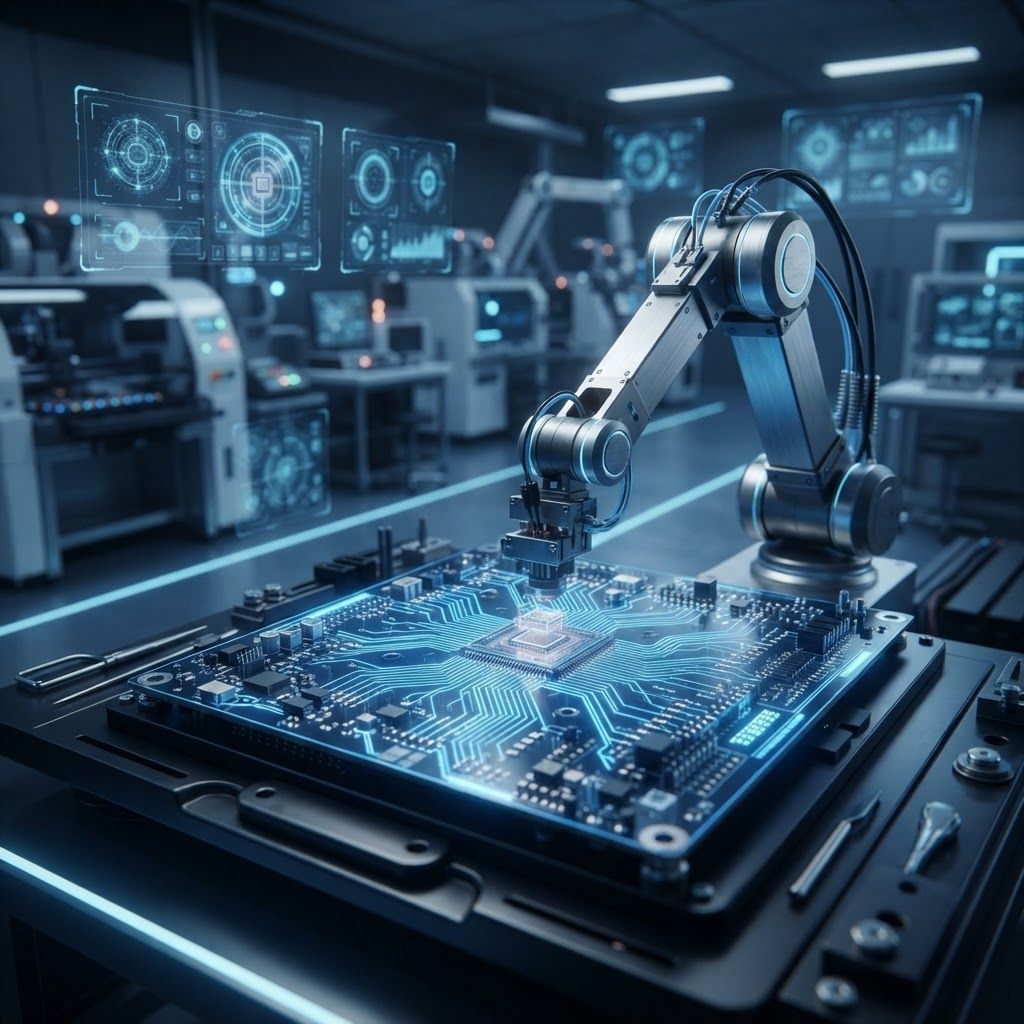
Electronics Manufacturing in the Kent Economy
Electronics manufacturing represents one of the most technically demanding activities in the Maidstone industrial economy. It requires precision equipment, controlled environments, rigorous quality systems and highly skilled staff. The businesses operating in this space tend to be specialists rather than generalists, serving customers who need reliability, traceability and engineering support rather than the lowest possible unit price.
Maidstone's appeal for this sector rests on several practical factors. The town offers modern industrial units at costs substantially below London and the immediate south east, strong road access to Channel ports and Heathrow for component supply and export, and a labour market with access to engineering graduates from regional universities and technical colleges. Proximity to the aerospace, defence, medical device and rail engineering clusters in the wider south east also generates consistent demand.
What Local Electronics Manufacturers Provide
Contract electronics manufacturing is the core activity, covering printed circuit board assembly using both surface mount and through-hole technology, cable and harness assembly, box build and full product integration. This work ranges from prototype quantities through to substantial production volumes.
Design and development services complement manufacturing, including schematic capture, printed circuit board layout, firmware development, electromagnetic compatibility pre-compliance and design for manufacture review. Testing and inspection capability, including automated optical inspection, functional testing and environmental stress screening, ensures products perform as specified. Many providers also offer obsolescence management, repair, refurbishment and end-of-life support.
1. Kent Circuit Assembly
Kent Circuit Assembly provides contract printed circuit board assembly with a strong emphasis on quality documentation and traceability. It handles fine-pitch surface mount components, mixed technology boards and low to medium volume production. Customers in regulated sectors value its inspection regime and its willingness to support small quantities that larger factories decline.
2. Medway Electronic Systems
Medway Electronic Systems specialises in control and instrumentation electronics for industrial applications, including process monitoring, machine control and data acquisition. The company combines electronic design with enclosure engineering and software, delivering complete systems rather than components. Its industrial customers value having a single accountable partner.
3. Invicta Electronics Engineering
Invicta Electronics Engineering focuses on new product development, taking concepts from specification through prototype to production readiness. Its services span hardware design, embedded firmware, compliance testing preparation and manufacturing transfer. For startups and established companies launching new products, this end-to-end capability substantially reduces development risk.
4. Weald Precision Electronics
Weald Precision Electronics operates in the higher-reliability end of the market, serving customers whose products must perform in demanding environments. Its processes reflect that positioning, with controlled handling, conformal coating capability, environmental testing and comprehensive batch records. The company is particularly experienced with harsh-environment applications.
5. Maidstone Cable and Harness
Maidstone Cable and Harness manufactures wiring looms, cable assemblies and connector solutions to customer drawings. This work is often overlooked but critical, since interconnection failures are a common cause of product problems. The company's crimping, testing and documentation standards give customers confidence in a component that is difficult to inspect once installed.
6. Southeast Sensor Technologies
Southeast Sensor Technologies develops and manufactures sensing and measurement devices for industrial, environmental and building applications. Its work combines analogue electronics expertise with calibration capability, an increasingly rare combination. The growth of building monitoring and industrial internet of things applications has expanded its market considerably.
7. Garden of England Electronics
Garden of England Electronics serves the agricultural technology sector, producing control electronics for irrigation, environmental control in glasshouses, grading equipment and cold storage monitoring. Given the area's strong horticultural base, this specialism connects electronics manufacturing directly to the local rural economy in a genuinely distinctive way.
8. Kentish Power Electronics
Kentish Power Electronics concentrates on power conversion, supplies, drives and battery management systems. As electrification advances across transport, heating and industrial equipment, demand for power electronics expertise has risen sharply. The company's thermal design and efficiency optimisation capability addresses the hardest part of these applications.
9. Test, Calibration and Compliance Laboratories
A crucial part of the electronics ecosystem is provided by independent test and calibration laboratories serving Kent manufacturers. They deliver electromagnetic compatibility testing, safety assessment, environmental testing and instrument calibration. Without accessible local testing, product development timescales lengthen significantly, so these facilities materially support the sector's competitiveness.
10. Electronics Repair and Refurbishment Specialists
The final entry recognises businesses extending equipment life through repair, refurbishment and obsolescence management. As sustainability expectations grow and legacy industrial equipment remains in service, the ability to repair boards, reverse engineer discontinued parts and source obsolete components has become commercially valuable rather than merely nostalgic.
Industry Trends and Challenges
Component availability remains the sector's defining challenge. Supply disruptions have taught manufacturers to design with alternative parts identified from the outset, hold strategic stock and maintain closer relationships with distributors. Providers offering active obsolescence management give customers real protection against sudden production stoppages.
Automation and inspection technology continue to advance. Automated optical inspection, X-ray inspection for hidden joints and in-circuit testing have raised achievable quality levels while reducing labour dependency. This helps domestic manufacturers compete on total cost rather than hourly rate alone.
Sustainability and regulatory compliance are also tightening. Restrictions on hazardous substances, requirements around repairability and emerging expectations for product carbon footprint reporting all influence design decisions. Manufacturers who understand these frameworks early help customers avoid costly redesign.
Choosing an Electronics Manufacturing Partner
Match the supplier to your volume and complexity. A high-volume factory will struggle with a fifty-unit prototype run, while a prototype specialist may lack capacity for production scale. Ask about quality certification, inspection methods and how non-conformances are handled and reported.
Assess engineering support seriously. A manufacturer that reviews your design for manufacturability and raises concerns before production begins will save you far more than a marginally cheaper quotation. Finally, discuss component procurement openly, including who carries obsolescence risk and how price changes are handled, since this is where most disputes arise.
Want your brand featured in front of decision-makers? Publish a guest post or get a link insertion in our guides through AAMAX's guest post and link insertion service.
Helpful Links
 SponsoredAAMAX — Full-Service Digital Agency
Write for Us
Share your expertise with our readers. We welcome guest contributions from industry specialists.
Pitch your idea

