The Shape of Electronics Manufacturing Around Canterbury
Canterbury is not a mass-volume electronics location, and it does not attempt to be. High-volume consumer assembly moved to Asia decades ago and is not coming back. What Kent has developed instead is a cluster of specialised electronics businesses working where engineering knowledge, certification, low-volume flexibility and proximity to the customer create real advantage. This includes prototype and development work, industrial control systems, instrumentation, sensors, medical devices and embedded systems.
Two conditions underpin this. The first is the research and skills base, with the University of Kent maintaining engineering and computing capability that generates both graduates and spin-out activity. The second is Kent's position within the wider south east electronics corridor, giving access to component distributors, test facilities and customers while operating at a lower cost base than London or the Thames Valley.
What Modern Electronics Manufacturing Involves
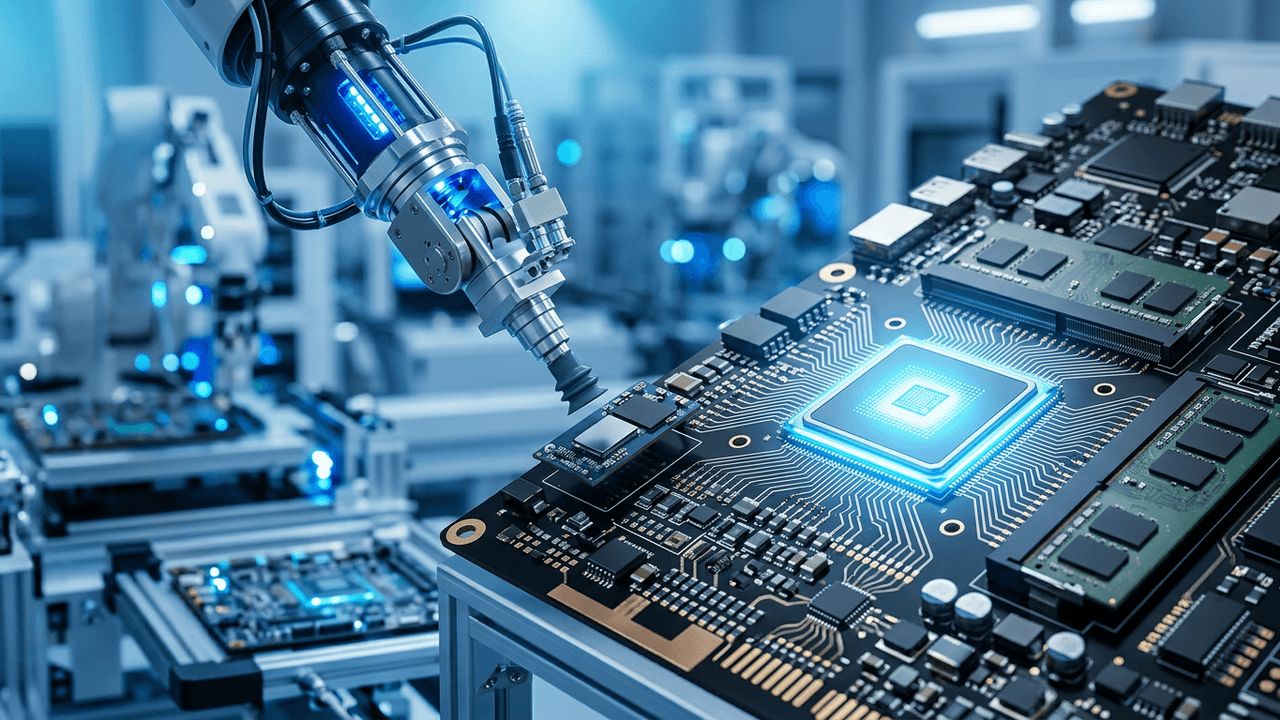
The industry breaks into distinguishable activities. Printed circuit board assembly covers surface mount and through-hole population, reflow soldering, inspection and testing, and is the core manufacturing operation most people picture. Contract electronics manufacturing extends this into a full service including component procurement, assembly, enclosure integration, functional testing and packaging.
Upstream sits design, comprising schematic capture, board layout, signal integrity analysis, firmware development and compliance planning. Downstream sits test and certification, covering electromagnetic compatibility, safety, environmental testing and the documentation needed for market access. A further specialism handles cable assemblies, wiring looms and electromechanical build, which is labour-intensive work that benefits from being close to the customer.
Ten Leading Electronics Manufacturers and Specialisms in Canterbury
1. Contract Electronics Manufacturing Providers
The backbone of the local sector is the contract electronics manufacturer offering end-to-end production from procurement through assembly to test. Kent providers in this space typically specialise in low to medium volume with high mix, which suits industrial, scientific and medical customers whose annual quantities are measured in hundreds rather than millions. Their competitive strengths are engineering support, traceability and the willingness to handle complex builds that large-volume factories decline.
2. Printed Circuit Board Assembly Specialists
Dedicated assembly houses focus on populating boards to a customer's design, using automated placement, reflow and wave soldering, automated optical inspection and increasingly X-ray inspection for hidden joints on modern packages. Quality management certification and, where relevant, aerospace or medical sector approvals are the key differentiators, since these determine which markets a provider can serve.
3. Electronic Design and Development Consultancies
Design consultancies take products from concept to manufacturable design, covering hardware architecture, board layout, embedded firmware, wireless integration and pre-compliance testing. Canterbury's university connections have produced several practices with strong capability in sensors, signal processing and low-power wireless. For companies without in-house electronics engineering, these consultancies are frequently the difference between an idea and a product.
4. Sensor and Instrumentation Manufacturers
Instrumentation is a notable regional strength, encompassing measurement devices, monitoring equipment and scientific instruments for environmental, agricultural, industrial and laboratory use. These products combine analogue precision, digital processing and robust packaging, and command high margins because performance rather than price drives purchasing. Kent's agricultural and environmental sectors provide a useful local market alongside export sales.
5. Industrial Control and Automation Electronics Firms
Manufacturers and integrators in this segment build control panels, programmable logic controller systems, motor drives and human machine interfaces for production lines, water treatment, food processing and building services. Work typically combines electronics manufacture with electrical engineering and software, and the customer base includes the substantial food and drink processing sector across Kent.
6. Medical Device Electronics Manufacturers
Medical electronics is a demanding specialism requiring quality management systems specific to medical devices, full traceability, validated processes and rigorous documentation. Providers with these approvals serve diagnostic, monitoring and therapeutic device developers. Barriers to entry are high, which makes established capability in the region commercially valuable and relatively secure.
7. Cable Assembly and Electromechanical Build Services
Wiring harnesses, cable assemblies, box build and panel wiring form a substantial and often underestimated part of the sector. This work resists automation and benefits from close customer collaboration on routing, labelling and testing. Kent providers serve transport, marine, industrial and renewable energy customers, the last of these growing quickly with offshore wind activity.
8. Rapid Prototyping and Small Batch Production Houses
Startups and research groups need working hardware quickly and in tiny quantities. Prototype specialists offer fast-turnaround board assembly, three-dimensional printed enclosures, hand-built samples and iterative revision support. The presence of this capability near two universities materially accelerates local hardware innovation, since a design can move from layout to tested prototype within days.
9. Test, Compliance and Certification Laboratories
No electronic product reaches market without compliance testing, and laboratories serving Kent handle electromagnetic compatibility, electrical safety, radio approvals, environmental and vibration testing. Pre-compliance testing during development is far cheaper than discovering a failure at final certification, and experienced providers advise on design changes rather than simply reporting results.
10. Repair, Refurbishment and Obsolescence Management Services
Industrial electronics often remain in service for decades, long after components are discontinued. Specialists in this segment repair legacy boards, source obsolete parts, reverse engineer unsupported designs and produce form-fit-function replacements. As sustainability pressure grows and capital replacement becomes harder to justify, this segment has expanded considerably and represents genuinely valuable engineering work.
Trends Affecting the Sector
Supply chain resilience has become the dominant commercial concern following the component shortages of recent years. Manufacturers now hold more inventory, design in alternative parts from the outset and maintain broader supplier relationships. Design for obsolescence resistance has become a standard requirement rather than an afterthought.
Sustainability regulation is the second theme, covering hazardous substance restrictions, energy efficiency requirements and emerging obligations around repairability and recycled content. The third is the continued spread of connected devices, driving demand for low-power wireless design, embedded security and over-the-air update capability. Security in particular has moved from optional to mandatory for consumer connected products.
Selecting an Electronics Manufacturing Partner
Match capability to your stage. A prototype house is not the right partner for volume production, and a volume manufacturer will not welcome iterative development work. Verify quality certifications relevant to your market, particularly for medical, aerospace or automotive applications where sector-specific approval is mandatory.
Discuss component procurement responsibility explicitly, since who owns supply risk and inventory has significant cost implications. Ask about test coverage, first article inspection and how failures are handled. Visit the facility, look at inspection equipment and ask about staff training and retention.
Canterbury's electronics sector rewards those seeking engineering partnership rather than the lowest quoted assembly price. For technically demanding, lower-volume products, the local capability is genuinely competitive and the collaboration that proximity allows is difficult to replicate at distance.
Want your brand featured in front of decision-makers? Publish a guest post or get a link insertion in our guides through AAMAX's guest post and link insertion service.
Helpful Links
 SponsoredAAMAX — Full-Service Digital Agency
Write for Us
Share your expertise with our readers. We welcome guest contributions from industry specialists.
Pitch your idea