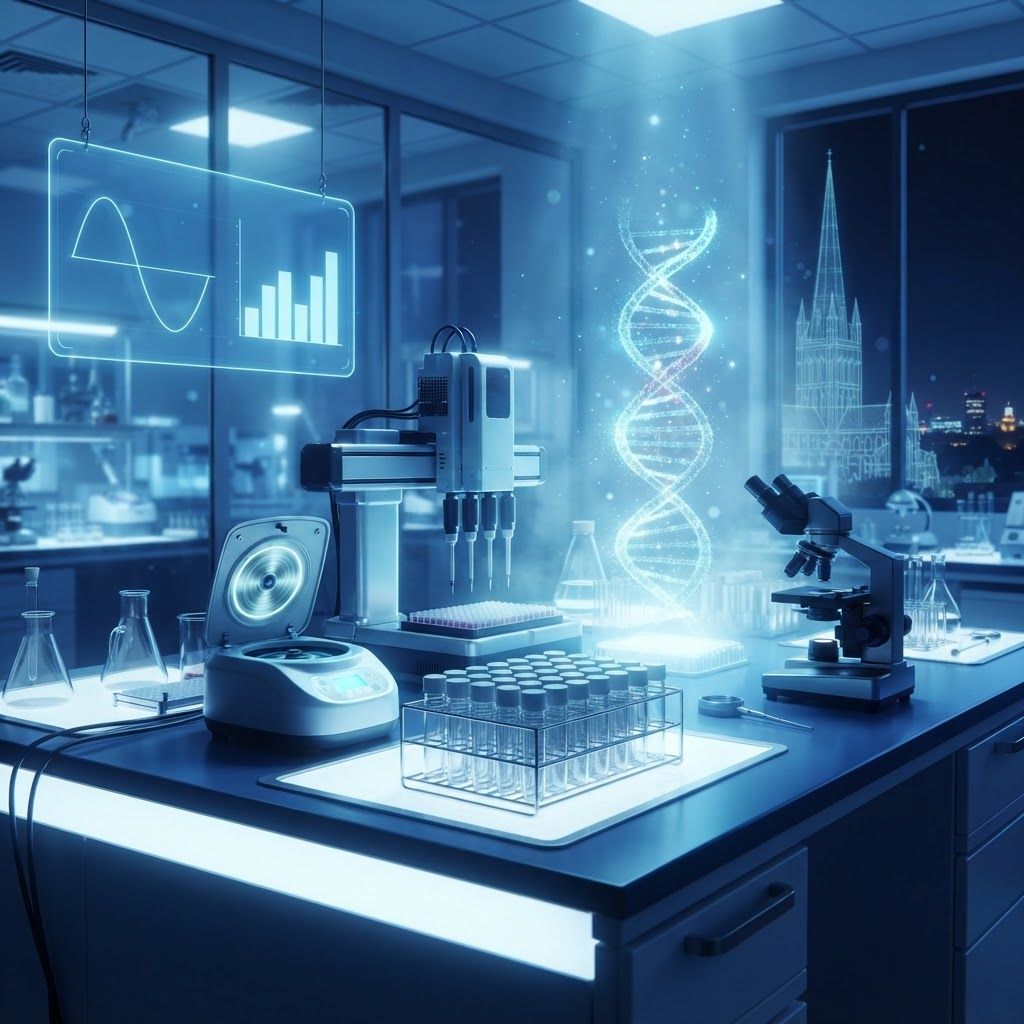
Why Diagnostics Matter So Much
Almost every significant clinical decision begins with a test. Blood chemistry, microbiology, histology, imaging and increasingly genomic analysis determine whether a condition is identified early enough to treat effectively. Diagnostic capacity has therefore become one of the most closely watched aspects of healthcare performance, and Norwich occupies an unusually strong position within it.
Two factors explain this. The first is the city's role as the acute healthcare centre for the whole of Norfolk, which concentrates laboratory and imaging infrastructure in Norwich rather than dispersing it. The second is the presence of Norwich Research Park, one of Europe's largest concentrations of research in food, health, genomics and plant science. The proximity of world-class research laboratories to a major teaching hospital creates genuine spillover benefits in technique, expertise and access to advanced analysis.
Understanding Different Types of Diagnostic Testing
Knowing what a test can and cannot tell you helps enormously.
Clinical biochemistry examines blood and other fluids for markers of organ function, metabolic state, inflammation, hormones and therapeutic drug levels. It answers most routine clinical questions and produces results quickly.
Haematology assesses blood cells and clotting, essential for investigating anaemia, infection, bleeding disorders and blood cancers.
Microbiology identifies bacteria, viruses, fungi and parasites, and critically determines antibiotic sensitivity. Culture takes time, which is why results are slower than blood chemistry.
Histopathology and cytology examine tissue and cells under microscopy, providing definitive diagnosis in cancer and many inflammatory conditions. This work is highly specialist and inherently unhurried.
Imaging covers radiography, ultrasound, computed tomography, magnetic resonance imaging and nuclear medicine, showing structure and increasingly function.
Genomic and molecular testing identifies genetic variants and pathogen genetic material, informing inherited disease diagnosis, cancer treatment selection and infection tracking.
A key point for patients: no test is perfect. False positives and false negatives occur, results must be interpreted alongside symptoms and examination, and a single abnormal value in isolation frequently means very little.
The Top 10 Diagnostic Labs in Norwich
1. Norfolk and Norwich University Hospital Pathology Services
The region's principal diagnostic laboratory complex provides biochemistry, haematology, microbiology, immunology, blood transfusion and histopathology for hospitals and general practices across Norfolk. Its scale, accreditation and integration with clinical teams make it the backbone of diagnostic provision in the county.
2. Norfolk and Norwich Radiology and Imaging Departments
Providing computed tomography, magnetic resonance imaging, ultrasound, radiography, mammography and interventional radiology, these departments handle both urgent and planned imaging for the region, supported by specialist reporting radiologists across multiple subspecialties.
3. Earlham Institute Genomic Analysis Facilities
Based at Norwich Research Park, the Earlham Institute operates advanced sequencing and computational genomics capability recognised internationally. While primarily research focused, its expertise and technology platforms have significant influence on genomic analysis capacity in the region.
4. Quadram Institute Microbiology and Sequencing Laboratories
Specialising in food, gut health and microbiome research, the Quadram Institute maintains sophisticated microbiological and sequencing facilities, including work on pathogen genomics and antimicrobial resistance that has direct public health relevance.
5. John Innes Centre Analytical Laboratories
Focused on plant and microbial science, the John Innes Centre operates high-specification imaging, metabolomics and molecular analysis facilities. Its methods and instrumentation contribute to the wider technical ecosystem at Norwich Research Park.
6. Norwich Private Blood Testing Clinics
Independent providers offer direct-access blood panels covering general health screening, hormones, thyroid function, vitamins, cholesterol and inflammatory markers, usually with rapid turnaround. They suit patients wanting proactive monitoring, though results are best reviewed with a clinician.
7. Spire Norwich Hospital Diagnostic Services
The city's independent hospital provides imaging, pathology and endoscopic diagnostics with short waiting times for privately funded and insured patients, including consultant-led investigation pathways.
8. Norwich Community Diagnostic and Phlebotomy Centres
Community-based sampling and diagnostic centres bring blood tests, basic imaging and monitoring closer to where people live. In a large rural county this substantially reduces travel and improves attendance rates.
9. Independent Imaging and Scanning Centres
Private imaging providers in and around Norwich offer magnetic resonance imaging, computed tomography and ultrasound, sometimes on a self-referral basis for specific scans. They provide useful additional capacity, particularly for musculoskeletal investigation.
10. Veterinary and Food Safety Testing Laboratories
Completing the list, Norfolk's agricultural and food production economy supports specialist laboratories for veterinary diagnostics, food microbiology, allergen testing and quality assurance. These facilities are essential to the region's food industry and to animal health surveillance.
Trends in Diagnostic Services
Community diagnostic capacity is expanding deliberately, moving testing out of acute hospitals to reduce waiting times and improve access, particularly for cancer pathways.
Genomic medicine is entering routine practice, with tumour profiling guiding cancer treatment and inherited disease panels replacing sequential single-gene testing.
Artificial intelligence support in imaging is growing, assisting with detection of subtle abnormalities and prioritising urgent scans for reporting, with the radiologist retaining clinical responsibility.
Point-of-care testing continues to spread, bringing rapid results to clinics and pharmacies for infection, inflammation and clotting markers, shortening decision times considerably.
Practical Guidance for Patients
Follow preparation instructions exactly, particularly fasting requirements and medication timing, since incorrect preparation invalidates many results. Ask when and how you will receive results, and who will explain them.
Request copies of your results and keep them, as trends over time are far more informative than single values. Be cautious with unregulated direct-to-consumer testing, which can generate anxiety over borderline findings of little clinical significance. If a result is abnormal, ask specifically what it means in the context of your symptoms, whether repeating it is appropriate, and what the next step is.
Finally, remember that reference ranges are statistical, not absolute. A slightly out-of-range value in an otherwise well person is frequently normal variation rather than disease.
Conclusion
Norwich offers diagnostic capability well beyond what a city of its size might suggest, thanks to the combination of a major teaching hospital and the internationally significant research laboratories of Norwich Research Park. Whether the requirement is routine blood chemistry, complex histopathology, advanced imaging or genomic sequencing, the expertise exists locally. For patients, the key is understanding what each test can reveal and ensuring results are interpreted properly rather than in isolation.
Want your brand featured in front of decision-makers? Publish a guest post or get a link insertion in our guides through AAMAX's guest post and link insertion service.
Helpful Links
 SponsoredAAMAX — Full-Service Digital Agency
Write for Us
Share your expertise with our readers. We welcome guest contributions from industry specialists.
Pitch your idea