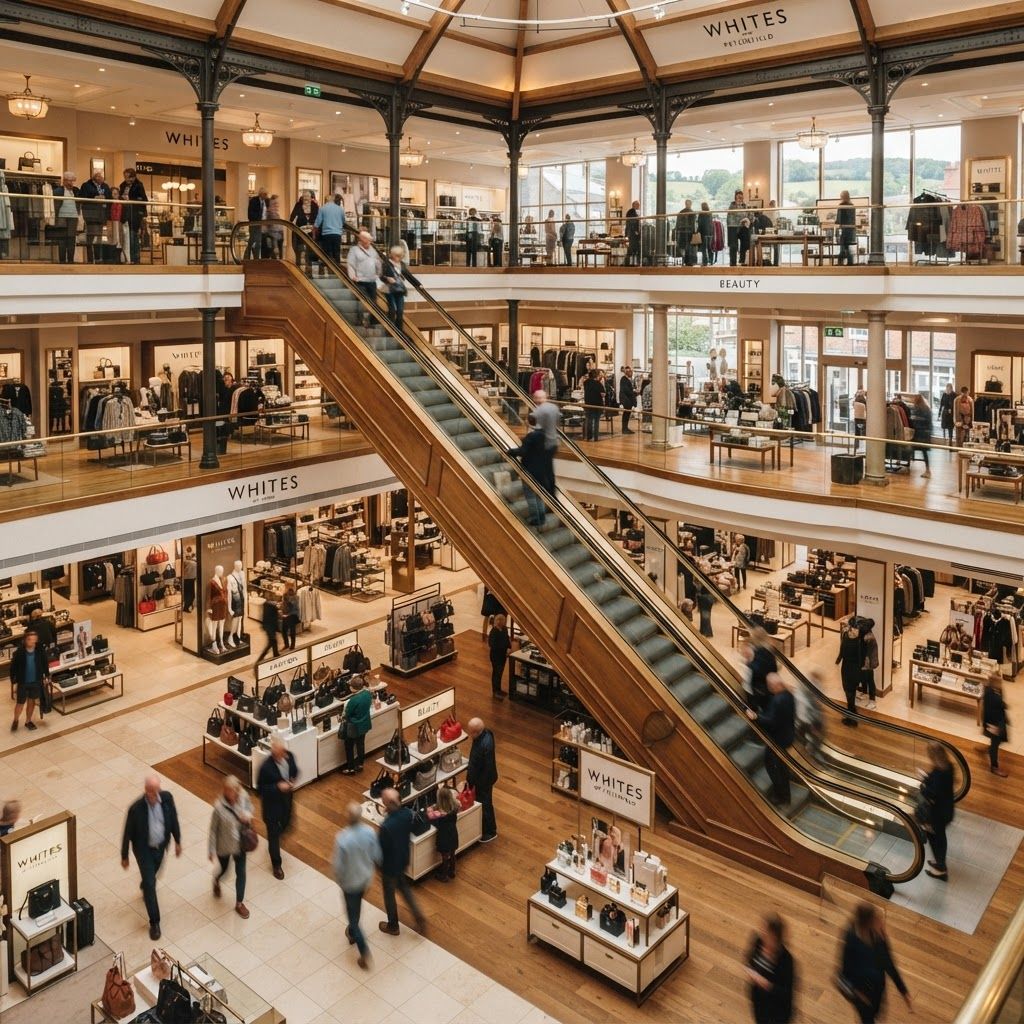
The Department Store in a Historic City
Department stores occupy an interesting position in Lancaster. The city has a compact, walkable centre built around historic streets, with the Marketgate shopping area providing covered retail space and a concentration of larger stores. Surrounding retail parks add out of town capacity, and the wider north west offers larger flagship stores within reasonable travelling distance.
What makes Lancaster distinctive is that the department store here competes not just with online retail but with a genuinely strong independent sector. Shoppers can find specialist bookshops, boutiques, delicatessens and homeware stores within a few minutes' walk, which means larger stores have to justify themselves through breadth, convenience and service rather than novelty alone.
Ten Department Stores and Large Format Retailers Serving Lancaster
1. Marks and Spencer functions as the city's most complete department store experience, combining clothing, homeware, beauty and one of the strongest food halls in the region. For many local shoppers it is the single most useful store in the centre, and its food offer drives regular footfall independently of its clothing ranges.
2. Debenhams occupied a central role in Lancaster retail for many years, and while the physical estate has changed considerably across the country, the brand continues online. Its former presence shaped local shopping habits and the redevelopment of large city centre retail space remains an ongoing conversation.
3. TK Maxx delivers a department store breadth of category, covering clothing, footwear, homeware, beauty and gifts, through a discount and discovery model. Its constantly changing stock encourages repeat visits and it performs strongly with students and value focused shoppers.
4. Next operates at department store scale in its larger formats, combining womenswear, menswear, childrenswear, footwear and an increasingly substantial home range. Its ordering system extends the effective range far beyond what any single store can stock.
5. Primark covers volume clothing, accessories, homeware and beauty at accessible prices. In a university city, its role is significant, particularly at the start of the academic year when students furnish accommodation and refresh wardrobes simultaneously.
6. Boots is more than a pharmacy in practice, functioning as a department store for health, beauty, fragrance, photographic services and gifting. Its beauty hall and healthcare services make it one of the most visited stores in the city centre.
7. Wilko style general merchandise retailers historically covered the household, cleaning, garden and stationery categories that traditional department stores once dominated, and this segment continues to serve practical everyday shopping needs across the city.
8. John Lewis, while not located within Lancaster itself, exerts real influence on local shopping behaviour. Many households travel for major purchases such as appliances, furniture and technology, drawn by service standards, guarantees and product curation.
9. Retail park anchor stores around Lancaster provide department store scale in specific categories, particularly homeware, electricals and furnishing. Free parking and easier access for bulky purchases give them an advantage over the historic city centre for certain trips.
10. Lancaster's independent department style stores and market traders deserve recognition. The city market and long established independent retailers collectively provide a comparable breadth of goods with far greater local character, and they remain an important part of how residents actually shop.
How the Format Is Changing
The traditional department store model, built on wide category coverage under one roof, has been under pressure for years. Online retail removed the convenience advantage, while specialist retailers offered greater depth in individual categories.
The stores succeeding in Lancaster have adapted in identifiable ways. Some have leaned into food, where physical retail retains a clear advantage. Others emphasise services that cannot be delivered online, such as fitting, beauty consultation, pharmacy provision and photographic printing. Several have integrated click and collect so effectively that the store functions as a fulfilment hub as much as a shop.
Experience has become a differentiator too. Cafes, events, personal shopping and seasonal displays give people a reason to visit that a website cannot match, which matters particularly in a city where the centre is pleasant to walk around.
What Makes a Good Department Store Visit
Layout and navigation matter enormously. Shoppers value clear signage, logical adjacencies and enough space to move with a pushchair or shopping bags. Fitting rooms with proper lighting and adequate provision significantly affect clothing conversion.
Staff knowledge remains a genuine differentiator. In beauty, electricals and homeware particularly, informed advice changes the purchasing experience entirely, and stores that invest in training see the benefit in customer loyalty.
Returns and exchange policies also shape behaviour. Generous, simple returns encourage larger baskets, and the ability to return online orders in store is now close to an expectation rather than a benefit.
Shopping Lancaster Strategically
For clothing basics and food, the city centre is efficient and pleasant, and the walk between stores is short. For bulky homeware, appliances and furniture, retail park locations with parking are more practical.
The city's independent sector is worth weaving into any shopping trip. Combining a department store visit with the market and nearby independents usually produces a better result than either alone, particularly for gifts, food and homeware with genuine character.
Timing helps too. Mid week mornings are considerably quieter, seasonal sale periods deliver real savings on homeware and clothing, and the run up to the academic year sees both increased choice and increased crowds.
The Outlook for Large Format Retail
Lancaster's city centre continues to evolve, with repurposing of large retail units an ongoing theme across British towns and cities. The likely direction is fewer, more focused large stores complemented by a stronger independent, food and leisure offer.
For shoppers, that is not necessarily a loss. A compact historic centre with a good market, strong independents, a solid food hall and a handful of well run larger stores arguably serves a city of this size better than a single dominant department store ever did.
Want your brand featured in front of decision-makers? Publish a guest post or get a link insertion in our guides through AAMAX's guest post and link insertion service.
Helpful Links
 SponsoredAAMAX — Full-Service Digital Agency
Write for Us
Share your expertise with our readers. We welcome guest contributions from industry specialists.
Pitch your idea