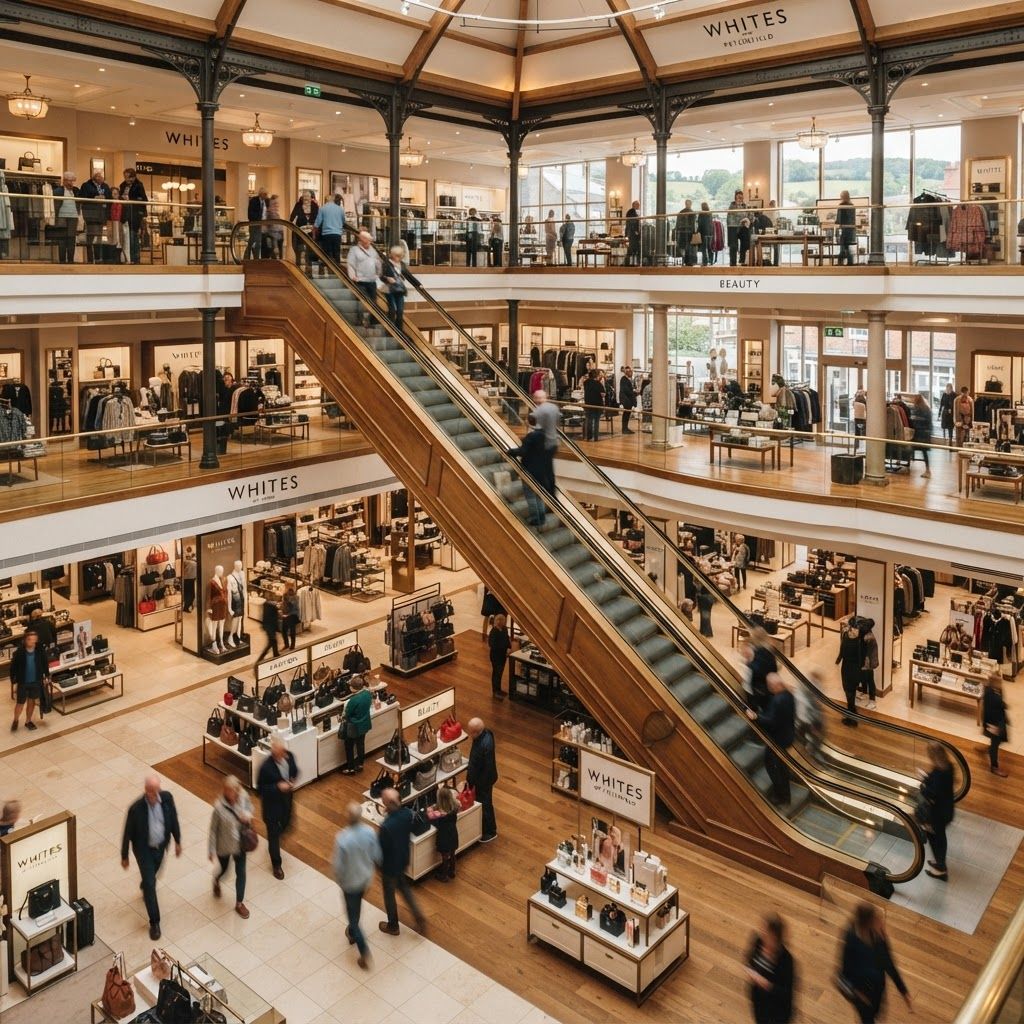
The Department Store in a Rural Region
The department store format has changed profoundly across the UK over the past two decades, and Dumfries and Galloway has felt those changes keenly. The closure of several national chains removed anchor stores from Scottish town centres, and in a region where the nearest large city is a considerable drive away, those losses were felt more sharply than in urban areas with abundant alternatives.
What has emerged is a different landscape. Rather than one or two large stores dominating, the region is served by a mix of national variety retailers, surviving independent multi-department businesses, retail park anchors and, crucially, a strong culture of independent specialists that collectively fulfil the role a department store once played.
Where the Region Shops
Dumfries functions as the principal retail centre, serving a wide catchment across Nithsdale and Annandale. Stranraer serves the Rhins and the western Machars, and also captures traffic connected to the Cairnryan ferry routes. Castle Douglas, Newton Stewart, Annan and Lockerbie support their local areas with smaller but often surprisingly complete retail offers.
Given the distances, shopping trips tend to be planned and comprehensive rather than casual. That behaviour favours locations where several needs can be met in one visit, which is precisely the department store proposition, whether delivered by a single store or a well-clustered town centre.
Leading Department Stores and Multi-Department Retailers
1. Marks and Spencer remains one of the most important anchors for the region. Its combination of clothing, homeware and a strong food hall delivers genuine department store breadth, and its quality positioning suits a customer base that values durability. For many households across the region, an M and S visit is the practical core of a shopping trip.
2. Dunelm has become the dominant homeware destination across much of Scotland. Its range across curtains, bedding, furniture, kitchenware and decorative items covers nearly everything the home department of a traditional store once provided, and its made-to-measure curtain service is widely used across the region's period properties.
3. Independent family department stores still operating in the region deserve particular recognition. Multi-generational businesses carrying clothing, footwear, haberdashery, gifts and household goods under one roof have survived by offering service standards and product knowledge that larger retailers cannot match, along with alteration services and personal account relationships.
4. TK Maxx occupies an interesting position as a de facto department store, offering clothing, footwear, homeware, accessories and gifts across a single floor. Its treasure-hunt model draws customers willing to travel, and the price positioning suits a region where value matters.
5. B and M and Home Bargains deliver broad general merchandise at low prices. While not department stores in the traditional sense, their range across household goods, garden, toys, seasonal items and food fills a similar role for everyday needs and has become central to how many households in the region shop.
6. The Range combines homeware, furniture, craft supplies, garden and DIY across a large floorplate. Its breadth is genuinely department-store-like, and the craft and hobby sections in particular serve a regional customer base with strong participation in making and crafting.
7. Retail park anchors around Dumfries collectively provide the department store experience through adjacency. Clothing, electricals, homeware and food retailers grouped within walking distance of one another allow a single trip to cover what one large store would have offered.
8. John Lewis through delivery and click-and-collect serves the region substantially despite having no local store. Its guarantee terms, product curation and reputation for after-sales service make it a default for significant household purchases, and collection points reduce the delivery friction that affects rural postcodes.
9. Garden centres with extensive retail offers across the region have quietly evolved into something close to department stores. Beyond plants, many now stock furniture, homeware, clothing, food halls and gifts, and their cafés make them a destination rather than an errand.
10. Independent town centre clusters in Castle Douglas, Kirkcudbright and Moniaive function collectively as distributed department stores. Castle Douglas in particular has built a reputation around independent food and specialist retail, and the concentration of quality independents within a short walk delivers variety that no single store in a town of that size could sustain.
How the Format Has Adapted
The traditional department store depended on footfall density that rural regions cannot generate. What has replaced it is a more distributed model where breadth comes from proximity between stores rather than departments within one building.
Services have become a differentiator. Alterations, curtain making, gift wrapping, click-and-collect, personal shopping and delivery to remote addresses all give physical retailers advantages that pure online competitors struggle to replicate.
Food and hospitality have become integral. Cafés and restaurants within or alongside retail turn a functional trip into a day out, which matters enormously when customers have travelled forty minutes to shop.
Experience-led retail has grown, with demonstrations, workshops and seasonal events used to give customers a reason to visit in person. Garden centres and independent stores have been notably effective at this.
Shopping Well Across the Region
Planning pays dividends. Checking stock availability online before travelling avoids wasted journeys, and many retailers now display live store stock levels.
Click-and-collect deserves more use than it gets in rural areas. Ordering online for collection in town combines the range of national retail with a single planned trip, and avoids both delivery charges and missed deliveries at properties with difficult access.
Supporting independents has a practical as well as sentimental logic. Independent multi-department stores that lose enough trade close permanently, and their replacement with nothing at all leaves residents travelling considerably further for basics.
For significant purchases, comparing total value rather than price alone is sensible. Delivery to a rural postcode, installation, returns handling and the ease of resolving a problem all carry real weight, and these are precisely the areas where established retailers with a local presence tend to perform best.
The Outlook
Department store retail in Dumfries and Galloway will not return to its twentieth century form, but the function it served is being delivered in new ways. The combination of strong national variety retailers, adaptable independents, garden centre destinations and improved online fulfilment has produced a retail landscape that, while different, covers most needs.
What continues to distinguish the region is the quality of its independent sector. In towns where a national chain would never open, family businesses carrying a genuinely broad range have sustained the department store principle of meeting many needs under one roof, and they remain among the most valuable retail assets the region has.
Want your brand featured in front of decision-makers? Publish a guest post or get a link insertion in our guides through AAMAX's guest post and link insertion service.
Helpful Links
 SponsoredAAMAX — Full-Service Digital Agency
Write for Us
Share your expertise with our readers. We welcome guest contributions from industry specialists.
Pitch your idea