

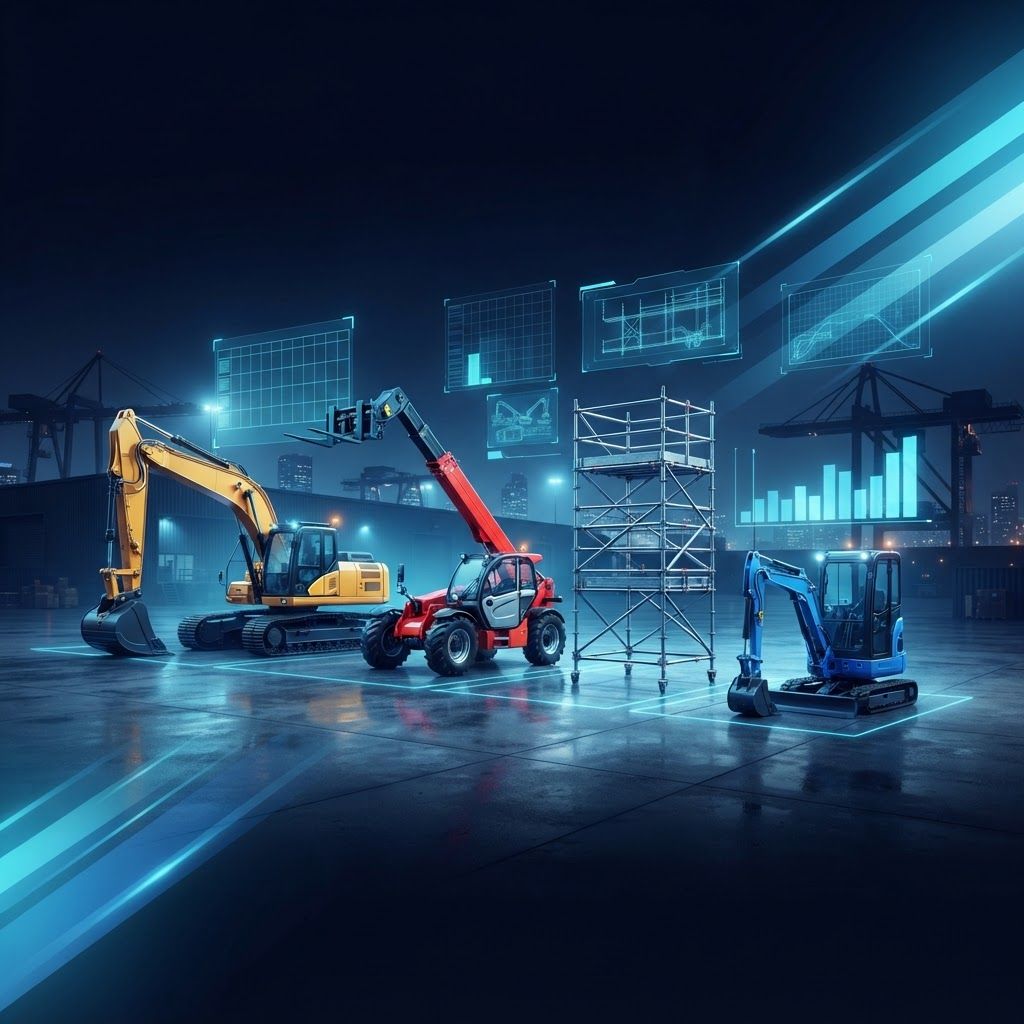
Why Rental Dominates Construction Equipment in Teesside
Construction plant is expensive to buy, expensive to maintain and expensive to store, and for most contractors it sits idle far more often than it works. Rental resolves that arithmetic. Rather than tying capital into a machine used a few weeks a year, a contractor pays for utilisation only, transferring maintenance, compliance testing, depreciation and storage to a specialist. In Stockton-on-Tees, where the contractor base is dominated by small and medium enterprises working across a wide variety of project types, this model is overwhelmingly the norm.
The borough's economic profile supports a deep rental market. Ongoing residential development at Ingleby Barwick and Wynyard drives demand for excavators, dumpers and compaction equipment. Industrial and process work along the Tees requires access platforms, lifting equipment, non-sparking tools and specialist environmental plant. Commercial fit-out generates demand for scaffold towers, dust extraction and temporary power. Domestic and landscaping work supports a steady tool hire trade. A well-run local hire company serves several of these markets simultaneously.
The Ten Best Construction Equipment Rental Companies
Tees Valley Plant Hire Ltd is the borough's broadest general plant provider, holding a fleet spanning mini excavators from under one tonne up to mid-range tracked machines, site dumpers, rollers, telehandlers and attachments. Its consistency comes from a disciplined replacement cycle, retiring machines before reliability declines, which matters far more to a contractor than headline daily rates.
Riverside Access Solutions specialises in working-at-height equipment, including scissor lifts, boom lifts, vertical mast platforms and spider lifts for confined access. All units come with current thorough examination certification, and the company provides familiarisation on delivery, which is a legal expectation frequently overlooked by cheaper suppliers.
Stockton Tool Hire Centre serves the small-tool market with breakers, disc cutters, mixers, floor saws, sanders and hand tools, backed by consumables supply. Its strength is availability and turnaround: for a tradesperson losing a day waiting for a tool, immediate counter availability outweighs a modest saving.
Billingham Industrial Plant Services focuses on the process and heavy industrial sector, supplying equipment suited to hazardous and regulated environments, including intrinsically safe lighting, air-driven tools, confined-space ventilation and gas detection, alongside heavier lifting plant.
Wynyard Site Services provides site establishment rather than machines: welfare units, offices, toilets, drying rooms, secure stores, fencing, hoarding and temporary lighting. Delivering a compliant site setup quickly is a distinct competency, and the company's understanding of welfare requirements under construction regulations makes it a common first call at project mobilisation.
Thornaby Power & Generation supplies temporary power, including diesel and increasingly hybrid and battery generators, transformers, distribution boards and site electrical equipment, along with load assessment advice so clients hire correctly sized units rather than defaulting to oversized machines that run inefficiently.
Norton Groundworks Equipment concentrates on the groundworks and drainage sector with trench shoring, pumps, compaction plant, laser levels and pipe-laying equipment. Its trench support offering is particularly valuable given the serious risk associated with unsupported excavation.
Teesside Crane & Lifting Hire supplies lifting equipment and contract lift services, including mobile cranes with operators, lifting accessories and appointed-person planning. Contract lifts, where the supplier takes responsibility for planning and execution, suit clients without in-house lifting competence.
Ingleby Landscaping & Garden Plant serves the domestic and landscaping market with turf cutters, chippers, rotavators, stump grinders and compact machines, with flexible weekend hire suited to smaller projects.
Hartburn Specialist Hire covers the less common requirements: environmental monitoring equipment, drying and dehumidification plant for water damage recovery, temporary heating, and surveying instruments, filling gaps that generalist depots do not stock.
How Rental Pricing Genuinely Works
Headline daily and weekly rates are only part of the cost, and comparing suppliers on rate alone frequently misleads. Weekly rates are typically far better value than daily rates, and monthly rates better again, so matching the hire period to realistic programme duration is the single largest lever on cost. Delivery and collection charges apply on most plant and can be significant for a short hire on a small machine, sometimes exceeding the rental itself.
Damage waiver or plant insurance is a further consideration. Hire agreements almost universally make the hirer responsible for the equipment while in their possession, including theft, and suppliers offer damage waiver schemes to cap that exposure. Contractors with their own hired-in plant insurance may decline the waiver, but doing so without cover in place is a serious commercial risk given that a stolen mini excavator represents a substantial replacement liability.
Fuel policy, cleaning charges and consumable costs such as breaker points and cutting discs should also be established at the outset. Reputable Stockton suppliers state these clearly in their terms, and vague answers at booking stage tend to precede disputed invoices.
Safety, Certification and Operator Competence
Plant hire sits within a substantial legal framework. Lifting equipment requires thorough examination at defined intervals under the lifting operations regulations, and access platforms and cranes must be supplied with current certification. Other work equipment falls under the provision and use of work equipment regulations, requiring it to be suitable, maintained and used by trained persons.
Critically, hiring equipment does not transfer operator competence. Excavators, telehandlers, dumpers and access platforms all require recognised operator training and, on most commercial sites, a valid competence card. Hire companies supply familiarisation on the specific machine but cannot substitute for underlying qualification. The better local suppliers verify competence before releasing higher-risk plant and will offer operated hire, supplying a trained operator with the machine, where a client lacks in-house capability. This is often the safer and ultimately cheaper route for occasional users.
Pre-use inspection remains the hirer's responsibility. Checking fluid levels, guards, hoses, tyres or tracks and control function before each shift catches most developing faults, and a good supplier provides a simple inspection record for this purpose.
Trends Reshaping Plant Hire
Electrification is advancing quickly. Battery-electric mini excavators, dumpers and access platforms are now commercially available, and demand is being driven by urban sites with noise restrictions, indoor and enclosed working where exhaust emissions are unacceptable, and clients with carbon reduction commitments. Hire fleets are the natural route for contractors to access this technology without committing capital to a rapidly evolving product category.
Telematics has become standard on mid-range and larger plant. Machines report location, hours, fuel consumption and fault codes, allowing suppliers to schedule maintenance accurately, recover stolen equipment and provide clients with utilisation data that supports better hire decisions. For contractors, this data increasingly informs whether to hire, contract hire or purchase.
Hybrid and alternative fuel power generation is displacing conventional diesel on many sites, with battery units handling low overnight loads and generators running only under demand, cutting fuel use and noise substantially.
Finally, digital booking has changed customer expectations. Online availability checking, digital agreements and photographic condition records at both ends of a hire reduce disputes and speed up mobilisation. The Stockton suppliers investing here are winning repeat business from contractors who value administrative simplicity as much as machine quality.
Choosing a Hire Partner
For occasional or domestic use, prioritise proximity, counter availability and clear terms. For contracting businesses, the calculation is different: fleet age, breakdown response time, availability during peak season and account terms matter far more than marginal rate differences, because a machine that fails mid-programme costs vastly more than it saves.
Ask about fleet replacement policy, confirm how quickly a breakdown is attended and whether a replacement machine is guaranteed, verify that certification is current, and clarify insurance and damage liability in writing. The construction equipment rental companies in Stockton-on-Tees that answer these questions confidently are the ones worth building a long-term relationship with.
Want your brand featured in front of decision-makers? Publish a guest post or get a link insertion in our guides through AAMAX's guest post and link insertion service.
Helpful Links
 SponsoredAAMAX — Full-Service Digital Agency
Write for Us
Share your expertise with our readers. We welcome guest contributions from industry specialists.
Pitch your idea

