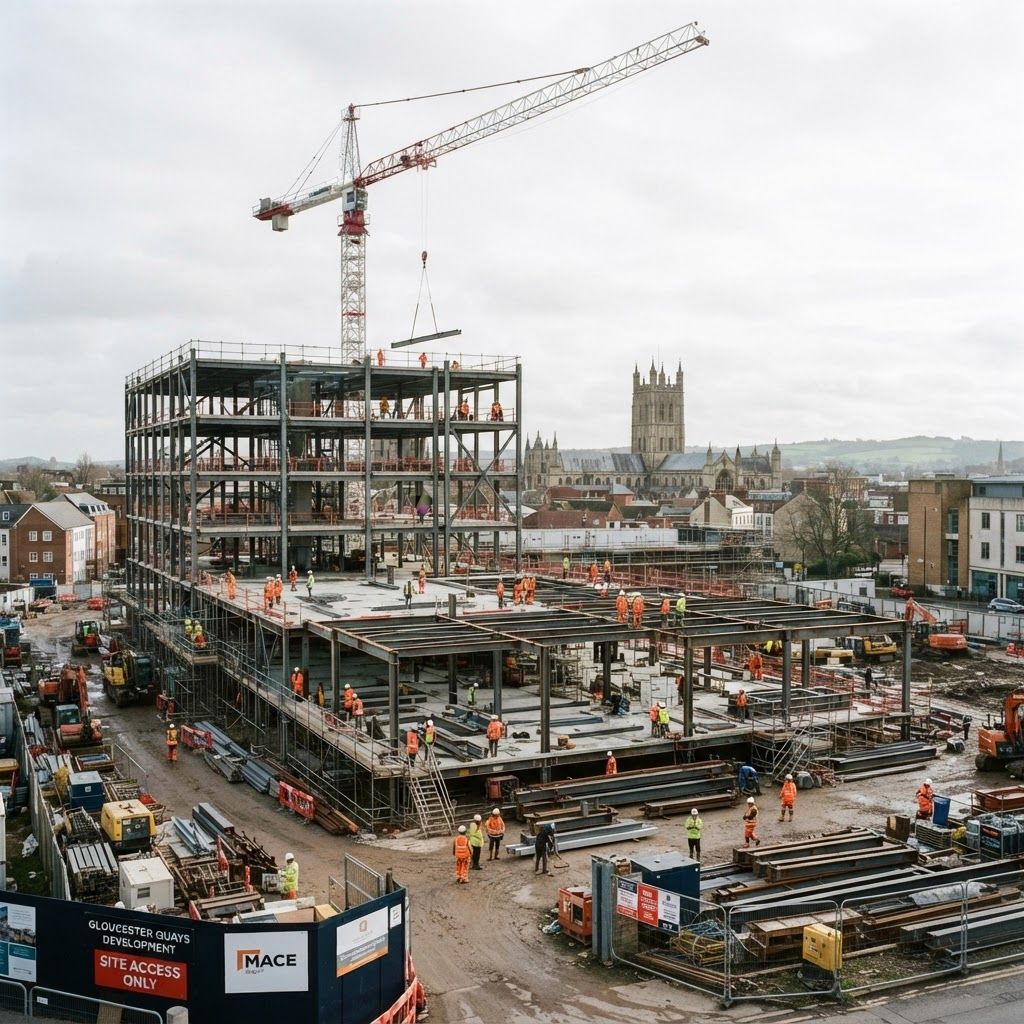
The Commercial Construction Picture in Gloucester
Gloucester's commercial construction sector is driven by its geography. The city sits directly on the M5 between Birmingham and Bristol, making it one of the most logistically attractive locations in the west of England. That has fuelled sustained demand for distribution warehousing, trade counters and light industrial units, particularly around Quedgeley, Barnwood and the business parks flanking the motorway.
Beyond logistics, the city has seen significant public sector investment in education and healthcare estates, continuing regeneration of the docks and city centre including leisure and retail schemes, and a steady flow of office refurbishment as occupiers adapt space to hybrid working patterns. Each of these requires different contractor capabilities.
What Commercial Clients Should Demand
Commercial construction is governed by contract far more rigorously than domestic work. Standard forms published by the Joint Contracts Tribunal or the New Engineering Contract suite allocate risk, define payment mechanisms and set out dispute procedures. A contractor comfortable operating under these forms is operating at a professional level.
Prequalification is standard practice. Constructionline registration, SafeContractor or CHAS accreditation, ISO 9001 quality management and ISO 14001 environmental management certification all indicate audited systems rather than informal practice. Financial standing should be verified, since contractor insolvency mid-project is among the most damaging outcomes a client can face.
Health and safety performance is equally important. Ask for accident frequency rates and evidence of Construction Design and Management Regulations compliance, including the appointment of a principal contractor and the production of a construction phase plan.
The Ten Best Commercial Construction Categories in Gloucester
1. Major Regional Main Contractors — Firms with established Gloucestershire operations delivering projects from one million pounds upwards. Their capability spans education, healthcare, commercial and industrial sectors, supported by in-house quantity surveying, planning and health and safety functions. Long-term framework relationships with public bodies are a strong quality signal.
2. Industrial and Distribution Warehouse Contractors — Specialists in steel portal frame construction, large-span roofing and cladding, power-floated industrial flooring, loading docks and yard works. Given Gloucester's logistics role, this is the most active commercial category. Programme certainty matters enormously because occupiers commit to lease dates.
3. Design and Build Contractors — Delivering single-point responsibility from outline brief to handover. For commercial clients this reduces interface risk and typically compresses the programme, since design and construction overlap. It works best where the client brief is clear and output specifications are well drafted.
4. Education Sector Specialists — Contractors experienced in schools, colleges and university buildings, including working on live campuses during term time. Phased delivery, strict safeguarding protocols, and the ability to complete critical works during holiday periods define competence in this sector.
5. Healthcare Construction Contractors — Building and refurbishing clinical environments requires specialist knowledge of infection control during construction, medical gas installation, specialist ventilation and compliance with health technical memoranda. Work in live hospital settings demands exceptional planning discipline.
6. Retail and Leisure Fit-Out Contractors — Serving Gloucester's city centre, the Quays and retail parks with shell adaptation, shopfronts, restaurant and bar construction and landlord works. Speed is the defining commercial pressure, as every week of construction is a week without trading revenue.
7. Office Refurbishment and Repurposing Contractors — Hybrid working has left many commercial buildings needing reconfiguration towards collaboration space, and some requiring conversion to alternative uses entirely. Contractors in this space combine construction with mechanical and electrical upgrade and often energy performance improvement.
8. Civil and Infrastructure Contractors — Delivering roads, car parks, drainage, attenuation systems and utility connections that underpin commercial development. In Gloucester, surface water management and flood resilience are particularly significant given the Severn's influence on the local water table.
9. Mechanical and Electrical Contractors — Increasingly central rather than subordinate, as building services now represent a large proportion of commercial project value. Expertise in heat pumps, building management systems, LED lighting controls, electric vehicle charging infrastructure and solar photovoltaic installation is in high demand.
10. Cost Consultants and Project Managers — Quantity surveying practices and project management consultancies based in Gloucester provide the client-side expertise that keeps commercial projects on budget. They prepare cost plans, run tender processes, administer contracts and value work in progress, and on any substantial project they typically save more than they cost.
Trends in Commercial Construction
Sustainability has moved from optional to commercially essential. Occupiers increasingly require BREEAM ratings and strong Energy Performance Certificate scores, and lenders and investors assess buildings on environmental credentials. Embodied carbon assessment is entering mainstream practice alongside operational energy.
Building safety reform has increased documentation requirements and competence expectations across the sector. The golden thread of building information is becoming standard practice rather than an aspiration, supported by building information modelling on larger schemes.
Off-site manufacture continues to grow, with modular plant rooms, prefabricated bathroom pods and volumetric units reducing site labour and improving quality consistency. Labour shortages in key trades remain the industry's most persistent constraint, and clients benefit from engaging contractors early rather than tendering at the last moment.
Procuring Successfully
Invest in the brief. Most commercial cost overruns originate in an incomplete client brief rather than contractor failure. Prequalify tenderers properly on financial standing, safety record and relevant sector experience. Use a recognised contract form and appoint a contract administrator. Build realistic contingency and float into both budget and programme. Engage with planning, building control and utility providers early, as utility connections in particular have long lead times.
Conclusion
Gloucester's commercial construction sector is well developed, with strong capability in industrial and distribution building, public sector work, fit-out and building services. Prequalify rigorously, procure under a proper contract, and involve cost and project management expertise from the outset. Discipline at the front end of a commercial project is what delivers certainty at the end of it.
Want your brand featured in front of decision-makers? Publish a guest post or get a link insertion in our guides through AAMAX's guest post and link insertion service.
Helpful Links
 SponsoredAAMAX — Full-Service Digital Agency
Write for Us
Share your expertise with our readers. We welcome guest contributions from industry specialists.
Pitch your idea