

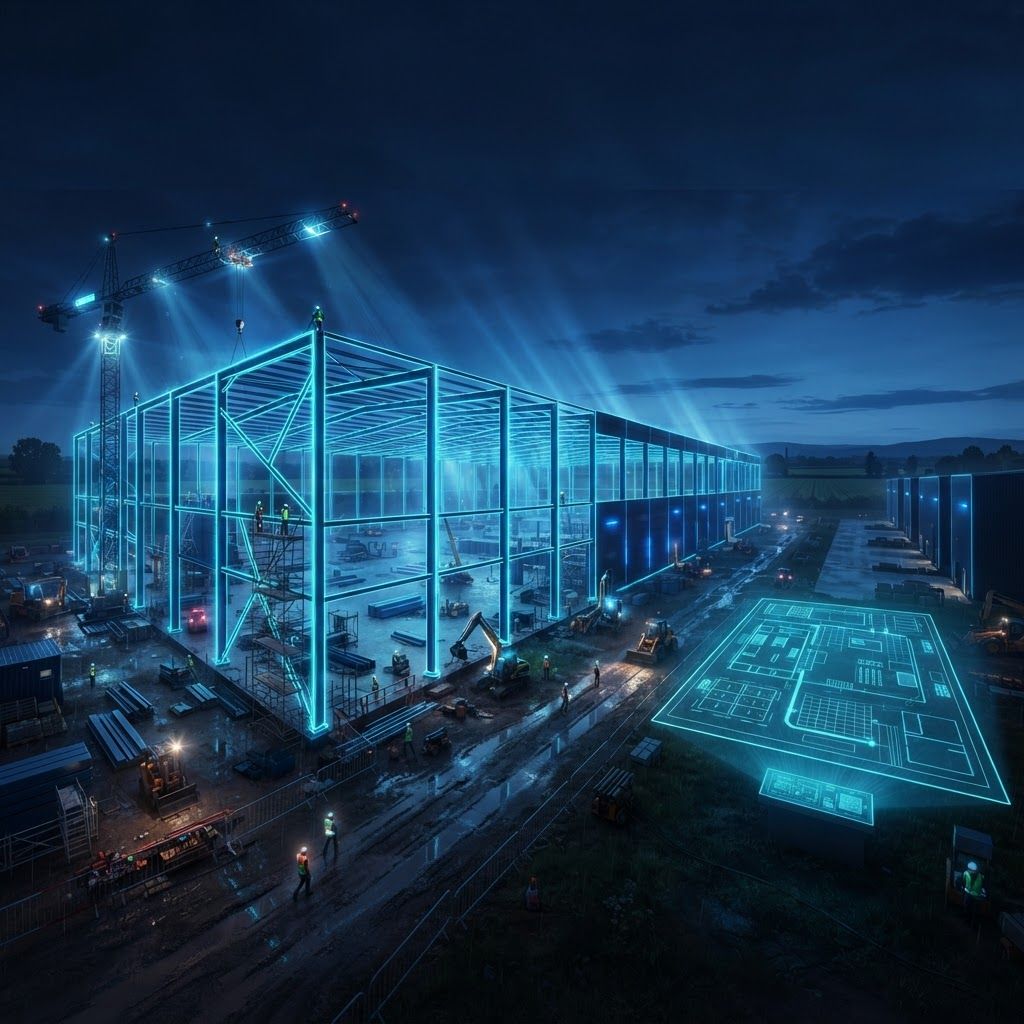
Commercial Construction in the Breckland Economy
Breckland's commercial building activity reflects its economic base. Agriculture and food processing require grain stores, packhouses, cold storage and machinery buildings. Manufacturing and engineering businesses in and around Thetford, Dereham and Attleborough need industrial units and workshop space. Logistics operators along the A11 and A47 corridors require warehousing and yard infrastructure. Alongside these sit retail units, offices, healthcare premises, education buildings, hospitality projects and community facilities.
Commercial work differs fundamentally from domestic construction. Programmes are tied to business operations, so delay carries direct trading cost. Compliance obligations are heavier, covering fire strategy, accessibility, energy performance certification and health and safety duties. Buildings must also anticipate change of use, expansion and evolving equipment requirements. The best contractors treat these as design questions rather than afterthoughts.
Top 10 Best Commercial Construction Companies in Breckland
1. Breckland Commercial Builders — The district's most complete commercial contractor, delivering industrial units, offices and mixed-use schemes. Strengths include structured programme reporting, robust subcontractor management and clear cost control through the construction phase.
2. Thetford Industrial Construction — Focused on steel frame industrial buildings, warehousing and production facilities. Experienced with heavy floor loadings, large door openings, craneage provision and phased construction around live operations.
3. Dereham Retail and Office Fit Out — Specialises in interior construction, covering shopfronts, partitioning, suspended ceilings, mechanical and electrical coordination and finishes. Frequently works overnight or in phases to keep premises trading.
4. Attleborough Agricultural Buildings — Delivers grain stores, livestock housing, machinery sheds and packhouses, with genuine understanding of ventilation, hygiene requirements, slurry management and seasonal construction windows around harvest.
5. Swaffham Steel Frame Contractors — Concentrates on portal frame design, fabrication and erection, cladding systems and concrete flooring. Attractive to clients wanting a fast, cost-efficient enclosure for storage or production use.
6. Watton Groundworks and Civils — Provides site preparation, drainage, hardstanding, yards, access roads and external works. Often the critical path element on rural commercial sites where drainage strategy and access are the hardest problems to solve.
7. Norfolk Commercial Refurbishment — Handles renovation and repurposing of existing commercial stock, including energy efficiency upgrades, roof replacement, cladding renewal and internal reconfiguration. Increasingly relevant as minimum energy standards for let property tighten.
8. Brecks Cold Storage and Food Facilities — Specialises in temperature-controlled construction, insulated panel systems, hygienic finishes and food-grade compliance. Serves the district's substantial food production and distribution sector.
9. Market Town Design and Build Commercial — Offers integrated design and construction under a single contract, including planning support, technical design and delivery. Attractive to businesses that need cost certainty and a single accountable party.
10. Breckland Sustainable Commercial Projects — Focused on low-carbon commercial construction, including high-performance building envelopes, solar photovoltaic integration, LED lighting design, heat pump systems and electric vehicle charging infrastructure.
Procurement Routes for Business Clients
The choice of procurement route materially affects risk allocation. Traditional procurement, with full design completed before tender, delivers strong cost certainty and detailed quality control but extends the pre-construction period. Design and build shortens the programme and places design responsibility with the contractor, which suits clients prioritising speed and single-point accountability. Construction management suits complex phased projects where the client wants direct control of specialist packages.
Whichever route is used, a properly drafted contract is essential. It should address programme and extension of time provisions, liquidated damages, valuation and payment cycles, variation procedure, retention, collateral warranties where a building will be let or sold, and defects liability.
Compliance and Regulation
Commercial projects carry significant statutory obligations. Construction design and management duties require the client to appoint competent designers and contractors and to ensure adequate planning for health and safety. Fire strategy must be developed early, as it influences layout, escape routes, compartmentation and structural protection. Accessibility requirements affect entrances, circulation, sanitary provision and parking. Energy performance obligations increasingly determine envelope specification and building services selection, particularly for property intended for letting.
Planning considerations in Breckland often involve highways access, landscaping, drainage strategy, ecology and, on rural sites, justification of development in the countryside. Early pre-application engagement typically saves months.
Controlling Cost and Programme
Commercial cost control depends on early definition of requirements. Late changes to layout, services capacity or equipment specification are the most expensive category of variation. Clients should therefore engage operational staff at design stage, not after construction begins.
Programme risk in the district frequently centres on groundworks and utilities. Winter excavation on heavy soils is slow, and electricity capacity upgrades can involve long lead times. Sequencing these early, and confirming utility timescales before setting an occupation date, prevents avoidable disruption to business planning.
Trends in the Local Commercial Market
Several developments are visible. Demand for warehousing and distribution space remains firm along the district's main road corridors. Energy retrofit of ageing industrial stock is accelerating, driven by both operating costs and letting standards. Solar generation and battery storage are increasingly specified at construction stage rather than added later. Electric vehicle charging provision has become a standard requirement for staff and fleet parking. Finally, food sector investment continues to support specialist cold storage and processing construction.
Final Thoughts
Breckland's commercial construction sector offers capability across industrial, agricultural, retail, food and refurbishment projects. Businesses achieve the best outcomes by defining operational requirements precisely, choosing a procurement route that matches their tolerance for risk and speed, resolving planning and utility constraints early, and appointing a contractor with demonstrable experience in the specific building type.
Want your brand featured in front of decision-makers? Publish a guest post or get a link insertion in our guides through AAMAX's guest post and link insertion service.
Helpful Links
 SponsoredAAMAX — Full-Service Digital Agency
Write for Us
Share your expertise with our readers. We welcome guest contributions from industry specialists.
Pitch your idea

