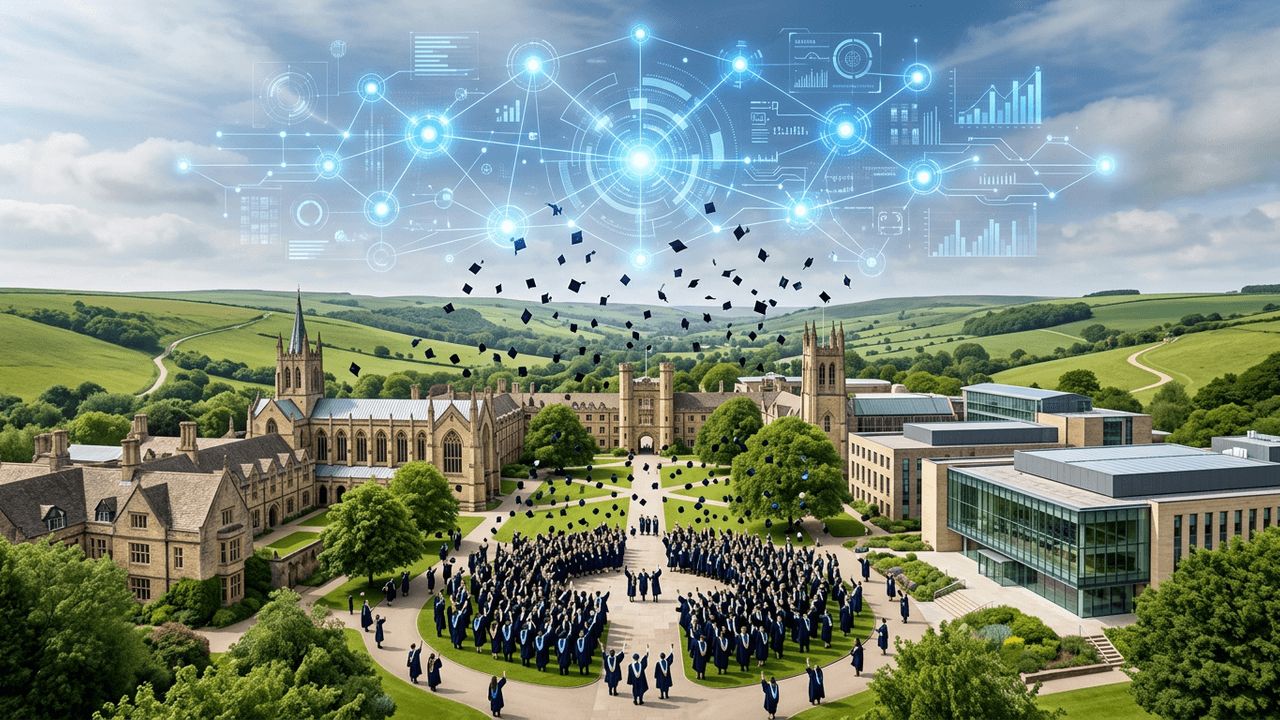
The Role of Colleges in Herefordshire
Further education carries particular weight in a rural county. For many Herefordshire students, the college years determine whether they stay in the county to build a career or leave for opportunities elsewhere. The local economy — food production, agriculture, engineering, construction, health and social care, hospitality and creative industries — depends heavily on colleges producing skilled, work-ready young people and retraining adults mid-career.
Herefordshire's post-16 landscape is smaller than that of a city region but surprisingly diverse. It includes a sixth form college with a national reputation, land-based education tied to the county's agricultural heartland, a distinctive art college tradition, and apprenticeship provision serving major local employers. Understanding the differences between academic, technical and land-based routes is the first step in choosing well.
Academic, Technical or Vocational: Choosing a Route
Students broadly face three pathways. A-levels through a sixth form college suit those aiming at competitive university courses and wanting breadth. T-levels and BTEC-style vocational qualifications suit students who learn best through applied, industry-linked study and want a direct route into employment or a technical degree. Apprenticeships combine paid employment with structured training, which appeals strongly in a county where practical skills carry real economic value.
The best decision depends on learning style, career clarity and, practically, on transport. Herefordshire's geography means that a course an hour's bus ride away is a materially different proposition from one in your own town.
The Ten Leading Colleges
1. Hereford Sixth Form College
The county's outstanding academic institution and one of the strongest sixth form colleges nationally. It offers an exceptionally broad A-level programme, specialist teaching, and a university progression record that includes consistent success at Russell Group universities, Oxbridge and competitive courses such as medicine and veterinary science. Its scale allows subject combinations that individual school sixth forms cannot match, and its enrichment programme is extensive.
2. Herefordshire, Ludlow and North Shropshire College
The principal general further education college for the region, delivering vocational qualifications, apprenticeships and adult education across multiple campuses. Its provision spans construction, engineering, motor vehicle, health and social care, hospitality, hairdressing and business, with strong employer partnerships that feed directly into local job markets. It is the backbone of technical education in Herefordshire.
3. Holme Lacy Campus
The land-based campus near Hereford delivers agriculture, horticulture, animal care, equine studies, countryside management and arboriculture. In a county defined by farming, orchards and land management, this provision is strategically vital. Practical facilities, working farm environments and industry placements are its defining strengths.
4. Hereford College of Arts
A specialist arts institution with a distinctive identity, offering further and higher education in art, design, ceramics, photography, illustration, jewellery, textiles, performing arts and media. Its studio-based culture, small cohorts and close tutor relationships give it a character quite unlike a general college, and it has a strong record of progression into creative industries and specialist art schools.
5. Hereford Cathedral School Sixth Form
The sixth form of the county's leading independent school offers a rigorous academic programme in a small-class environment. It appeals to families seeking continuity from the senior school, individualised university guidance, and the school's exceptional music and choral tradition alongside academic study.
6. John Kyrle High School Sixth Form, Ross-on-Wye
A well-established school-based sixth form serving the south of the county. It provides a broad A-level offer with the pastoral advantage of a familiar setting and smaller cohorts, and it saves Ross-on-Wye students a long daily commute to Hereford.
7. John Masefield High School Sixth Form, Ledbury
Serving east Herefordshire, this sixth form combines academic A-levels with notable strength in performing arts, drama and music. Its local accessibility is a significant practical benefit for Ledbury and Colwall families.
8. Bishop of Hereford's Bluecoat School Sixth Form
Attached to a large Hereford academy, this sixth form offers academic and applied courses within a values-led Church of England framework. Its breadth of extracurricular activity, established sports programmes and internal progression routes make it a straightforward choice for students already at the school.
9. Apprenticeship Training Providers Serving Herefordshire
A network of independent training providers delivers apprenticeship frameworks across engineering, food manufacturing, construction, business administration and care. Working with employers including cider producers, food processors, engineering firms and the NHS, these providers offer earn-while-you-learn routes that are increasingly competitive with traditional academic pathways.
10. Adult and Community Learning Provision
Herefordshire's adult education services deliver functional skills in English, maths and digital literacy, alongside professional qualifications and leisure courses. Delivered in community venues across market towns and villages, this provision is essential for career changers, returners to work and residents improving essential skills later in life.
Trends Shaping Further Education
T-levels are gradually reshaping technical education, offering substantial industry placements and a clearer line between vocational study and skilled employment. Herefordshire providers have engaged with these carefully, focusing on sectors where local employer demand is genuine.
Green skills represent a major growth area. Retrofit and insulation, heat pump installation, renewable energy, sustainable land management and regenerative agriculture all feature increasingly in Herefordshire curricula, reflecting both national policy and the county's environmental economy.
Digital delivery has matured beyond emergency remote teaching into blended models that genuinely help rural students, reducing travel burden for theory components while preserving hands-on workshop time. Higher-level apprenticeships and degree apprenticeships are also expanding, allowing students to reach degree-level qualifications without leaving the county or accumulating full tuition debt.
How to Choose the Right College
Attend open events and speak to current students rather than only staff. Examine progression data honestly: where do students actually go after the course, and does that match your ambition? For vocational courses, inspect the workshops and equipment, since the quality of facilities directly shapes employability.
Investigate transport thoroughly. Bus timetables, college transport schemes and travel bursaries can make or break attendance. Consider the total journey time over two years, not just the novelty of the first week.
Finally, think about environment. A large general college offers breadth and independence; a specialist institution like Hereford College of Arts offers immersion and identity; a school sixth form offers familiarity and close support. Each suits a different kind of learner.
Final Thoughts
Herefordshire's colleges cover an impressive spread for a county of its size, from a nationally strong academic sixth form to specialist arts and land-based provision. The county's real advantage is that these institutions are closely connected to local employers and the landscape itself, giving students a route into meaningful work without necessarily leaving the area.
Want your brand featured in front of decision-makers? Publish a guest post or get a link insertion in our guides through AAMAX's guest post and link insertion service.
Helpful Links
 SponsoredAAMAX — Full-Service Digital Agency
Write for Us
Share your expertise with our readers. We welcome guest contributions from industry specialists.
Pitch your idea