

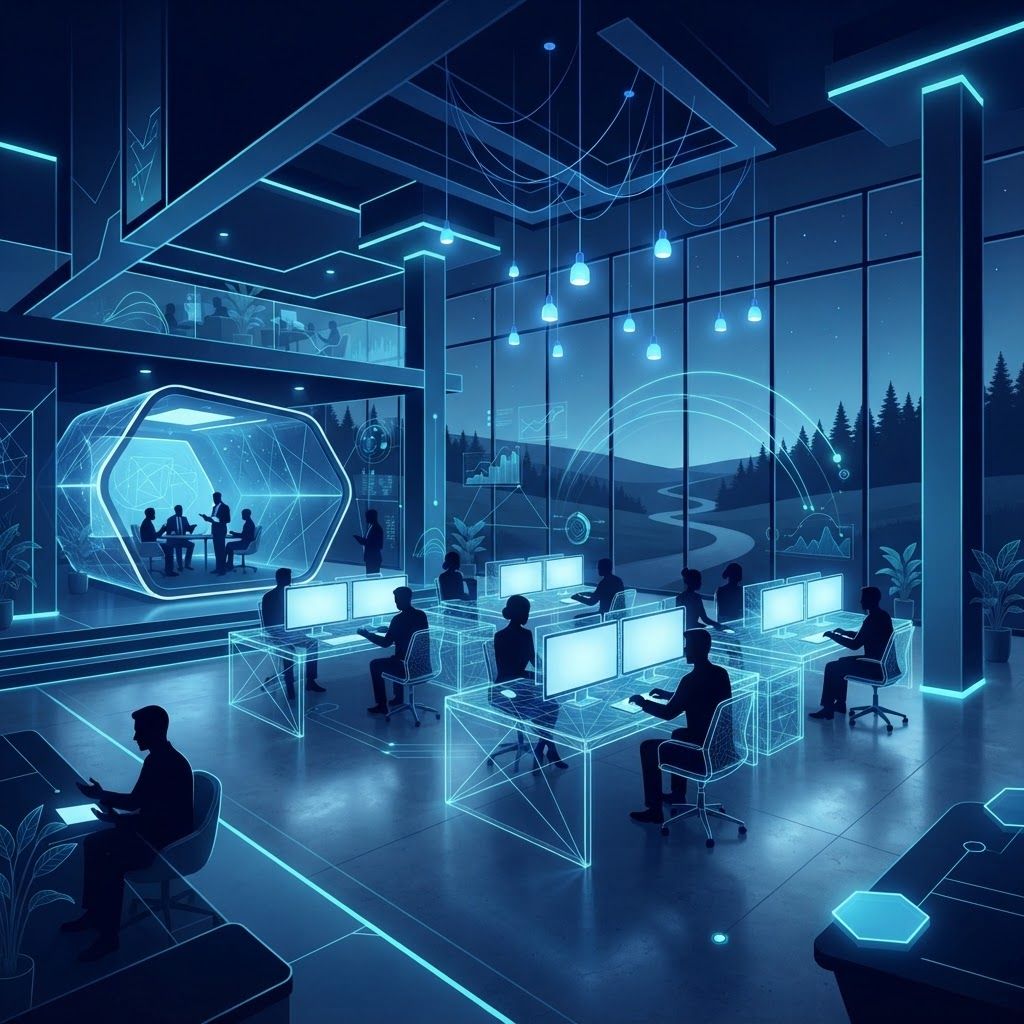
Why Flexible Workspace Took Hold Here
South Cambridgeshire was unusually well positioned to benefit from the shift to hybrid working. The district has always had a large population of highly skilled professionals commuting into Cambridge, and once that daily journey became optional for two or three days each week, demand emerged for somewhere to work that was neither the kitchen table nor a forty minute commute away.
At the same time, the district's science parks were developing flexible provision for a different reason. Early-stage biotechnology and technology companies need laboratory and office space without committing to a ten year lease, and they need the ability to expand from three people to thirty without moving. Science park operators responded with incubation and scale-up accommodation that functions much like co-working with technical infrastructure attached.
The result is a genuinely varied local market: village hubs serving hybrid workers and freelancers, campus-based flexible space serving science and technology companies, and everything from a desk in a village hall to a fully serviced laboratory suite.
What Distinguishes a Good Space
The photographs never tell you what matters. Connectivity is the single most important factor, and it means both raw bandwidth and reliability, ideally with a business-grade connection and backup rather than a domestic broadband line shared among forty people. Acoustic design matters enormously, because an attractive open space with hard surfaces and no soundproofed call areas becomes unusable when three people take video calls simultaneously.
Beyond that, consider whether there are genuinely private call and meeting rooms rather than glass boxes, whether desks are properly sized with adjustable chairs and monitor provision, whether the space is staffed, and whether opening hours suit your actual working pattern. Parking availability is a practical necessity in most of this district, where public transport between villages is limited. And consider the community: some spaces cultivate genuine professional networks, while others are simply desks in a room.
1. Babraham Research Campus Incubation and Flexible Space
Babraham provides some of the most specialised flexible accommodation in the district, combining office space with laboratory provision for early-stage bioscience companies. The value proposition extends well beyond space: proximity to institute research capability, shared equipment access, and a cluster of technically adjacent companies that generates genuine collaboration and recruitment opportunity. For a life science startup, this environment is difficult to replicate.
2. Granta Park Flexible Business Accommodation
Granta Park at Great Abington offers serviced and flexible office provision within a landscaped parkland campus that also hosts major pharmaceutical and life science occupiers. The setting is exceptional, with substantial amenity provision, and the co-location with large corporate occupiers has real business development value for smaller companies serving that market.
3. Wellcome Genome Campus Enterprise Space
At Hinxton, the campus provides accommodation for genomics, bioinformatics and data-focused companies alongside major research institutes. For companies working in genomic data, sequencing applications or computational biology, being physically embedded in this environment offers access to expertise and talent that no generic co-working space can provide.
4. Melbourn Science Park
Serving the southern part of the district, Melbourn Science Park provides office and technical accommodation with a focus on technology, engineering and instrumentation companies. Its scale is more human than the largest campuses, which suits companies that want a professional environment without the corporate formality, and its A10 corridor position works well for staff living towards Royston and Hertfordshire.
5. Cambourne Business Park Flexible Offices
Cambourne's business park provision includes serviced and flexible office options that are particularly convenient for the growing residential population of Cambourne, Bourn and the western villages. For a resident of Cambourne, working ten minutes from home in a professional environment with meeting rooms and reliable connectivity is a materially better arrangement than either commuting to Cambridge or working from a spare bedroom.
6. Cambridge Research Park at Waterbeach
Serving the northern part of the district, this park provides office and laboratory accommodation with flexible options. Its position is strategically useful as Waterbeach's new town develops, and the combination of technical space with good road access towards the A10 and A14 suits companies with logistics or field-based operations alongside office functions.
7. Village Hub and Community Co-working Initiatives
A genuinely important category in this district. Village halls, community centres, church halls and repurposed rural buildings across Sawston, Melbourn, Histon, Linton, Cottenham and elsewhere have established co-working sessions, sometimes weekly, sometimes permanent. The offer is modest, typically a desk, decent wifi and coffee, but the benefit is substantial: local walkable workspace and connection with other residents working from home. For freelancers and remote employees, these initiatives address professional isolation as much as workspace need.
8. Farm Diversification and Barn Conversion Workspaces
Rural diversification has produced some of the district's most distinctive workspace. Converted barns, granaries and farm buildings across South Cambridgeshire now house studios, workshops and small office suites. These appeal particularly to creative businesses, designers, consultants and craft enterprises who value character, quiet and generous space over city centre proximity. Parking is abundant and rents are typically well below urban equivalents.
9. Cambridge City Flexible Workspace Providers
Although outside the district proper, the flexible workspace operators in central Cambridge and on the Biomedical Campus serve many South Cambridgeshire residents who want city centre presence for client meetings while working locally most of the week. Hybrid memberships combining a village base with occasional city access have become a common pattern.
10. Hotel, Pub and Café Based Work Facilities
Several hotels and larger pubs across the district have adapted to daytime working demand, offering day passes, reliable wifi, meeting room hire and a professional-enough environment for calls. This informal end of the market is genuinely useful for occasional needs, particularly for meeting a client somewhere presentable without committing to a membership.
Trends in Flexible Workspace
Several shifts are shaping provision. Membership flexibility has increased substantially, with day passes and part-time packages replacing rigid monthly desk rental. Meeting room demand has risen relative to desk demand, as hybrid teams use offices primarily for collaboration rather than solo work. Laboratory co-working has emerged as a distinct category in this district specifically, offering shared equipment and containment facilities to companies that could never fund their own. Amenity expectations have risen, with showers, cycle storage and quality catering now standard rather than premium. And environmental credentials increasingly influence choice, particularly for companies with their own net zero commitments.
How to Choose
Trial before committing. Almost all providers offer day passes, and a single day tells you more than any tour, particularly about noise levels and connectivity at busy times. Test the wifi speed yourself rather than accepting a quoted figure. Visit at your normal working time, not at a quiet hour. Check how meeting rooms are booked and whether your membership includes any allocation or whether every booking is chargeable.
Consider the total cost including parking, and calculate the real comparison against working from home plus occasional coffee shop use. And weigh the community dimension honestly: if you want a professional network, choose a space with genuine events and an active member base, but if you simply want quiet and reliable connectivity, a barn conversion with three other tenants may suit you far better than a busy hub.
South Cambridgeshire's flexible workspace market is one of the better developed for a rural district, precisely because its residents include so many people whose work can happen anywhere with a good connection.
Want your brand featured in front of decision-makers? Publish a guest post or get a link insertion in our guides through AAMAX's guest post and link insertion service.
Helpful Links
 SponsoredAAMAX — Full-Service Digital Agency
Write for Us
Share your expertise with our readers. We welcome guest contributions from industry specialists.
Pitch your idea

