

Why Co-working Has Taken Hold in East Hampshire
The shift to hybrid working changed the geography of the office. When attendance in a central London or Portsmouth headquarters dropped to two or three days a week, the value of living in a beautiful district with a long commute increased sharply — provided there was somewhere decent to work on the other days. East Hampshire has benefited from this more than most.
The district has the right ingredients. Petersfield offers a direct rail service to London Waterloo and a walkable town centre. Alton combines a rail connection with an established business base and lower occupancy costs. Whitehill and Bordon's regeneration has delivered purpose-built modern workspace as part of a deliberate strategy to create local employment rather than a dormitory town. And across the rural parts of the district, converted barns and farm buildings have become some of the most appealing workspaces anywhere in Hampshire.
The demand profile is distinctive too. Rather than venture-funded startups, East Hampshire's flexible workspace serves consultants, creative professionals, remote employees of London firms, small professional services practices and growing local businesses that want an office without a fifteen-year lease.
The Ten Formats Available Across the District
Purpose-built business centres offer serviced private offices on flexible licences, with reception, meeting rooms, cleaning, utilities and broadband bundled into a single monthly fee. For a team of four to twenty, this remains the most practical option, removing lease liability, dilapidations risk and fit-out cost entirely.
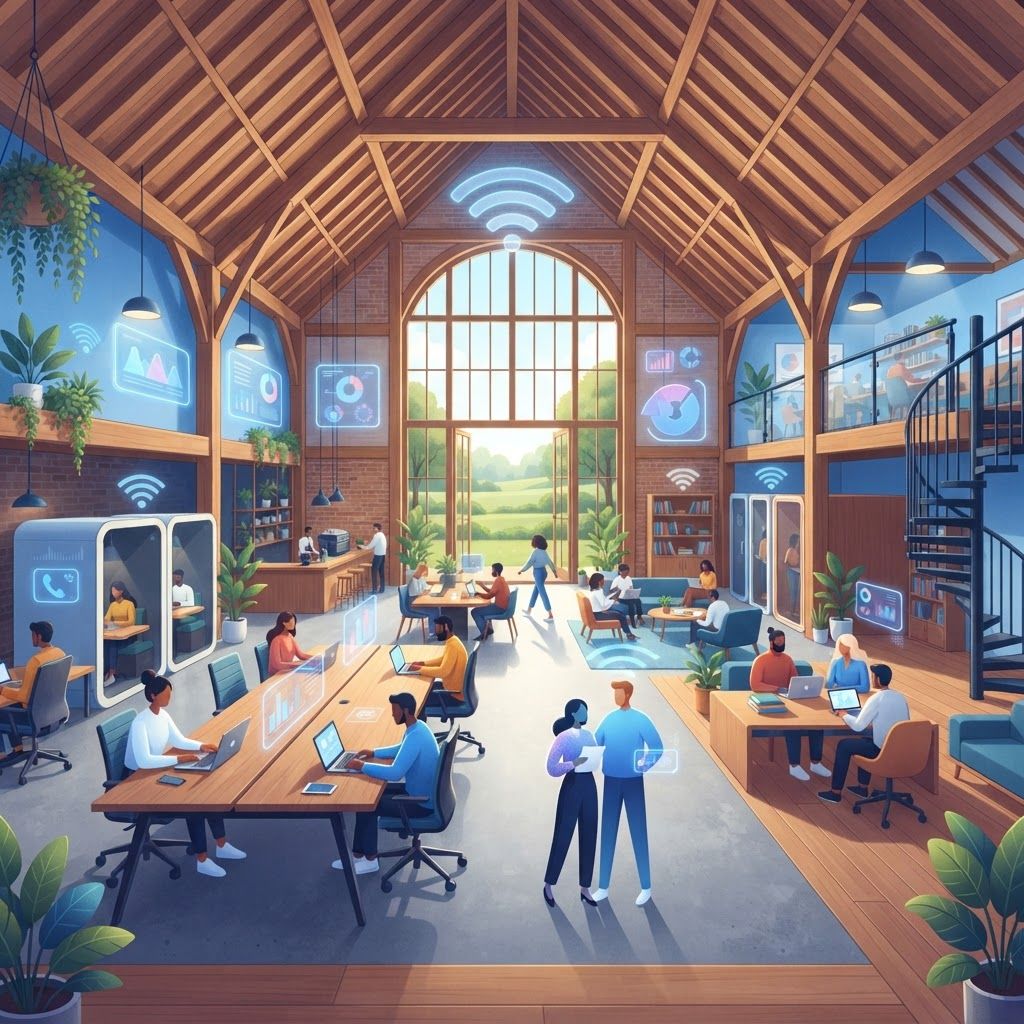
Rural barn and farm building conversions represent East Hampshire's signature workspace product. Landed estates and farm diversification projects across the district have converted redundant agricultural buildings into characterful studios and offices, typically with generous parking, exposed timber and immediate access to countryside. For creative businesses and consultancies, the setting is a genuine recruitment and client-hosting advantage.
Town centre co-working lounges in Alton and Petersfield provide hot desking, fixed desks and day passes in an open-plan environment. These suit freelancers and remote workers who want separation between home and work without committing to a private office, and their community events often generate genuine local business.
Managed workspace within larger commercial buildings allows occupiers of small suites to share reception, meeting rooms and kitchen facilities with other tenants. It sits between full serviced office and conventional lease, often at lower cost than the former.
Enterprise and innovation centres, frequently supported by local authority or economic partnership funding, combine affordable workspace with business support, mentoring and grant signposting. For early-stage businesses in the district, the advisory component can matter more than the desk.
Light industrial and workshop co-working serves makers, craftspeople, furniture restorers and small manufacturers. East Hampshire has a strong tradition in these trades, and shared workshop units with communal equipment offer a route in without heavy capital outlay.
Hotel and pub workspaces have expanded as hospitality businesses monetised quiet daytime hours. Several country hotels and gastropubs across the district now offer day-rate desk access with food and coffee, which suits occasional users and informal client meetings.
Library and public sector spaces provided through Hampshire County Council's library network offer free or very low-cost study and work areas with wifi and bookable rooms. For students, jobseekers and occasional users, these are genuinely valuable and frequently overlooked.
Village halls and community hubs in settlements including Four Marks, Liss, Clanfield and Rowlands Castle increasingly host regular co-working sessions. These reduce isolation for rural home workers and strengthen village economies at the same time.
Garden office and home studio providers serve a different but related need. For many East Hampshire residents on larger plots, a dedicated garden office delivers permanent workspace without a commute, and specialist suppliers across Hampshire design and install these to a high standard.
What to Evaluate Before Committing
Connectivity is the first test and the one most often assumed rather than checked. Ask for the actual upload speed, not just the download figure, because video calls and large file transfers depend on it. Establish whether the connection is a dedicated leased line or a shared consumer broadband service, and what the contingency is if it fails. In rural locations this question is not academic.
Acoustics matter enormously in practice. Open-plan spaces with hard surfaces and no soft furnishing become unworkable once several people are on calls. Look for dedicated phone booths and check whether meeting rooms are genuinely sound-isolated. Visit during a busy period rather than a quiet one.
Read the licence terms carefully. Notice periods vary from one month to twelve, and the flexibility you are paying for should actually exist. Check what is included: printing, meeting room hours, refreshments, and whether mail handling and a registered business address are available. Confirm access hours, since some spaces are staffed-hours only while others provide twenty-four hour fob access.
Practical details make a surprising difference in this district. Parking availability is critical given limited public transport across rural East Hampshire, and secure cycle storage with showers matters to a meaningful minority. Distance from a railway station affects how easily clients and colleagues can reach you.
Trends Shaping Flexible Workspace Locally
Hub-and-spoke arrangements are growing, with employers headquartered in London, Guildford or Portsmouth buying blocks of desk credits so staff can work locally two or three days a week. This has brought corporate demand into small-town workspace for the first time.
Sustainability credentials are becoming a selection criterion, with occupiers asking about EPC ratings, renewable electricity, heat pumps and EV charging. Rural conversions with solar arrays are well positioned here.
Wellbeing-led design — natural light, biophilic planting, walking routes from the door — is a genuine East Hampshire advantage. A space that opens onto the South Downs offers something no city centre can replicate.
Final Thoughts
Co-working in East Hampshire is not a compromise for people who cannot reach a city office. For a growing number of professionals it is a deliberate choice: better light, shorter commutes, lower costs and a working day that ends with countryside rather than a train. The right space is the one whose connectivity, acoustics and community genuinely match how you work, so visit several, use a day pass first, and choose on experience rather than photographs.
Want your brand featured in front of decision-makers? Publish a guest post or get a link insertion in our guides through AAMAX's guest post and link insertion service.
Helpful Links
 SponsoredAAMAX — Full-Service Digital Agency
Write for Us
Share your expertise with our readers. We welcome guest contributions from industry specialists.
Pitch your idea

