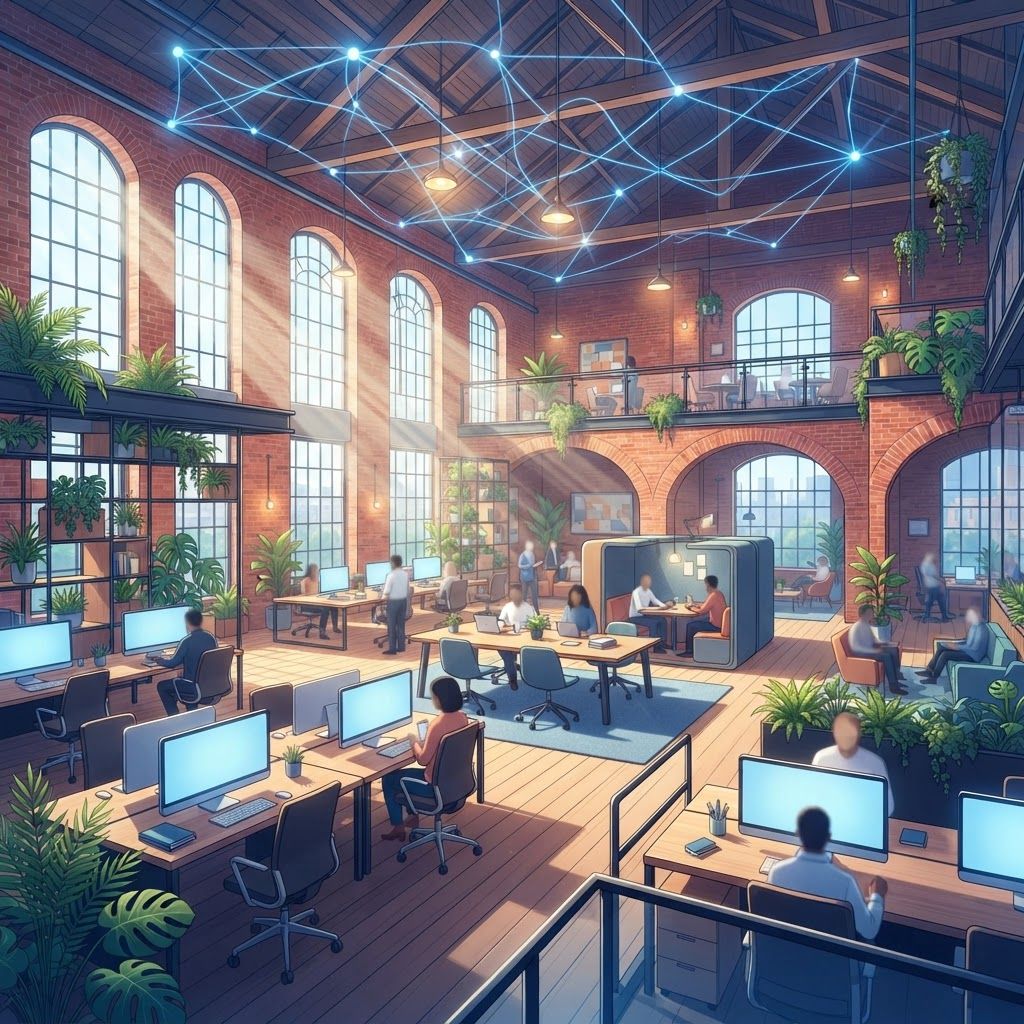
Flexible Workspace Reaches East Lancashire
Co-working began as a metropolitan phenomenon, concentrated in Manchester, Leeds and central London, and for years towns like Blackburn had little provision beyond conventional serviced offices. That has changed substantially. Hybrid working permanently redistributed where people work, and a significant number of Blackburn with Darwen residents who commuted daily to Manchester or Preston now work locally for part of the week. That created genuine demand for professional workspace outside the home and outside the corporate office.
The borough is well positioned for this shift. Its housing costs are low, its road connectivity is good, and its stock of former mill buildings provides exactly the kind of characterful, high-ceilinged industrial space that converts well to flexible workspace. Blackburn town centre regeneration has reinforced this, with public investment supporting business space alongside retail and leisure repositioning.
Ten Workspace Options in the Borough
Blackburn Enterprise Centre functions as a cornerstone of local business support, providing offices, workshops and flexible space alongside business advice and networking. Its combination of affordable space and genuine support infrastructure makes it particularly valuable for first-time business owners who need more than a desk.
Cotton Exchange Workspace represents the mill conversion model, offering co-working desks and private studios within a converted industrial building in central Blackburn. The architectural quality of these spaces, with exposed brick, timber beams and large windows, delivers an environment that new-build offices rarely match, and the character has real value for client-facing businesses.
Darwen Business Hub serves the southern borough with flexible desks, meeting rooms and small private offices. Darwen has a distinct business community, and having provision locally means residents avoid travelling into Blackburn for workspace, which is precisely the convenience hybrid workers are seeking.
The Mill Works provides creative-oriented studio and desk space suited to designers, photographers, digital agencies and craft businesses. Creative clusters generate collaboration and referral between members that generic office space does not, and the tenant mix is a genuine part of the offer.
Barnfield Business Centre offers serviced office and flexible workspace within the Barnfield Group's local portfolio. Its appeal lies in professional standard accommodation with straightforward all-inclusive terms, which suits established small businesses wanting reliability over community atmosphere.
Blackburn Central Library and community workspace provision deserves mention because free and low-cost desk space with reliable connectivity has genuine value for freelancers and students at the earliest stages, before revenue supports a paid membership.
Whitebirk Business Park flexible units provide small business units and office suites near the M65, appealing to businesses combining office function with storage, light assembly or vehicle-based operation. This hybrid requirement is common among local trades and product businesses and is poorly served by desk-only co-working.
Northlight and East Lancashire creative workspace network represents the broader regional flexible workspace ecosystem accessible to borough residents, with mill-based creative and business space across East Lancashire. For members who travel, network access across multiple sites adds practical value.
Blackburn Digital Hub focuses on technology and digital businesses, providing desk space with strong connectivity alongside events and skills provision. Digital-focused spaces typically invest more heavily in bandwidth resilience and power provision, which matters for developers and video-heavy work.
Pennine Coworking Darwen operates as a smaller independent space emphasising community and flexibility, with month-to-month membership and a collaborative member culture. Independent spaces of this scale offer more direct relationship with operators and greater willingness to accommodate unusual requirements.
Matching a Space to Your Working Pattern
The most common mistake is buying more access than you use. Consider honestly how many days each week you will attend. Someone working from a space one or two days weekly is far better served by a day pass bundle or part-time membership than a full-time dedicated desk, and the cost difference is substantial across a year.
Consider what you actually need from the environment. If your work involves frequent calls and video meetings, prioritise spaces with adequate phone booths and bookable meeting rooms, because open-plan co-working with insufficient private space makes call-heavy work genuinely difficult and irritates other members. If your work is focused solo output, a quieter space with fewer events may suit better than a highly social environment.
Assess connectivity seriously. Ask about bandwidth, whether it is a dedicated business line, whether there is failover provision and how many members share it. A space with an inadequate connection is unusable regardless of how attractive the interior is, and this is worth testing during a trial day rather than accepting a claim.
Understanding Membership Structures
Flexible workspace pricing generally spans several tiers. Hot desking provides access to any available desk, usually at the lowest cost, and suits irregular attendance. Dedicated desks reserve a specific workstation with storage, offering consistency and the ability to leave equipment. Private offices provide a lockable room for individuals or teams and suit businesses handling confidential information or needing to control their environment. Virtual membership provides a business address and mail handling without workspace, which is useful for home-based businesses wanting a professional address.
Check what is included. Meeting room hours, printing allowance, refreshments, lockers, mail handling and after-hours access vary considerably between operators, and a headline monthly figure means little without understanding inclusions. Ask specifically about notice periods, since some operators require a full month or more.
The Business Case Beyond Cost
The financial argument for co-working over a conventional lease is strong for small businesses. A traditional commercial lease involves multi-year commitment, rates liability, service charges, insurance, fit-out cost, furniture, connectivity installation and dilapidations exposure at expiry. Flexible workspace bundles all of this into a single predictable monthly cost with short notice, transferring risk to the operator. For a business uncertain about its growth trajectory, that flexibility has genuine value.
The less quantifiable benefit is separation and structure. Working from home blurs the boundary between work and rest, and many people find their productivity and wellbeing improve measurably with a physical commute and a defined workspace. For those in smaller homes without a dedicated study, which describes a substantial proportion of the borough's housing stock, this is not a marginal consideration.
Networking value is real but frequently overstated in marketing. Members do generate referrals and collaboration, but this depends on the tenant mix and the operator's community management rather than simply occupying the same building. Ask who else works there before assuming professional benefit.
Trends in Flexible Workspace
Enterprise demand is growing as larger employers take flexible space in regional towns to give distributed staff local options rather than requiring travel to a central office. This trend directly benefits places like Blackburn with Darwen with commuter populations serving Manchester and Preston.
Operators are also investing more heavily in acoustic design and meeting infrastructure as video calling became permanent rather than temporary, and the better spaces now provide considerably more private call capacity than early co-working designs did.
Trying Before Committing
Almost every operator offers a trial day or short-term pass, and using several before committing costs little and reveals a great deal. Visit at your normal working hours, test the connection, make a call, and observe whether the noise level and culture suit your work. Blackburn with Darwen's flexible workspace market is small enough that trialling most of the credible options is entirely practical.
Want your brand featured in front of decision-makers? Publish a guest post or get a link insertion in our guides through AAMAX's guest post and link insertion service.
Helpful Links
 SponsoredAAMAX — Full-Service Digital Agency
Write for Us
Share your expertise with our readers. We welcome guest contributions from industry specialists.
Pitch your idea