Chemicals and Barnsley's Industrial Economy
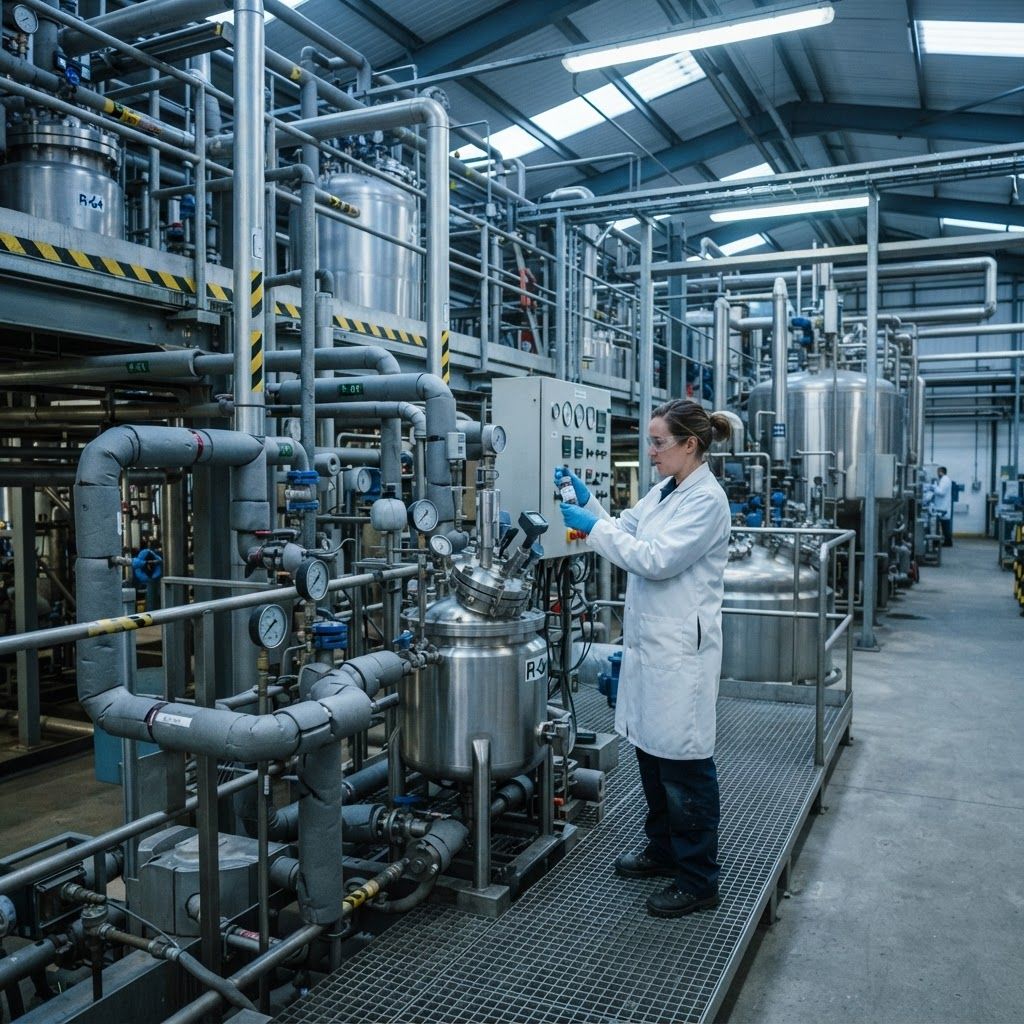
The chemical industry rarely features in popular descriptions of Barnsley, yet chemistry underpins a remarkable share of the borough's manufacturing activity. Textile finishing requires dyes, fixatives and functional treatments. Metal fabrication depends on cleaning agents, pretreatments, coatings and corrosion inhibitors. Food manufacturing needs cleaning and sanitation chemistry. Water and effluent treatment across industry relies on coagulants, flocculants and biocides. Construction consumes admixtures, sealants and adhesives. Behind each of those requirements sits a formulator, blender, distributor or technical service provider, and Barnsley hosts a solid cluster of them.
The borough's advantages for chemical businesses are practical rather than glamorous. Industrial land is available at reasonable cost, road access via the M1 is excellent for distribution across the north, and the surrounding concentration of manufacturing provides a substantial local customer base. Proximity to the research chemistry capability of Sheffield and Leeds universities also supports technical development work for firms willing to collaborate.
How to Assess a Chemical Supplier
Regulatory compliance is the foundation. Any credible chemical business must operate within REACH registration requirements, classify and label products correctly under CLP, supply accurate and current safety data sheets, and hold appropriate environmental permits for its operations. Storage and handling must satisfy COMAH thresholds where relevant, DSEAR requirements for flammable materials, and containment obligations to prevent environmental release.
Beyond compliance, technical service is what separates a genuine formulation partner from a drum vendor. The best chemical companies employ qualified chemists who visit customer sites, understand the process the product goes into, troubleshoot problems and develop bespoke formulations. Laboratory capability, whether for quality control, product development or customer support testing, is a strong indicator of real technical depth. Supply chain reliability and stockholding also matter greatly, since a production line halted for want of a process chemical is expensive regardless of the unit price achieved.
1. Barnsley Specialty Chemicals
Barnsley Specialty Chemicals operates as a formulator and blender producing specialty chemical products for industrial customers, including surfactant blends, process aids, cleaning formulations and functional additives. Its capability covers small-batch development through to commercial-scale blending, with in-house laboratory support for formulation work and quality control. The company's strength is collaborative development, working with customers to design products around specific process requirements rather than fitting a standard product to an imperfect application. Its technical documentation and regulatory support are well regarded.
2. Dearne Water Treatment Chemicals
Dearne Water Treatment Chemicals supplies and services water treatment programmes for cooling systems, boilers, closed heating circuits and industrial effluent. Its portfolio includes corrosion and scale inhibitors, biocides, coagulants, flocculants and pH adjustment chemistry, supported by on-site testing, dosing equipment supply and system surveys. Poorly managed water chemistry causes enormous hidden costs through corrosion, scaling, efficiency loss and legionella risk, and the company's service-led approach addresses those risks systematically rather than simply delivering product.
3. Cudworth Coatings and Surface Chemistry
Cudworth Coatings and Surface Chemistry formulates and supplies industrial coatings, primers, pretreatments and corrosion protection systems for metal fabrication, automotive and construction applications. Its technical team advises on substrate preparation, application method, cure schedules and specification compliance, which is where most coating failures actually originate. The company has invested in lower-VOC and water-based technologies, responding both to tightening emissions regulation and to customer demand for safer workplace chemistry.
4. Penistone Adhesives and Sealants
Penistone Adhesives and Sealants manufactures and distributes structural adhesives, sealants, tapes and bonding systems for manufacturing and construction customers. Its range spans epoxies, polyurethanes, cyanoacrylates, silicones and MS polymers, and its technical service includes substrate compatibility testing, surface preparation advice and joint design guidance. Adhesive bonding increasingly replaces mechanical fastening in lightweight assembly, particularly in transport applications, and the company's application engineering support is valuable to manufacturers making that transition.
5. Yorkshire Laboratory Services
Yorkshire Laboratory Services provides analytical and testing services rather than products, covering chemical composition analysis, contamination investigation, water and effluent testing, materials failure analysis and regulatory compliance testing. Independent analytical capability is essential across the manufacturing economy, whether for verifying incoming material quality, investigating a process problem or demonstrating environmental compliance. The company's accredited methods and clear reporting make it a trusted resource for manufacturers, environmental consultants and legal proceedings alike.
6. Hoyland Industrial Cleaning Chemistry
Hoyland Industrial Cleaning Chemistry formulates cleaning, degreasing and sanitation products for food manufacturing, engineering and general industry. Its food-sector range is designed for clean-in-place systems, open plant cleaning and hygiene programmes, with the documentation and validation support that food safety audits demand. For engineering customers it supplies aqueous degreasers, parts washer chemistry and metal cleaning formulations. The company's shift towards aqueous and lower-hazard alternatives to traditional solvent cleaning reflects both regulatory pressure and genuine workplace safety improvement.
7. Silkstone Polymer Additives
Silkstone Polymer Additives supplies and blends additives for plastics processing, including stabilisers, flame retardants, colour masterbatches, processing aids and impact modifiers. Its technical service helps processors solve problems around thermal degradation, colour consistency, dispersion and regulatory compliance for end applications. With growing use of recycled polymer, the company's expertise in stabilising and upgrading recyclate has become particularly valuable to processors working to meet recycled content targets without sacrificing product performance.
8. Worsbrough Environmental Chemistry
Worsbrough Environmental Chemistry focuses on remediation and environmental treatment, supplying products and expertise for contaminated land treatment, soil stabilisation, odour control and spill response. Barnsley's industrial and mining history has left a legacy of contaminated sites, many now targeted for redevelopment, and the company's ground remediation chemistry supports that regeneration work. Its services include site assessment collaboration, treatment design and validation sampling to demonstrate that remediation objectives have been achieved.
9. Barugh Green Lubricant Technologies
Barugh Green Lubricant Technologies formulates and blends industrial lubricants, metalworking fluids, hydraulic oils and greases. Metalworking fluid management is a genuinely technical discipline involving concentration control, microbial management, tramp oil removal and operator health considerations, and the company provides fluid management programmes alongside product supply. Its work extends tool life, improves surface finish and reduces fluid disposal costs for machining businesses across the borough's substantial engineering base.
10. Northern Chemical Distribution
Northern Chemical Distribution operates as a distributor and repackager, holding stock of commodity and specialty chemicals and supplying them in quantities suited to smaller manufacturers who cannot take bulk deliveries. Its value lies in breaking bulk, maintaining local stock availability, handling the compliance and documentation burden, and providing rapid delivery across the region. The company also manages waste chemical collection and disposal, offering customers a single compliant route for both supply and end-of-life handling.
Regulation, Safety and Sustainability
The chemical sector operates under some of the most demanding regulation in manufacturing, and that framework continues to tighten. Substances of concern face increasing restriction, driving reformulation towards safer alternatives. Emissions and effluent standards are being progressively strengthened. Producer responsibility for packaging and end-of-life handling is expanding. For customers, this means supplier selection should include a genuine assessment of regulatory competence, because a supplier caught out by a substance restriction can disrupt your production as effectively as a supply failure.
Sustainability pressure is also reshaping product development. Green chemistry principles favouring lower hazard, reduced solvent use, bio-based feedstocks, and design for recyclability are moving from aspiration to commercial requirement as manufacturers face their own customer and regulatory demands. The companies investing in that direction now are positioning themselves well.
Building an Effective Supplier Relationship
Treat chemical suppliers as technical partners rather than transactional vendors. Share the process context, not just the product specification, since a chemist who understands your application can often improve it. Request and read safety data sheets properly, and ensure they inform your COSHH assessments and operator training. Discuss stockholding and lead times explicitly, and consider consignment or call-off arrangements for critical materials. Ask about reformulation roadmaps where regulatory restriction is foreseeable. Audit storage, handling and quality control if the material is critical to your process, and confirm what technical support is available when something goes wrong at three in the afternoon on a production shift.
Final Thoughts
Barnsley's chemical companies form an unglamorous but genuinely important layer of the borough's industrial economy, supplying the formulations, treatments and analytical capability that manufacturing across South Yorkshire depends upon. The ten profiled here span specialty formulation, water treatment, coatings, adhesives, analytical services, cleaning chemistry, polymer additives, remediation, lubricants and distribution. The best of them compete on technical service, regulatory competence and problem-solving capability rather than on price per kilogram, and for manufacturers those attributes reliably deliver the greater long-term value.
Want your brand featured in front of decision-makers? Publish a guest post or get a link insertion in our guides through AAMAX's guest post and link insertion service.
Helpful Links
 SponsoredAAMAX — Full-Service Digital Agency
Write for Us
Share your expertise with our readers. We welcome guest contributions from industry specialists.
Pitch your idea