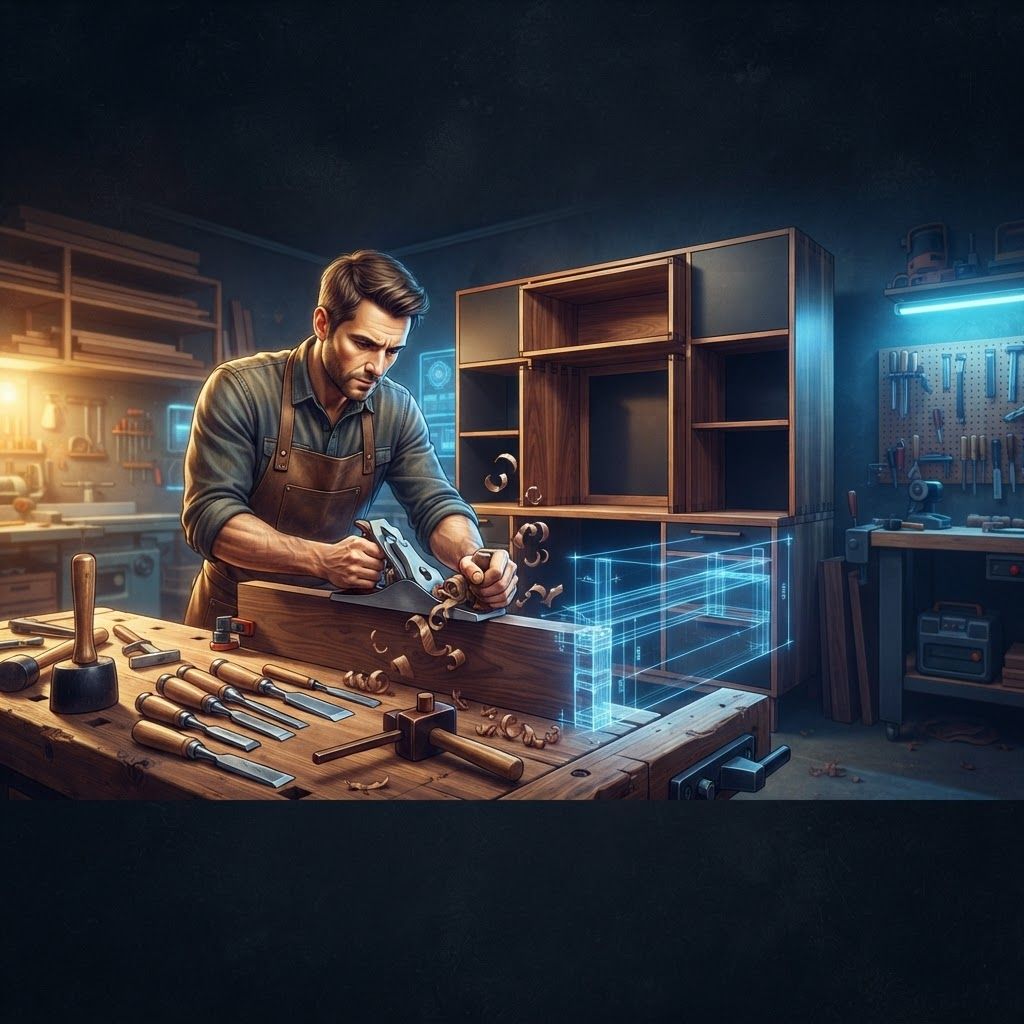
Carpentry, Joinery and Cabinetmaking: Understanding the Distinction
The words are often used interchangeably, but in the trade they describe genuinely different work, and knowing the difference is the fastest route to hiring the right person in Stockton-on-Tees. Site carpentry, sometimes called first and second fix, is structural and installation work carried out on the building itself: floor joists, roof timbers, stud partitions, door hanging, skirtings and architraves. Joinery is workshop-based manufacture of components such as staircases, windows, doors and frames, which are then installed on site. Cabinetmaking is the finest end of the spectrum, producing furniture and fitted pieces where tolerances are measured in fractions of a millimetre.
A skilled site carpenter may be entirely unsuited to producing a hardwood staircase, and an exceptional cabinetmaker may have no interest in cutting a roof. Stockton's better carpentry businesses are clear about which of these they do, and the strongest either specialise deeply or operate genuinely separate site and workshop teams.
Why the Borough's Building Stock Shapes Local Carpentry
Stockton-on-Tees contains a wide span of construction periods, and each presents distinct carpentry challenges. Victorian and Edwardian terraces in the town centre, Norton and Hartburn typically feature cut roofs, suspended timber ground floors and substantial softwood joinery, much of it now suffering from decades of moisture exposure or unsympathetic modification. Interwar and post-war housing in Billingham and Thornaby introduced different framing conventions and, in places, early prefabricated elements. Modern estates at Ingleby Barwick and Wynyard use trussed rafters, engineered floor joists and factory-finished joinery.
These differences are practical, not academic. Repairing a cut roof requires an understanding of how rafters, purlins and ceiling ties act together, and cutting into a trussed rafter without engineered replacement can compromise an entire roof structure. Replacing a sash window sympathetically in a conservation area near Yarm requires knowledge of section profiles and glazing conventions that a modern-only installer will not possess. Carpenters who work across the borough regularly develop this range of judgement, which is precisely what clients are paying for.
The Ten Best Carpentry Services in Stockton-on-Tees
Tees Valley Carpentry & Joinery is the borough's most complete operation, combining a site carpentry team with a fully equipped workshop. This dual capability means a client extending a property can have structural roof and floor work, bespoke internal doors and a fitted staircase delivered by a single accountable contractor, which removes the interface problems that arise when separate trades blame one another for dimensional errors.
Norton Heritage Joinery specialises in period restoration and conservation work. The firm produces matched sash windows, panelled doors and mouldings replicated from existing profiles, and its approach favours repair over replacement wherever timber remains sound. This is both more sympathetic and, in listed or conservation contexts, often the only approach planners will accept.
Riverside Structural Carpentry concentrates on the structural end of the trade: roof cutting, floor construction, timber frame erection and structural alterations under engineer's design. Its value lies in reading and executing structural drawings accurately, and in recognising when a proposed alteration genuinely requires engineered input rather than assumption.
Ingleby Bespoke Furniture Makers operates as a cabinetmaking workshop producing fitted wardrobes, media units, libraries and freestanding furniture. Its work is characterised by traditional jointing methods combined with modern hardware, and by a design process that begins with how a space is actually used rather than with a catalogue.
Thornaby Kitchen & Fitted Interiors designs and manufactures bespoke kitchens and utility spaces. The advantage of a genuine maker over a supply-and-fit retailer is that awkward spaces, sloping ceilings and non-standard dimensions become straightforward rather than requiring filler panels and compromise.
Billingham Commercial Carpentry serves the fit-out market, producing and installing reception desks, shopfittings, partitions and specialist joinery for offices, schools and retail units. Its strength is working to programme within occupied or phased buildings.
Stockton Staircase Company focuses exclusively on stair manufacture and installation, including winders, cut strings, glass balustrades and structural steel-and-timber combinations. Staircases are unforgiving work, governed by Building Regulations Part K for rise, going, headroom and guarding, and specialisation shows in the results.
Yarm Fine Woodworking undertakes high-specification residential joinery, working with hardwoods and veneers on projects where finish quality is the primary criterion. Its spray-finishing capability produces a durability and evenness that hand-applied site finishes cannot match.
Hartburn Property Carpentry handles the practical repair and maintenance market: door adjustments, rotten frame repairs, decking, garden structures, loft conversions and general remedial work. Its reliability on smaller jobs, an area many larger firms neglect, has made it a fixture with local homeowners and letting agents.
Teesside Timber Frame Services specialises in modern engineered timber construction, including closed-panel systems, glulam and cross-laminated timber elements, positioning it well for the growing offsite construction market in the region.
Timber Selection and Why It Determines Longevity
Material choice is where cheap carpentry reveals itself, usually two or three winters later. Softwoods such as redwood and whitewood dominate structural and general joinery work, and for external use they require either preservative treatment to an appropriate use class or a naturally durable alternative. Hardwoods including oak, ash and sapele offer greater density, stability and durability at significantly higher cost, and are typically reserved for staircases, external doors, windows and furniture.
Engineered products have become central to modern carpentry. Laminated veneer lumber and I-joists offer greater spans and far better dimensional stability than solid timber, which matters in heated homes where solid sections shrink and squeak. Moisture content is the quiet determinant of quality: timber installed too wet will shrink, opening joints and cracking paint, while properly conditioned timber remains stable. Good carpenters check moisture content and acclimatise material before fixing, particularly for internal joinery and flooring.
Certification is increasingly expected. Timber carrying FSC or PEFC chain-of-custody documentation confirms responsible sourcing, and specifying it costs little while supporting sustainable forestry. Commercial and public-sector projects in the borough now routinely require it.
How Carpentry Work Is Priced
Site carpentry is usually priced by day rate or by measured item, such as per door hung or per square metre of flooring laid. Workshop joinery is priced per unit, reflecting design time, material, machining and finishing. Bespoke cabinetmaking commands the highest rates because it includes genuine design work, and because the fitting stage in an imperfect building demands considerable skill.
When comparing quotations, examine specification rather than headline price. A quotation for internal doors that does not state timber species, whether doors are solid or hollow-core, and what ironmongery is included is not comparable to one that does. Similarly, a staircase quotation should state string type, timber, balustrade design and whether finishing is included. Reputable Stockton carpenters provide this detail unprompted.
Trends Reshaping the Trade Locally
Digital fabrication has arrived in workshops that would once have been entirely hand-tool operations. Computer-controlled routers and panel saws allow small local businesses to achieve repeatability previously available only to large manufacturers, while three-dimensional modelling lets clients see and approve fitted joinery before any timber is cut, dramatically reducing costly misunderstandings.
Sustainability is a second major driver. Timber's carbon-storing properties have made it central to lower-carbon construction, and interest in engineered timber structures is growing across the region. At the domestic level, repair-and-restore is increasingly favoured over replacement, which plays to the strengths of carpenters with traditional skills.
Finally, the retrofit agenda is creating new carpentry demand. Insulation upgrades, airtightness improvements and ventilation installation all require careful carpentry to avoid creating cold bridges or trapping moisture in timber elements, and carpenters who understand building physics rather than just cutting timber are becoming considerably more valuable.
Choosing Well
Ask to see completed work of the same type as your project, ideally in person for joinery where finish quality matters. Confirm insurance, ask who will actually carry out the work, and for structural alterations establish clearly whether engineered design is included or your responsibility. Above all, be sceptical of a carpenter who quotes without measuring. Accurate carpentry begins with accurate survey, and the firms in Stockton-on-Tees that take time at the outset are consistently the ones whose work still looks right a decade later.
Want your brand featured in front of decision-makers? Publish a guest post or get a link insertion in our guides through AAMAX's guest post and link insertion service.
Helpful Links
 SponsoredAAMAX — Full-Service Digital Agency
Write for Us
Share your expertise with our readers. We welcome guest contributions from industry specialists.
Pitch your idea