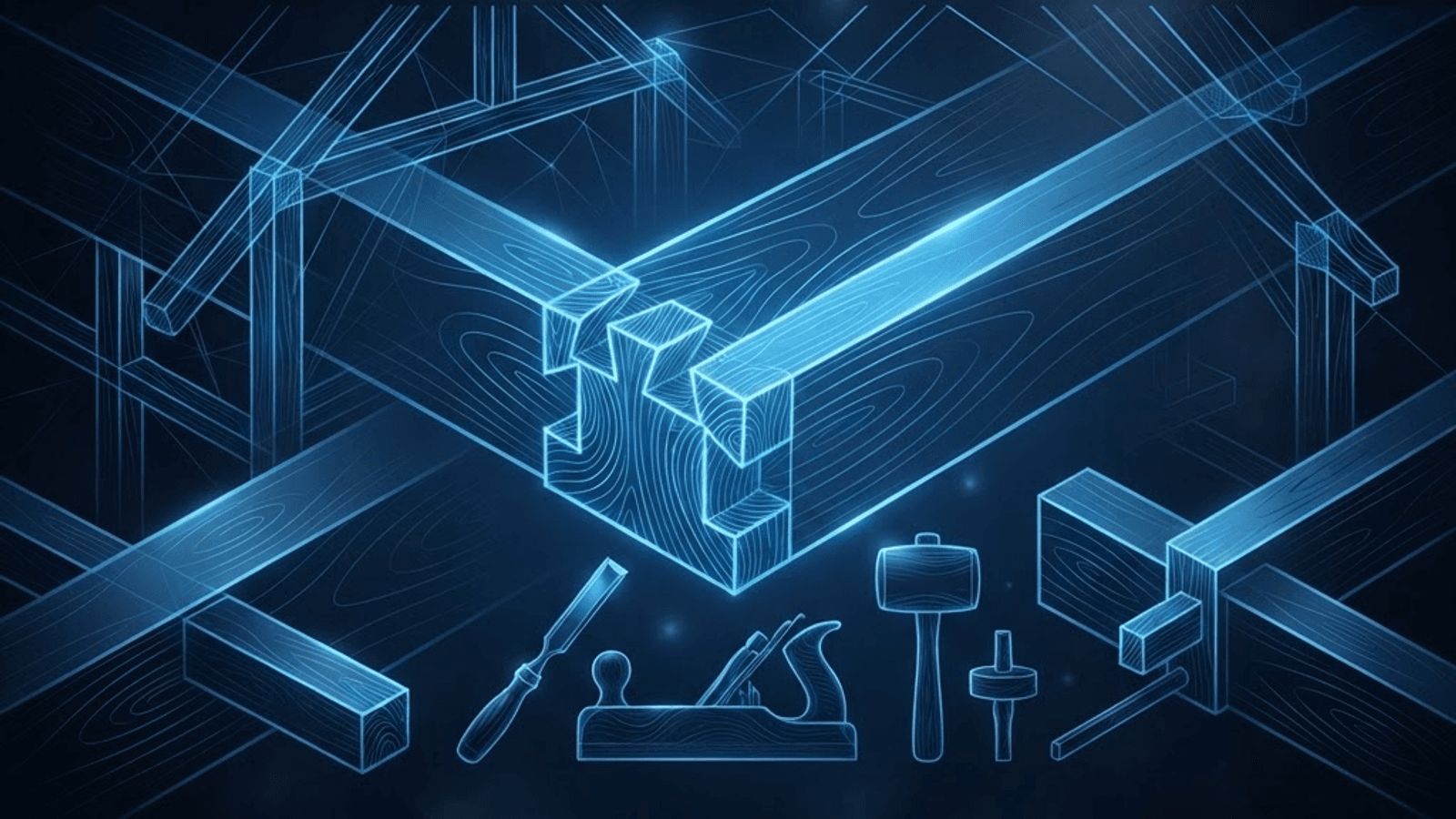
Carpentry: The Trade That Defines a Finished Building
Carpentry sits at the heart of almost every construction project, yet it is the trade whose quality is most immediately visible to anyone using the finished space. A misaligned door, a staircase with inconsistent risers or a fitted wardrobe with uneven reveals will be noticed daily long after the structural work is forgotten. In North West Leicestershire, where the housing stock ranges from timber-framed rural cottages to precision-engineered new builds, carpentry demands a genuinely wide skill set.
The trade divides broadly into two disciplines. First fix carpentry is structural and hidden: floor joists, roof trusses, stud partitions, door linings, window frames and noggins. Second fix carpentry is what the occupant sees: skirting, architrave, doors and ironmongery, staircases, cladding and fitted furniture. Bench joinery, often confused with carpentry, is the workshop-based manufacture of components such as windows, doors and staircases before they reach site.
Why Local Carpentry Skills Matter Here
The district's building stock creates specific demands. Period properties in Ashby-de-la-Zouch, Breedon on the Hill and the National Forest villages contain original softwood and oak joinery that is often repairable rather than requiring replacement, but repairing it demands skills that are becoming scarce. Conservation area and listed building consents frequently require like-for-like timber repair rather than uPVC substitution, which means splicing new timber into existing frames, matching mouldings and using traditional glazing methods.
Meanwhile, the growth in home working across the district has driven substantial demand for bespoke fitted studies, alcove cabinetry and garden offices. This is craft work where the value lies in accurate scribing to out-of-square walls, consistent grain matching and durable hinge and runner selection.
Ten Carpentry Services in North West Leicestershire
1. Charnwood Carpentry and Joinery
A full-service outfit covering first and second fix, roof carpentry and bespoke joinery from an in-house workshop. Their ability to manufacture non-standard components rather than adapt off-the-shelf products sets them apart on period properties.
2. Ashby Heritage Joinery
Specialists in traditional timber windows, doors, sash box repair and conservation-grade joinery. Regularly appointed on listed buildings where consent requires historically appropriate profiles and materials.
3. Coalville Bespoke Furniture Makers
Focused on fitted wardrobes, alcove units, media walls, home office installations and kitchen cabinetry. Known for careful template work in older terraces where no wall is truly straight.
4. National Forest Timber Works
A firm with a strong sustainability ethos, working with locally sourced and FSC-certified timber, offering garden rooms, timber cladding, decking and pergolas alongside interior carpentry.
5. Ivanhoe Staircase Specialists
Concentrated on staircase design, manufacture, replacement and refurbishment, including open-tread, winder and feature staircases. Their Building Regulations knowledge around rise, going and balustrade spacing prevents costly rework.
6. Measham Structural Carpentry
Handling roof framing, floor structures, timber frame erection and structural repair. Frequently engaged on extensions and loft conversions where structural timber must integrate with existing fabric.
7. Whitwick Door and Window Services
A trade specialist fitting internal and external doors, frames, ironmongery, and timber window installation and adjustment. A practical choice for whole-house door replacement projects.
8. Kegworth Commercial Joinery
Oriented towards shopfitting, reception desks, counters, wall panelling and commercial fixtures, supplying fitout contractors and direct commercial clients across the district.
9. Donington Decking and Outdoor Carpentry
Focused on decking, garden structures, fencing, gates and external timber work, with attention to ground preparation and treatment that determines whether outdoor timber lasts five years or twenty.
10. Moira Restoration Carpentry
Specialising in repair and restoration of existing joinery, including rot splicing, moulding replication and structural timber treatment. A cost-effective alternative to wholesale replacement in period homes.
Materials and Trends
Engineered timber has become standard in structural applications. Glulam beams, laminated veneer lumber and engineered floor joists offer greater spans, better dimensional stability and more predictable performance than solid softwood. They also allow easier service routing through pre-formed openings, which simplifies plumbing and electrical first fix.
On the finish side, natural timber has returned strongly to interiors. Oak, walnut and ash veneers, slatted acoustic panelling, exposed beams and timber-clad feature walls have replaced the painted-everything aesthetic of the previous decade. Carpenters who understand grain matching, movement and appropriate finishes are in demand accordingly.
Sustainability has become a meaningful differentiator. Timber is a carbon-storing material, and clients increasingly ask about chain of custody certification, locally sourced stock and low-VOC finishes. In a district defined partly by The National Forest, that resonance is stronger than in most areas.
How to Judge Carpentry Quality
Look at completed work rather than photographs alone. Check that mitres on architrave and skirting close tightly, that scribes to uneven walls are neat, that door gaps are consistent along their length and that drawer fronts align across a run. On external work, check that end grain is sealed, that timber is not in direct ground contact without appropriate treatment, and that fixings are corrosion resistant.
Ask about apprenticeship and qualification background. City and Guilds or NVQ qualifications in carpentry and joinery, and membership of the Institute of Carpenters, indicate formal training. For structural work, confirm the carpenter works to the structural engineer's drawings rather than by eye.
On bespoke work, expect a drawing or at minimum a detailed sketch before manufacture begins, along with clarity on materials, finish, ironmongery and installation date. A deposit for materials on a bespoke commission is reasonable; a large upfront payment for labour is not.
Final Thoughts
Carpentry is where a building stops being a structure and becomes a home or a workplace. Across North West Leicestershire the trade remains strong, with workshops producing genuinely bespoke work and a healthy tradition of heritage repair. Choosing a carpenter whose specialism matches the job, and judging them on completed work rather than price alone, is the surest route to a result that still looks right in twenty years.
Want your brand featured in front of decision-makers? Publish a guest post or get a link insertion in our guides through AAMAX's guest post and link insertion service.
Helpful Links
 SponsoredAAMAX — Full-Service Digital Agency
Write for Us
Share your expertise with our readers. We welcome guest contributions from industry specialists.
Pitch your idea