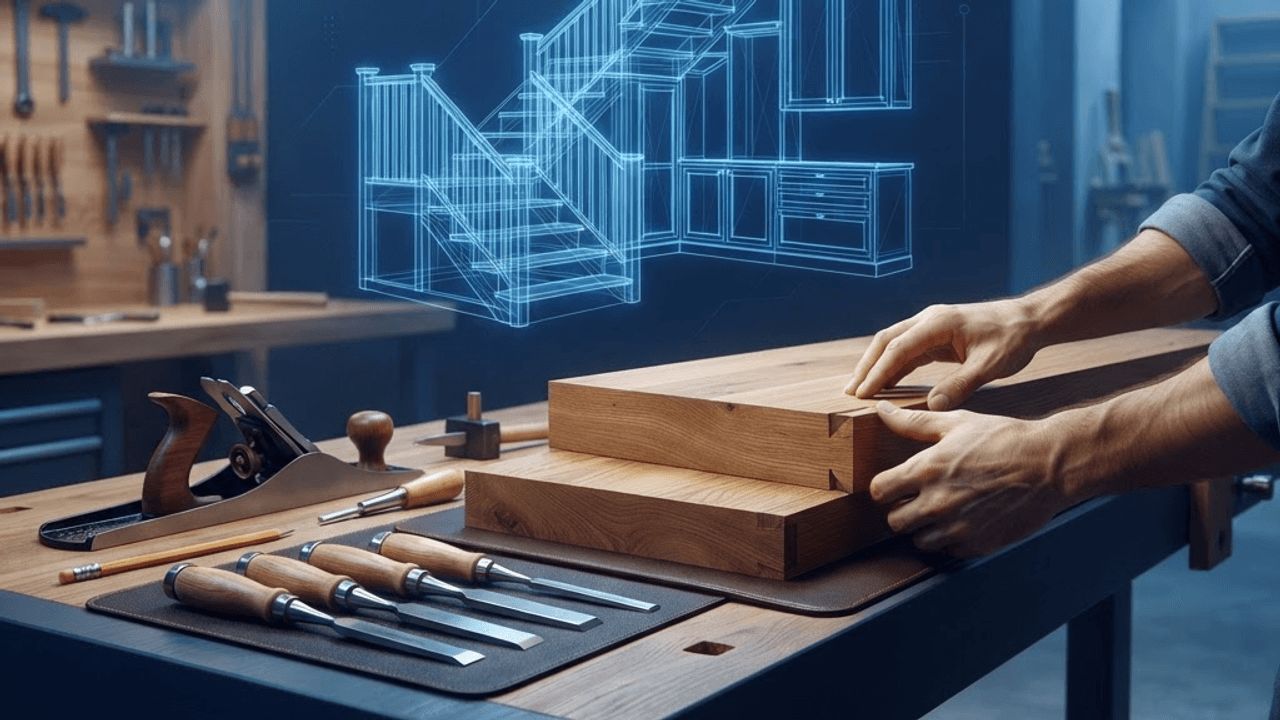
The Two Halves of the Timber Trade
Carpentry and joinery are often used interchangeably, but they describe different disciplines. Carpentry is structural and site-based: roof timbers, floor joists, stud partitions, formwork and structural repair. Joinery is workshop-based and fine: doors, windows, staircases, cabinetry and mouldings, manufactured to tight tolerances then installed. Most timber projects in Dundee need both, and understanding the distinction helps clients approach the right specialist.
Local conditions make timber work particularly demanding. High humidity and driving rain mean external timber must be properly detailed, sealed and ventilated or it will decay. Older properties contain original timber that has been in service for over a century and may have localised rot, insect damage or historic notching that has weakened it. Meanwhile, the demand for fitted storage and bespoke joinery in compact city flats continues to grow.
1. Tayside Carpentry and Joinery
Tayside Carpentry and Joinery covers the full range from structural carpentry to finished joinery installation, including roof repairs, floor renewal, partitions, doors, skirtings and architraves. Its combination of site carpentry and workshop capability means alterations that require both structural and decorative timber work can be handled by one team, avoiding coordination gaps between separate trades.
2. Riverside Bespoke Joinery Workshop
Bespoke joinery makes awkward spaces usable. Riverside Bespoke Joinery Workshop manufactures fitted wardrobes, alcove shelving, window seats, media walls, home office furniture and kitchen cabinetry to measured drawings. Its workshop manufacture with site installation delivers precision that flat-pack systems cannot match, which matters enormously in older properties where no wall is truly square or plumb.
3. Kingsway Structural Timber Repairs
Structural timber problems are common in older buildings and frequently discovered late. Kingsway Structural Timber Repairs replaces and reinforces joists, rafters, purlins, lintels and beam ends, splicing new timber into sound existing structure where full replacement is unnecessary. Its diagnostic approach identifies whether decay stems from an active water source that must be resolved before repair, which prevents recurrence.
4. Broughty Ferry Sash Window Restoration
Original sash and case windows are among the most valuable features of Dundee's traditional buildings, and replacement is rarely the best option. Broughty Ferry Sash Window Restoration repairs rotten sills and rails, splices new sections into original frames, replaces cords and weights, fits draught sealing and installs slim double glazing where appropriate. The result retains character while dramatically reducing draughts and noise.
5. Lochee Staircase Design and Installation
Staircases are the most technically demanding piece of domestic joinery. Lochee Staircase Design and Installation manufactures and fits straight, winder and open-tread staircases, along with balustrades, handrails and newel posts. Its compliance with rise, going and headroom requirements ensures loft conversions and layout alterations achieve building warrant approval, an area where improvised stairs routinely fail.
6. Angus Flooring Carpentry
Timber floors define the feel of a room. Angus Flooring Carpentry lifts, repairs, sands and finishes original floorboards, installs solid and engineered timber flooring, replaces defective joists and adds acoustic and thermal insulation between floors. Correct acclimatisation of new timber before installation is treated as essential, since flooring laid at the wrong moisture content will cup, gap or buckle within months.
7. Ninewells Doors and Architectural Woodwork
Doors and mouldings carry a building's architectural language. Ninewells Doors and Architectural Woodwork manufactures and hangs internal and external doors, fire doors with correct intumescent detailing, panelled surrounds, cornices and matched period mouldings. Its ability to replicate existing profiles allows alterations to blend seamlessly with original work rather than announcing themselves.
8. Camperdown Kitchen Fitting Carpentry
Kitchen installation is a carpentry discipline first and foremost. Camperdown Kitchen Fitting Carpentry handles unit assembly and levelling, worktop templating and jointing, appliance housings, end panels and scribing to uneven walls. Precise worktop jointing and correct sealing at sink cut-outs prevent the water ingress that destroys carcasses in poorly fitted kitchens.
9. Dundee Outdoor Carpentry and Decking
External timber must be specified for a wet climate. Dundee Outdoor Carpentry and Decking builds decking, pergolas, fencing, garden rooms, sheds and gates using pressure-treated and naturally durable timbers with correct ventilation beneath boards and stainless or coated fixings. Adequate airflow under decking and proper ground clearance are the details that determine whether a structure lasts five years or twenty.
10. Tay Heritage Joinery and Conservation
Historic buildings require conservation-minded technique. Tay Heritage Joinery and Conservation undertakes repair of original shutters, panelling, church and institutional joinery, traditional window casements and decorative timber elements, using traditional jointing and matching timber species. Repair rather than replacement preserves both historic fabric and value, and is usually less expensive than full reproduction.
Understanding Timber Selection
Choice of species and grade determines longevity. Softwoods such as redwood and whitewood are economical and suitable for internal and treated external use. Hardwoods including oak, ash and sapele offer greater durability and stability for staircases, doors and high-wear surfaces. Engineered products such as glulam and laminated veneer lumber provide dimensional stability for long spans. For external use in Dundee, pressure treatment or naturally durable species is not optional but essential.
Moisture: The Deciding Factor
Timber moves with humidity, and almost every joinery failure traces back to moisture. Internal joinery should be installed at a moisture content matching the eventual environment, which means allowing new timber to acclimatise in the heated space before fitting. External timber must shed water through sloped surfaces, drip details and end-grain sealing. Ventilation behind and beneath timber elements allows drying, and any timber in contact with damp masonry will eventually decay regardless of treatment.
Specifying Joinery Well
Provide accurate measured drawings or commission a survey, since assumed dimensions are the most common source of expensive remakes. Specify species, finish and hardware explicitly rather than leaving choices to interpretation. Discuss whether items are pre-finished in the workshop, which usually produces a better result than site painting. Agree lead times early, as bespoke joinery is frequently the longest-lead item on a renovation programme. Finally, confirm who is responsible for making good decoration after installation.
Final Thoughts
Carpentry and joinery in Dundee spans structural repair of century-old timber, restoration of original sash windows and panelling, and precise bespoke cabinetry for modern living. The businesses above cover both site carpentry and workshop joinery with genuine craft standards. Respect moisture behaviour, specify durable timber for external use, provide accurate measurements, and well-executed timber work will outlast almost every other element of a building's interior.
Want your brand featured in front of decision-makers? Publish a guest post or get a link insertion in our guides through AAMAX's guest post and link insertion service.
Helpful Links
 SponsoredAAMAX — Full-Service Digital Agency
Write for Us
Share your expertise with our readers. We welcome guest contributions from industry specialists.
Pitch your idea