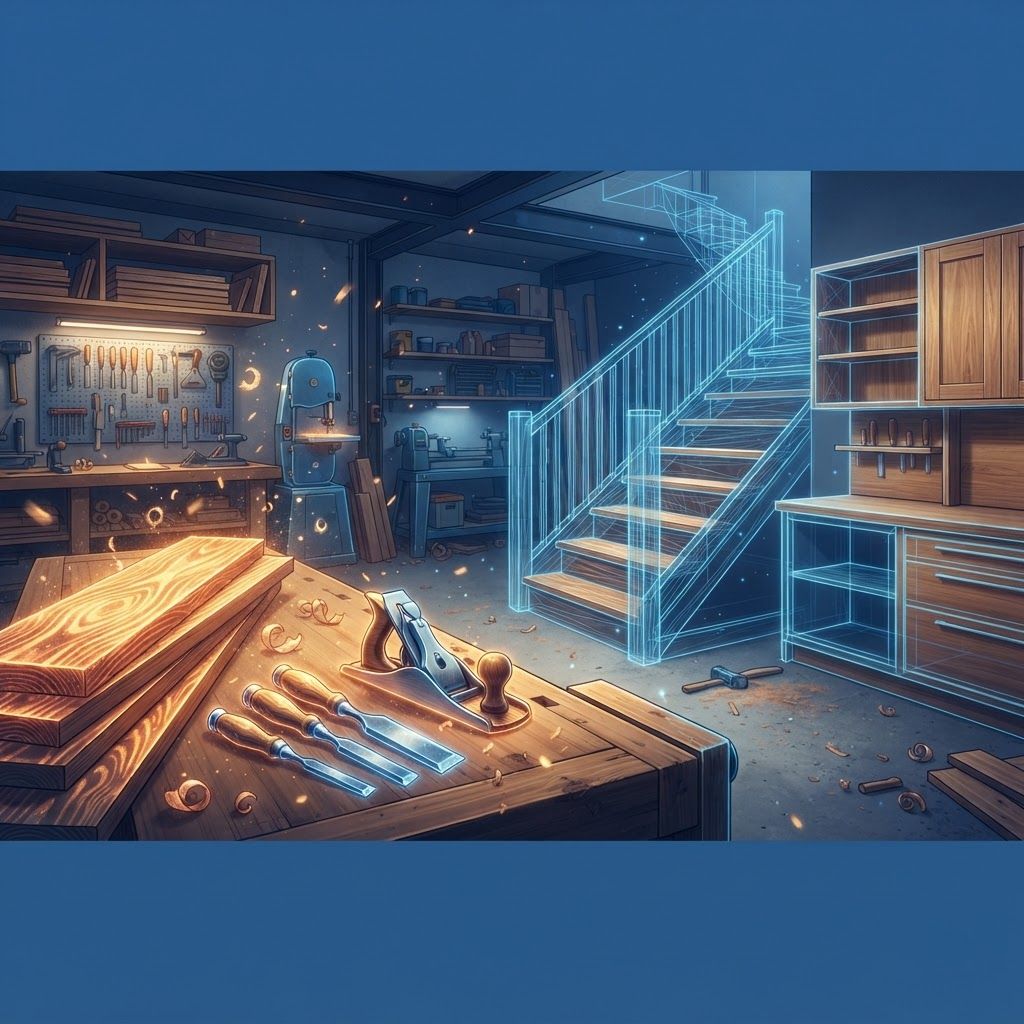
The Enduring Craft of Carpentry
Carpentry is among the oldest building trades and remains one of the most visible. Across the Causeway Coast and Glens, timber shapes the built environment in ways both structural and decorative: roof trusses carrying loads, floor joists spanning rooms, door and window frames, staircases, fitted kitchens, panelling and furniture. The quality of this work determines both how a building performs and how it feels to live in.
The trade divides broadly into two branches. Carpentry, sometimes called first fix, covers structural and concealed timber work carried out on site, including roof structures, floors, stud partitions and door linings. Joinery, or second fix, covers the finished components often manufactured in a workshop, including doors, skirting, architrave, staircases, kitchens and built-in furniture. Many tradespeople in the borough work across both, though the most refined joinery comes from dedicated workshops.
The Ten Carpentry Specialisms
1. Structural and First Fix Carpenters
These carpenters build the timber skeleton of a building: floor joists, roof rafters and trusses, wall plates, stud partitions and door linings. Accuracy here determines everything that follows, as out-of-level floors and out-of-plumb walls create problems for every subsequent trade. On exposed coastal sites, roof carpentry also involves substantial strapping and restraint detailing to resist wind uplift.
2. Roofing Carpentry and Cut Roof Specialists
While prefabricated trusses dominate volume housing, cut roofs built on site remain essential for complex geometries, extensions matching existing roof lines, and conversions. This work requires genuine skill in setting out hips, valleys, dormers and irregular pitches. Loft conversions frequently need structural carpentry to replace truss members with beams and dwarf walls while maintaining roof stability.
3. Second Fix Carpenters and Finishing Joiners
Second fix work is what occupants see and touch daily: doors hung to close cleanly, skirting and architrave with tight mitres, window boards, and ironmongery fitted precisely. The difference between competent and excellent second fix is immediately visible in the consistency of margins, the crispness of joints and the smoothness of door operation.
4. Bespoke Kitchen Makers
Custom kitchen manufacture allows every centimetre of an awkwardly shaped room to be used, which matters greatly in older properties and converted spaces common across the borough. Handmade kitchens in painted timber, oak or walnut offer durability and repairability that mass-produced units cannot match. Local makers also provide design consultation, ensuring the layout works ergonomically rather than simply looking appealing.
5. Staircase Design and Manufacture
Staircases combine structural engineering with visual impact. Makers design and build straight flights, winders, quarter and half landings, and open-tread contemporary designs. Regulations govern rise and going dimensions, headroom, handrail heights and balustrade spacing, and compliance must be achieved without compromising the design. Staircase renovation, replacing dated balustrades and refinishing treads, is also a popular improvement.
6. Built-In Furniture and Wardrobe Specialists
Fitted wardrobes, home office installations, window seats, alcove shelving and media units maximise storage in rooms where freestanding furniture wastes space. In period properties with chimney breasts and irregular walls, bespoke fitting is often the only way to achieve a neat result. These makers work in painted MDF for cost efficiency or solid timber and veneers for premium finishes.
7. Timber Window and Door Manufacture
Traditional timber windows and doors remain essential for conservation areas, listed buildings and homeowners who prefer authentic materials. Modern timber joinery uses engineered laminated sections with factory-applied microporous finishes, offering far greater stability and longevity than older solid sections. Sash window restoration, including cord replacement, draught sealing and slim double glazing, extends the life of original windows considerably.
8. Decking, Garden Structures and External Joinery
Outdoor timber work includes decking, pergolas, summer houses, garden offices, fencing and gates. In this climate, material selection is critical. Pressure-treated softwood, naturally durable hardwoods and composite decking all perform differently, and detailing that sheds water rather than trapping it is essential. Decking near the coast also needs slip-resistant treatment given persistent damp.
9. Heritage and Restoration Joinery
The borough's older buildings contain joinery worth preserving: panelled doors, shutters, cornices, staircases and shopfronts. Restoration joiners repair rather than replace, splicing in new timber where decay has occurred, matching mouldings with custom cutters and using traditional jointing methods. This work requires patience and a genuine understanding of historic construction.
10. Commercial and Shopfitting Carpentry
Commercial joinery covers reception desks, bar counters, retail display units, wall panelling and fitted seating. These items must withstand heavy public use, comply with fire performance requirements for surface spread of flame, and be manufactured to tight programmes. Local workshops serving the borough's hospitality sector deliver a significant volume of this work each off season.
Choosing Timber for a Coastal Climate
Material selection matters more here than in drier regions. Softwoods used externally must be properly pressure treated, and any cut ends should be treated on site before fixing. Naturally durable hardwoods such as oak, iroko and accoya perform excellently outdoors without preservative treatment. All external fixings should be stainless steel, since standard galvanised fixings corrode in salt air and cause unsightly staining and eventual joint failure. Internally, timber should be allowed to acclimatise to the building before installation, as moisture content changes cause shrinkage, gaps and warping after fitting.
Signs of Quality Workmanship
Several details reveal the standard of carpentry. Mitres on architrave and skirting should be tight with no visible gaps. Door margins should be even on all sides and doors should close without catching. Drawer and cupboard doors should align consistently. Fixings should be concealed or neatly filled. Scribes against uneven walls should follow the contour precisely rather than leaving gaps filled with sealant. Surfaces should be sanded smooth with no machine marks visible under paint.
Working With a Carpenter or Joiner
For bespoke work, expect a design and measurement stage before manufacture begins, and understand that workshop lead times of several weeks are normal for quality work. Clarify whether the price includes finishing, as some joiners supply primed items for a decorator to complete. Confirm who is responsible for removing existing items and making good afterwards. For structural carpentry, ensure engineering calculations are in place where beams or roof alterations are involved, as building control will require them.
Sustainability and Local Timber
Timber is a renewable material with low embodied carbon compared with alternatives, and sourcing from certified sustainable forestry ensures that benefit is genuine. Repairing and restoring existing joinery is more sustainable still, retaining material already in use. Local workshops also reduce transport impact and keep skilled craft employment within the Causeway Coast and Glens, sustaining a trade that has shaped the region's buildings for centuries.
Want your brand featured in front of decision-makers? Publish a guest post or get a link insertion in our guides through AAMAX's guest post and link insertion service.
Helpful Links
 SponsoredAAMAX — Full-Service Digital Agency
Write for Us
Share your expertise with our readers. We welcome guest contributions from industry specialists.
Pitch your idea