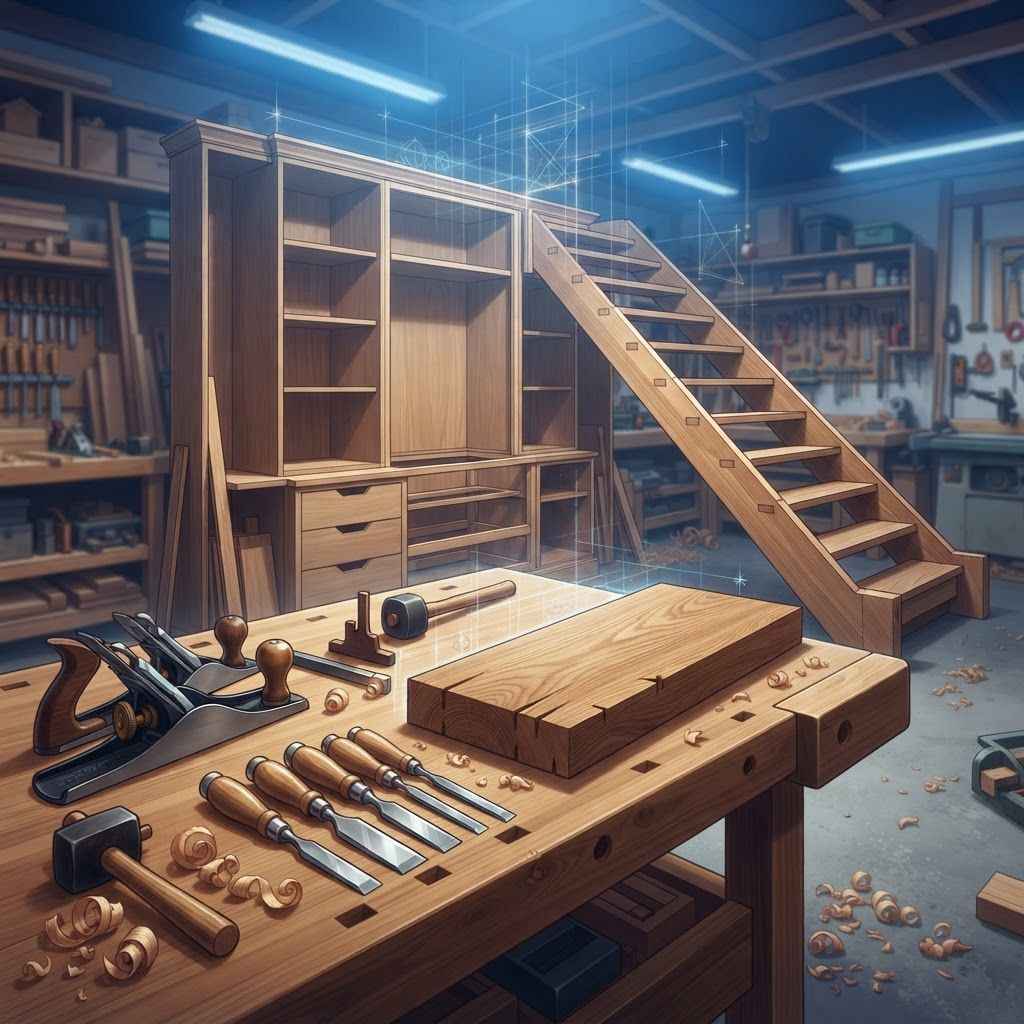
Carpentry: The Trade Behind the Finish
Carpentry is one of the oldest construction trades and remains among the most visible in a finished building. It divides broadly into structural or first fix work, such as roof timbers, floor joists, studwork and door linings; second fix work, including skirting, architrave, doors, staircases and mouldings; and joinery or cabinetmaking, where components are manufactured to measure in a workshop.
Quality carpentry is easy to recognise and difficult to fake. Consistent mitres, flush door alignment, tight scribes to uneven walls and staircases that neither creak nor deflect are the marks of a skilled carpenter. In Basildon's mix of post-war housing and newer developments, carpenters frequently work with out-of-square walls and non-standard openings, which makes adaptability as important as accuracy.
Common Carpentry Projects Locally
Typical work includes fitting internal doors and ironmongery, installing skirting and architrave during renovation, building stud partitions to reconfigure rooms, constructing loft conversion floors and dormers, replacing rotten fascia and soffit timber, building garden rooms and decking, fitting bespoke alcove storage and wardrobes, and manufacturing wall panelling and media units.
The Top 10 Carpentry Services in Basildon
1. Basildon Carpentry & Joinery
A well-established firm covering both structural carpentry and finished joinery. Their ability to handle first fix framing and later return for second fix and bespoke storage gives clients continuity across a project.
2. Essex Bespoke Joinery Workshop
A workshop-based joinery specialist producing made-to-measure wardrobes, alcove units, media walls and library shelving. Spray-finished doors and soft-close hardware are standard on their cabinetry.
3. Pitsea Kitchen Fitting Services
Focused on kitchen installation, including cabinet levelling, worktop templating, appliance integration and scribing to uneven walls. Precision at this stage determines whether an expensive kitchen looks expensive.
4. Laindon Staircase Specialists
Manufactures and installs staircases, balustrades, handrails and newel posts, including renovation of existing stairs with new spindles and cladding to modernise dated interiors.
5. Cranes Farm Structural Carpentry
Handles roof carpentry, floor structures, studwork and timber frame elements on construction sites, working from engineer's drawings and specified timber grades.
6. Vange Doors & Second Fix Carpentry
Specialises in door hanging, fire door installation and certification-aware fitting, plus skirting, architrave and window boards. Fire door compliance in flats and rental property is a particular strength.
7. Nevendon Garden Rooms & Timber Structures
Builds garden offices, summerhouses, pergolas, decking and fencing, with attention to ground preparation, insulation and weatherproofing on habitable outbuildings.
8. Basildon Wall Panelling & Interior Woodwork
Focused on decorative interior carpentry including shaker panelling, slatted feature walls, boxing-in and cornice work, tailored to room proportions rather than kit dimensions.
9. Fryerns Timber Repair Services
Deals with rot, insect damage and structural timber repair, including splicing joist ends, replacing wall plates and repairing window frames rather than replacing whole units.
10. Billericay Road Carpentry Contractors
Provides full carpentry packages on extensions and renovations, including roof structures, floors, partitions and complete second fix, coordinated to a build programme.
Materials and Their Trade-Offs
Softwood remains the workhorse for structural and painted work, offering good value and easy machining. Hardwoods such as oak and ash suit exposed staircases, worktops and furniture where grain is part of the design. Engineered boards including plywood and medium density fibreboard provide dimensional stability for painted cabinetry and panelling. For external work, treated timber, thermally modified timber and composite alternatives resist moisture cycling far better than untreated softwood.
Bespoke Versus Off-the-Shelf
Flat-pack and modular storage is cheaper and quicker, but rarely uses the full space in older properties with sloping ceilings, chimney breasts and irregular alcoves. Bespoke joinery typically costs more per metre yet delivers greater usable capacity and a built-in appearance. On resale, well-executed fitted storage is frequently mentioned by buyers as a differentiator.
How to Judge a Carpenter Before Hiring
Ask to see photographs of completed work, ideally including close-ups of joints and door reveals rather than wide room shots. Confirm whether they work alone or with a team, as this affects programme. Discuss how they handle out-of-square conditions, since a carpenter who explains scribing and packing techniques clearly is usually one who does them well. Confirm whether making good, painting and waste disposal are included.
Trends in Interior Woodwork
Interest in tactile, natural materials has driven a resurgence in panelling, timber slat screens and integrated storage that conceals technology. Home offices carved out of alcoves and understairs voids remain in demand. In external work, garden rooms continue to be popular as flexible workspace, with better insulation and glazing specifications than the sheds they replaced.
Final Thoughts
Carpentry sets the perceived quality of an interior more than almost any other trade. Basildon's carpenters cover structural timber work, precise second fix and workshop-made joinery, and choosing a specialist whose portfolio matches your project delivers results that look intentional rather than improvised.
Structural Carpentry Versus Joinery
The trade divides broadly into two disciplines. First fix carpentry is structural and covers floor joists, roof timbers, trussed rafters, stud partitions, door linings and window openings. Second fix carpentry and joinery is the visible layer, covering skirting, architrave, staircases, doors, fitted wardrobes, kitchens and bespoke cabinetry. Many Basildon tradespeople specialise in one side, and knowing which you need avoids disappointment. A superb site carpenter framing a loft conversion is not necessarily the right person to build a hand painted alcove library, and vice versa.
Bespoke joinery is increasingly popular in the borough because so much of the housing stock has awkward alcoves, chimney breasts and sloping ceilings that flat pack furniture cannot address. A well made fitted unit uses every millimetre of a difficult space and typically outlives several generations of mass produced alternatives.
Timber Choices and Sustainability
Material selection drives both cost and durability. Softwood remains the workhorse for structural framing and painted trim. Engineered timber and laminated veneer lumber offer superior stability for long spans and are increasingly used in loft conversions. Hardwoods such as oak, ash and walnut are chosen for staircases, worktops and furniture where grain is part of the design. Responsible carpenters specify certified timber from managed sources and can explain the moisture content and acclimatisation period a material needs before installation, which is the single most common cause of shrinkage gaps and warped doors.
Final Thoughts
The carpenters and joiners listed here have built solid reputations across Basildon for precise setting out, clean site conduct and finishes that stand up to close inspection. Ask to see work in person, discuss ironmongery and finish specification early, and allow realistic lead times for anything genuinely bespoke.
Want your brand featured in front of decision-makers? Publish a guest post or get a link insertion in our guides through AAMAX's guest post and link insertion service.
Helpful Links
 SponsoredAAMAX — Full-Service Digital Agency
Write for Us
Share your expertise with our readers. We welcome guest contributions from industry specialists.
Pitch your idea