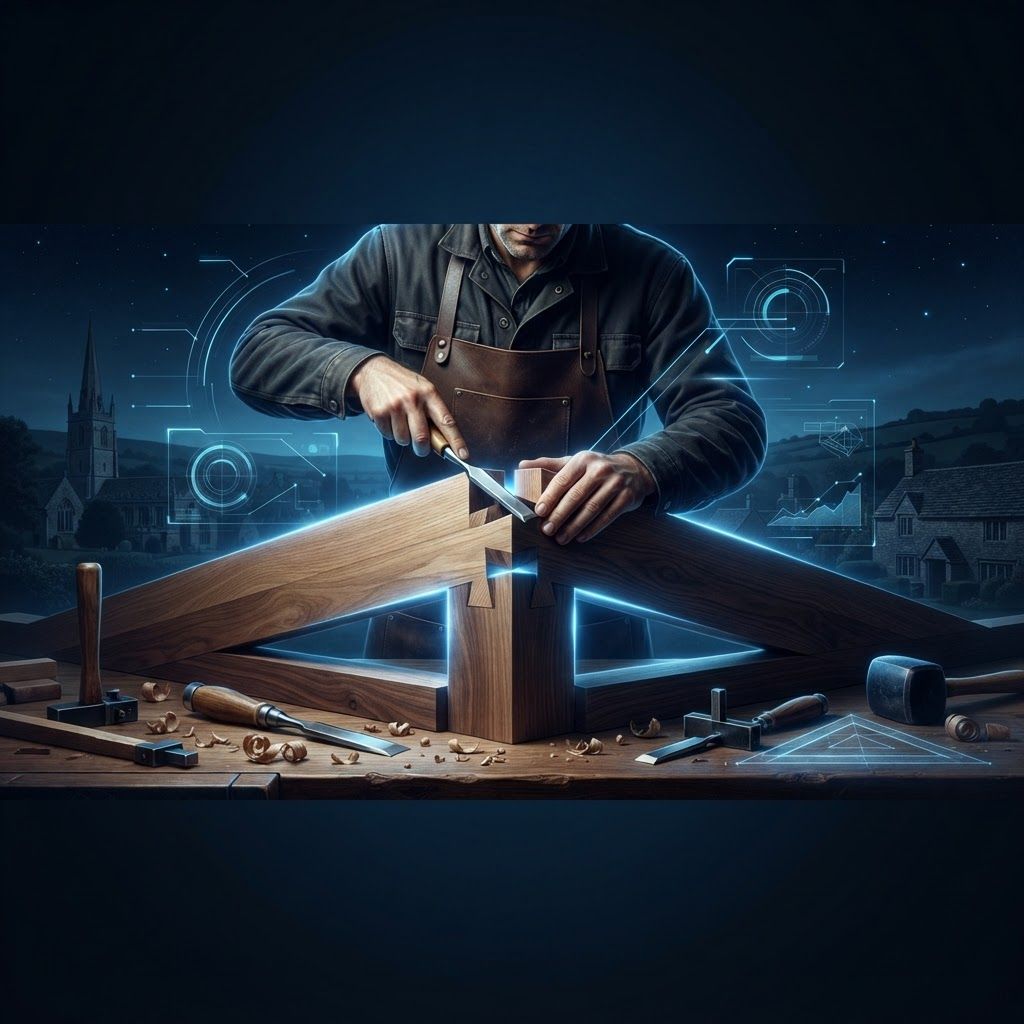
Carpentry in a Borough Built on Craft
Derbyshire has a long association with skilled trades, and carpentry remains one of the most visible expressions of that heritage across Amber Valley. The borough's building stock provides constant work for joiners: timber sash windows in Belper's mill-town streets, exposed roof structures in converted barns near Crich, traditional staircases in Victorian terraces and an ongoing appetite for bespoke fitted furniture in modern homes throughout Ripley, Heanor and Alfreton.
Carpentry divides broadly into two disciplines. First fix carpentry covers structural and concealed work such as floor joists, roof timbers, stud partitions and door linings. Second fix carpentry, often called finish carpentry, covers everything visible once plastering is complete: skirting, architrave, doors, staircases, fitted wardrobes and kitchen installation. Bench joinery, where components are manufactured in a workshop rather than cut on site, forms a third specialism and is where the finest local work tends to be produced.
What Separates Excellent Carpentry From Adequate Work
The difference is usually found in the details that only become obvious over time. Correctly acclimatised timber does not shrink away from mitres six months after installation. Properly scribed skirting follows an uneven wall rather than leaving a gap filled with caulk. A staircase built to the correct rise and going feels comfortable underfoot in a way that is difficult to articulate but immediately noticeable.
Material selection matters enormously. Kiln-dried softwood behaves very differently to green timber. Hardwoods such as oak, ash and walnut each have distinct movement characteristics, and a carpenter who discusses grain direction, moisture content and expansion allowance is demonstrating genuine expertise rather than salesmanship.
Ten Carpentry Services Worth Knowing in Amber Valley
Amber Valley Joinery Works operates a full workshop producing bespoke doors, windows, staircases and fitted furniture to order. Workshop manufacture allows tolerances that on-site cutting rarely achieves.
Derwent Bespoke Carpentry focuses on fitted furniture, including alcove cabinetry, home offices, media walls and walk-in wardrobes designed around the awkward geometry of older properties.
Belper Heritage Joinery specialises in restoration, repairing rather than replacing original sash windows, panelled doors and timber mouldings where the existing fabric can be saved.
Ripley Kitchen Fitters and Joiners combines kitchen installation with carpentry, handling worktop templating, cabinet levelling on uneven floors and the fine scribing that separates a good kitchen fit from a mediocre one.
Heanor Structural Carpentry concentrates on first fix and structural timber, including roof carpentry, floor systems, loft conversions and timber frame elements for extensions.
Alfreton Staircase Specialists designs and installs staircases in both traditional and contemporary styles, including open riser designs, oak and glass balustrades and replacement spindles for period homes.
Crich Country Woodcraft produces garden and outdoor timber work such as pergolas, garden rooms, decking, gates and bespoke summerhouses built for the local climate.
Somercotes Carpentry Contractors works primarily with builders and developers, delivering site carpentry packages across new-build and renovation projects on scheduled programmes.
Codnor Doors and Trim handles second fix work at scale, supplying and installing internal doors, ironmongery, skirting and architrave for whole-house refurbishments.
Amber Fine Furniture occupies the craft end of the market, producing hand-made tables, cabinets and commissioned pieces using traditional jointing techniques alongside modern finishing.
Trends Shaping Carpentry Demand
Bespoke storage has become one of the strongest growth areas. As house prices encourage improvement over relocation, homeowners increasingly invest in joinery that maximises awkward spaces, particularly under stairs, in loft eaves and within the deep alcoves typical of Victorian chimney breasts. Fitted solutions consistently outperform freestanding furniture in these situations.
Garden rooms and timber home offices have also grown substantially, driven by hybrid working. These structures demand a broader skill set than traditional carpentry, incorporating insulation detailing, breathable membranes, cladding systems and basic electrical coordination.
Sustainability is influencing material choice too. Responsibly sourced timber, engineered products with lower waste and a renewed interest in repairing original joinery rather than replacing it all reflect a shift in customer priorities. Heritage repair in particular is now valued both for conservation reasons and because original timber is frequently denser and more durable than modern equivalents.
Commissioning Carpentry Successfully
Bespoke joinery works best when the brief is detailed early. Agree on timber species, finish, hardware and dimensions in writing before manufacture begins, and ask to see samples of both the material and the finish. For furniture, a simple drawing or elevation prevents misunderstanding about proportion and door style.
Timescales deserve realistic discussion. Workshop-made joinery takes weeks rather than days, and rushing the process usually compromises quality. Where a project involves other trades, clarify sequencing so that decorating and flooring happen in the right order relative to installation.
Finally, ask how the piece will be finished. Factory-applied finishes are generally more durable than site-applied ones, while hand-finishing on site allows colour matching to existing woodwork. Neither is automatically better, but the choice should be deliberate.
Conclusion
Carpentry in Amber Valley spans a genuinely wide spectrum, from structural roof work on new extensions to the careful restoration of two-hundred-year-old sash windows. The common thread among the best providers is patience: correct measuring, appropriate material selection and a refusal to hide poor fitting behind filler. Choose a carpenter whose portfolio matches the work you need, discuss the detail thoroughly before starting, and the result will be joinery that still looks right decades later.
Want your brand featured in front of decision-makers? Publish a guest post or get a link insertion in our guides through AAMAX's guest post and link insertion service.
Helpful Links
 SponsoredAAMAX — Full-Service Digital Agency
Write for Us
Share your expertise with our readers. We welcome guest contributions from industry specialists.
Pitch your idea