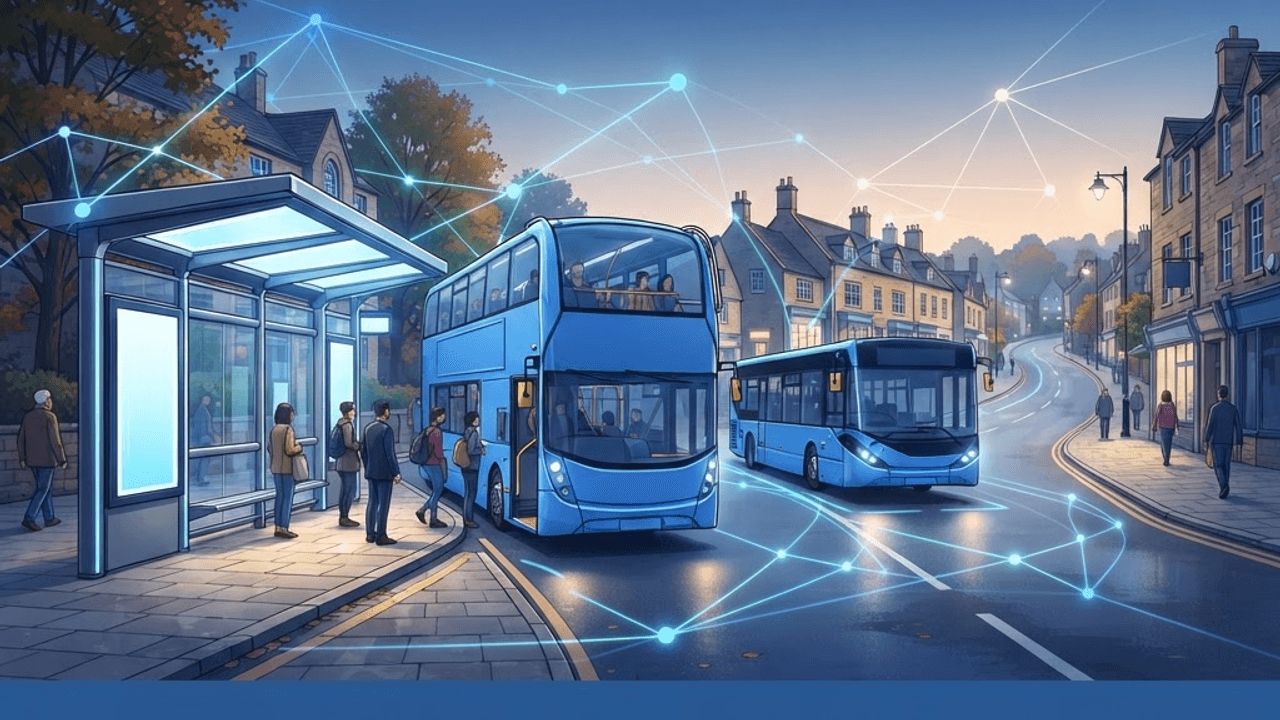
Why Buses Matter in Welwyn Hatfield
Rail dominates the conversation about transport in commuter Hertfordshire, but buses carry the journeys that trains cannot. Travel between Welwyn Garden City and Hatfield, access to the university campuses, connections to business parks, hospital journeys, school transport and links to surrounding villages all depend on the bus network.
The borough's geography makes this particularly important. Settlements are dispersed, with a mix of dense town centres, suburban estates, business parks and rural villages. Rail serves a north-south corridor well but does very little for east-west movement. Buses fill that gap and provide the only realistic public transport option for a significant share of residents, including students, older people and households without a car.
The Different Types of Bus Operation
Several distinct categories operate locally and understanding them helps when planning a journey. Commercial local services run on fixed routes and timetables, funded by fares. Supported services cover socially necessary routes that would not be commercially viable, often in rural areas or at off-peak times. Dedicated campus and staff shuttles serve specific institutions and employers. Airport coach services connect the area to major terminals. Long-distance coach operators link the borough into the national network. Community transport schemes provide door-to-door services for passengers who cannot use conventional buses.
Ten Bus and Coach Operators Serving the Borough
Hertfordshire Regional Buses operates a core network of local routes connecting the main towns, residential areas and transport interchanges, forming the backbone of everyday public transport in the borough.
Garden City Transit concentrates on Welwyn Garden City services, with frequent town routes linking residential neighbourhoods to the station, town centre and employment areas.
Hatfield Campus Shuttle serves the university community, connecting campuses, halls of residence, the town centre and the railway station with high-frequency services timed around academic schedules.
Broadwater Coaches specialises in private hire and group travel, providing coaches for school trips, sports fixtures, corporate events and social outings.
Peartree Airport Coaches runs scheduled services to major airports, offering a cost-effective alternative to taxis and parking for travellers with luggage.
Shire Park Employee Transit operates employer-funded shuttle services linking business parks to stations and residential areas, reducing car dependency for commuters.
Welwyn Community Transport provides accessible door-to-door journeys for passengers with mobility difficulties, including dial-a-ride style booking and volunteer driver schemes.
Old Hatfield Village Link serves rural communities on the borough's fringes with lower-frequency but essential services that maintain access to shops, healthcare and connections.
Northaw School Transport focuses on home-to-school services, operating dedicated vehicles with trained drivers and appropriate safeguarding procedures.
Hertfordshire Express Coaches connects the borough to long-distance destinations across the country, serving travellers who prefer coach economics to rail pricing.
Planning Journeys Effectively
Frequency matters more than speed for most passengers. A service every ten minutes removes the need to plan, while an hourly service requires timetable discipline and makes a missed bus genuinely costly. When comparing options, check frequency at the time you actually travel, since evening and Sunday services are typically far sparser than weekday peaks.
Interchange quality is the other key factor. A journey requiring two buses with a poorly timed connection can take longer than walking part of the route. Where possible, prefer direct services or interchanges at locations with frequent onward options.
Real-time information has improved considerably, and most services now report actual vehicle positions rather than scheduled times. Checking live data before leaving home is the simplest way to avoid waiting at a stop in poor weather.
Ticketing and Value
Single fares are rarely the best value for regular travel. Day tickets typically pay for themselves within two or three journeys. Weekly, monthly and annual products offer substantially better rates for commuters. Contactless payment with daily capping has simplified this considerably, automatically limiting what a passenger pays within a day.
Concessionary travel is available to eligible older and disabled passengers, generally during off-peak hours. Student discounts are widely offered locally given the university population. For airport coaches, booking in advance almost always costs less than buying on the day.
Accessibility Considerations
Modern buses are predominantly low-floor with wheelchair spaces, audible and visual next-stop announcements and priority seating. Coverage is not universal, however, particularly on some rural and private hire operations, so passengers with specific access needs should confirm vehicle specification when it matters.
Community transport fills the remaining gap, providing assisted door-to-door travel for those who cannot reach or board a conventional service. These schemes are often underused simply because eligible passengers are unaware of them.
Trends Shaping Local Bus Services
Fleet decarbonisation is the most visible change, with electric and hybrid buses progressively replacing older diesel vehicles, reducing both emissions and noise in town centres. Demand-responsive transport is being trialled in lower-density areas, using app-based booking to run flexible routes where fixed timetables are uneconomic.
Integration is also improving, with better coordination between bus and rail timetables, combined ticketing products and interchange facilities designed around actual passenger flows rather than administrative boundaries. Employer-sponsored transport continues to grow as businesses address staff recruitment, parking pressure and sustainability commitments simultaneously.
Practical Advice for Passengers
Allow buffer time when connecting to a train or flight, as road traffic is inherently less predictable than rail. Signal clearly to the driver at request stops, particularly in the evening. Have payment ready to keep boarding efficient. For coach travel to airports, book the service before the one you strictly need, since the cost of a missed flight vastly exceeds an extra hour at the terminal.
Conclusion
Bus and coach services in Welwyn Hatfield perform a role that rail cannot, linking towns, campuses, villages and workplaces across the borough and connecting residents to airports and the national network. The operators that serve the area cover commercial routes, campus shuttles, community transport and long-distance coaching. Understanding frequency, ticketing options and interchange quality is the key to making the network work well, and for many local journeys it remains the most economical and practical choice available.
Want your brand featured in front of decision-makers? Publish a guest post or get a link insertion in our guides through AAMAX's guest post and link insertion service.
Helpful Links
 SponsoredAAMAX — Full-Service Digital Agency
Write for Us
Share your expertise with our readers. We welcome guest contributions from industry specialists.
Pitch your idea