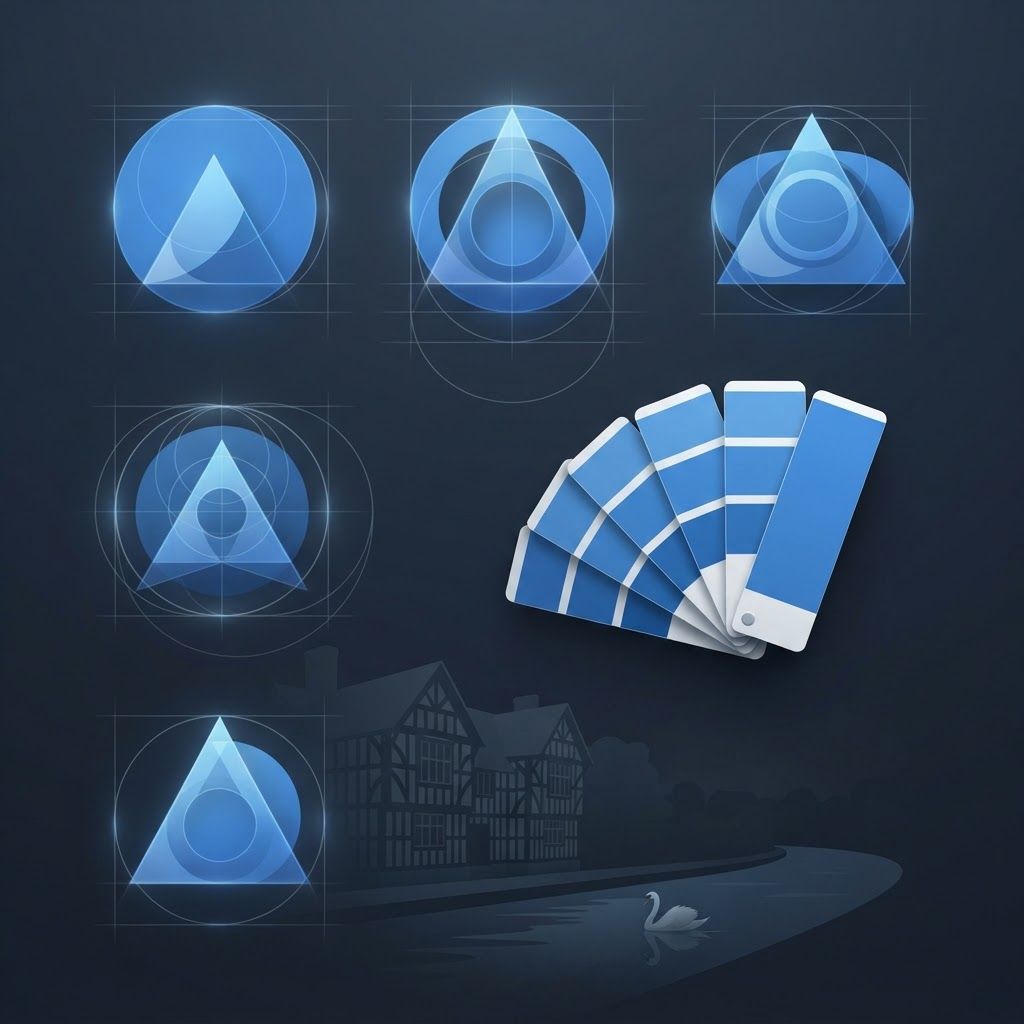
The Particular Challenge of Branding in a Heritage Setting
Stratford-on-Avon presents branding professionals with a constraint that most towns do not. The district's visual identity is already established, globally recognised and fiercely protected. Timber framing, the Avon, the theatre and the Shakespeare association form a shared visual vocabulary that every local business operates within, whether it chooses to or not. A brand that ignores this context looks imported. A brand that leans on it too heavily becomes indistinguishable from the souvenir trade.
The best local branding work navigates between those failures. It borrows the district's qualities of craft, longevity and quiet confidence without literally reproducing its imagery. That is a subtle brief, and it explains why Stratford supports a design community with more strategic depth than its size would suggest.
What Branding Actually Covers
Confusion between branding and logo design causes a great deal of wasted budget. A logo is an identifier. A brand is the accumulated set of associations a business holds in its audience's mind, and identity design is only one lever influencing it. Serious branding engagements typically address positioning, audience definition, naming, messaging, visual identity, tone of voice and the application guidelines that keep all of it coherent across every touchpoint. The agencies below vary considerably in how much of that scope they take on.
1. Bancroft Brand Studio
Bancroft Brand Studio delivers full identity programmes, beginning with market and audience research before any visual work starts. Its process produces comprehensive brand books covering logo systems, typography, colour, photography direction and voice. Clients tend to be established businesses with multiple touchpoints where consistency has begun to break down, and the studio's documentation discipline addresses exactly that problem.
2. Tudor Row Design
Tudor Row Design works predominantly with hospitality, retail and food businesses in the district. The studio's strength is in applied identity: signage, packaging, menus, interior graphics and the physical materials that carry a brand in a town where much of the customer relationship happens face to face. Its awareness of conservation area constraints and planning considerations for signage is a practical advantage locals appreciate.
3. Avon Identity Co.
Avon Identity Co. positions itself around brand strategy rather than execution, running positioning workshops, competitor audits and messaging development before handing visual delivery to partner studios or in-house teams. Businesses that already have design capability but lack clarity on what they stand for find this focused engagement efficient and cost-effective.
4. Guild Street Creative
Guild Street Creative serves startups and early-stage ventures across Warwickshire, offering compressed identity packages designed to get a credible brand into market quickly. The studio's naming and domain research capability is genuinely useful at that stage, and its pricing structure reflects the constraints founders work within.
5. Meadow Mark Studio
Meadow Mark Studio specialises in rebrands and brand evolution for long-established businesses. Much of its work involves modernising identities that carry real equity, updating them for digital application without discarding recognition built over decades. Family businesses and professional practices in the district form a substantial part of its client list.
6. Riverside Brand Works
Riverside Brand Works focuses on the tourism, attraction and leisure sector. Its portfolio includes wayfinding systems, visitor interpretation design and multi-language application, reflecting the district's international audience. The studio understands the operational realities of high-footfall environments where signage clarity affects visitor experience directly.
7. Clopton Design Partnership
Clopton Design Partnership is a senior two-person practice taking on a small number of substantial projects. Its work spans corporate identity, annual reports and complex brand architecture for organisations with multiple sub-brands or divisions. Clients value direct access to principals throughout the engagement rather than delegation to junior staff.
8. Shottery Brand Lab
Shottery Brand Lab approaches identity through a digital-first lens, designing systems that perform in app icons, social avatars and small-screen contexts before considering print. For technology companies, SaaS businesses and digital services in the district, this ordering of priorities produces more practical results than traditional print-led processes.
9. Old Bank Creative
Old Bank Creative combines branding with packaging design, serving food producers, drinks brands and consumer goods manufacturers across Warwickshire. The studio's understanding of retail shelf competition, regulatory labelling requirements and print production constraints makes it a natural fit for physical product businesses.
10. Warwickshire Brand Collective
Warwickshire Brand Collective assembles specialists per project, drawing on strategists, designers, illustrators and copywriters as each brief requires. The flexible structure allows it to handle projects of varying scale without carrying fixed overhead, and clients benefit from specialists rather than generalists at each stage.
Running a Successful Branding Project
Branding projects fail more often through client-side process than agency capability. Establish who holds final approval before work begins, and keep that group small. Committee-driven design converges on the inoffensive, which is the opposite of what branding should achieve. Provide honest input on competitors and on how the business is actually perceived, including uncomfortable feedback, because a brand built on internal aspiration rather than market reality will not hold.
Budget for implementation, not just design. A new identity requires updated signage, print materials, website changes, uniforms, vehicle graphics and digital assets. Projects that spend the entire budget on the design phase leave businesses unable to deploy what they have paid for, and a half-implemented brand is worse than no rebrand at all.
Current Directions in Brand Design
Several tendencies are visible in contemporary identity work. Flexible identity systems, where a core mark adapts across contexts rather than being reproduced identically, have largely replaced rigid single-logo approaches. Accessibility considerations now shape colour and typography decisions from the outset rather than being retrofitted. Motion has become a standard deliverable, with animated logo behaviour specified alongside static application. And there is a marked return to craft, illustration and hand-made elements as a reaction against the uniformity of geometric sans-serif minimalism.
Final Thoughts
Stratford-on-Avon supports a design community characterised by strategic seriousness and respect for craft. Whether the need is a foundational positioning exercise, a sensitive evolution of an established mark, or a complete identity system for a new venture, the studios profiled here offer credible routes. Be clear about scope, protect the approval process, and reserve budget for putting the work into the world.
Want your brand featured in front of decision-makers? Publish a guest post or get a link insertion in our guides through AAMAX's guest post and link insertion service.
Helpful Links
 SponsoredAAMAX — Full-Service Digital Agency
Write for Us
Share your expertise with our readers. We welcome guest contributions from industry specialists.
Pitch your idea