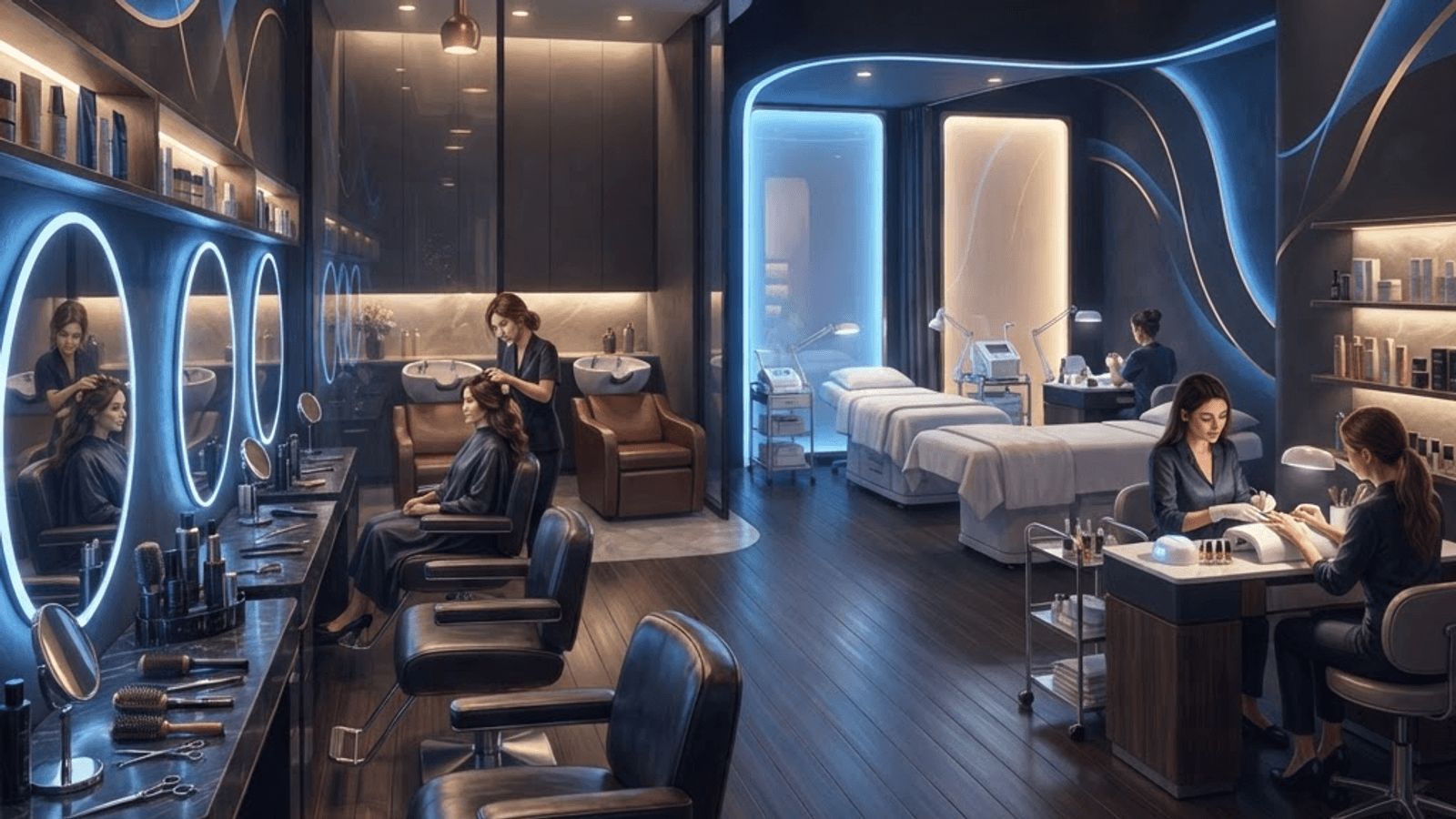
Supplying the Beauty Industry in South Wales
The beauty and personal care sector has grown consistently over the past decade, and South Wales reflects that national trend. Bridgend town centre, Porthcawl, Maesteg, Pencoed and the surrounding villages support a substantial population of hair salons, barbershops, nail bars, beauty rooms, aesthetic clinics, spas and independent retailers. Behind all of them sits a wholesale supply network providing professional products, tools, equipment and consumables.
Professional beauty wholesale differs meaningfully from consumer retail. Products are often higher concentration or professional-only formulations, packaging is designed for salon use rather than shelf appeal, and purchasing typically requires proof of qualification or trade status. That gatekeeping exists for good reason, as many professional products require training to use safely.
Professional Haircare and Salon Supply
Haircare represents the largest segment. Wholesalers supply shampoos, conditioners, treatments, colour ranges, developers, bleaches, styling products, perming and relaxing systems, and the extensive consumables that a salon consumes daily: foils, gloves, capes, towels, tint bowls and brushes.
Colour is commercially the most important category. Salons typically commit to one or two colour houses, invest in training on those systems, and build their service menus around them. That commitment makes the supplier relationship substantial and long-lasting. Wholesalers who provide education, whether through in-salon training, colour workshops or technical helplines, become genuine partners rather than order-takers.
Equipment supply runs alongside consumables: chairs, backwash units, trolleys, dryers, straighteners, clippers and processing equipment. Barbering has been a notable growth area, with demand for professional clippers, trimmers, razors, shaving products and beard care expanding significantly.
Skincare, Aesthetics and Clinic Supply
Professional skincare occupies a more clinical end of the market. Wholesalers supply facial treatment ranges, chemical peels, professional-strength active ingredients, microdermabrasion consumables, and increasingly the products supporting advanced aesthetic treatments.
The regulatory landscape here is complex and evolving. Certain treatments and products sit at the boundary between cosmetics and medicines or medical devices, with different legal frameworks applying. Wales has moved toward a licensing scheme for special procedures, and practitioners must understand what qualifications and registrations their treatments require. Responsible wholesalers verify practitioner credentials before supplying restricted products and provide clear guidance on safe use.
Training is inseparable from supply in this category. Reputable distributors either provide accredited training themselves or work with recognised training providers, and they decline to supply products to practitioners who are not qualified to use them.
Nail Products and Systems
Nail services have expanded dramatically in scope and technical sophistication. Wholesalers supply gel polish systems, builder gels, acrylic liquid and powder systems, electric files, UV and LED lamps, and an enormous range of art products and decorative elements.
Safety awareness has risen appropriately in this category. Overexposure to methacrylate monomers can cause allergic sensitisation in both technicians and clients, making adequate ventilation, correct product handling and appropriate PPE genuinely important rather than optional. Suppliers who provide clear safety data sheets and practical guidance on ventilation and skin protection serve their customers well.
Product quality varies enormously in this segment, and cheap imported alternatives sometimes contain ingredients restricted in UK and EU cosmetics regulation. Buying from established wholesalers who verify their supply chain protects both the technician and the client.
Regulatory Compliance and Product Safety
Cosmetic products supplied in the UK must comply with cosmetic regulations, which require a safety assessment, a product information file, notification to the appropriate authority, and correct labelling including full ingredient listing in INCI nomenclature.
The responsible person, meaning the legal entity accountable for compliance, must be established in the UK for products placed on the GB market. Salons importing products directly from overseas may unknowingly assume that responsibility, along with significant liability. Buying through established UK wholesalers avoids that exposure.
Counterfeit professional products circulate, particularly in haircare and fragrance. Fakes may contain incorrect or hazardous ingredients and can cause serious client reactions. Buying through authorised distribution channels rather than unverified online marketplaces is the only reliable protection.
Retail Sales and Salon Profitability
Retail is one of the most underexploited profit opportunities for salons. A client who buys professional aftercare achieves better results, returns more frequently, and generates margin that requires no additional chair time.
Good wholesalers support this actively, offering merchandising guidance, display units, sales training for stylists and therapists, and starter packages that reduce the initial stock investment. Salons should approach retail strategically, stocking a focused range that genuinely supports the services they perform rather than an overwhelming selection that ties up cash and confuses clients.
Sustainability in Beauty
Environmental concern has reached the beauty sector forcefully. Plastic packaging, water consumption, microplastics in formulations and single-use consumables have all drawn scrutiny.
Wholesalers are responding with refill systems for salon backbar products, concentrated formulations reducing packaging and transport weight, recyclable and post-consumer recycled packaging, and vegan and cruelty-free ranges that have moved from niche to mainstream expectation. Salon waste recycling schemes, which recover hair clippings, foils, colour tubes and plastics that ordinary recycling cannot process, have grown in popularity and offer salons a credible sustainability story.
Clients increasingly ask about these things, and salons able to answer confidently gain a genuine differentiator.
Choosing a Beauty Wholesaler
Consider brand portfolio first, as your product choice shapes your service menu and your salon's positioning. Assess the education offer, because ongoing training keeps your team current and your services competitive.
Evaluate practical logistics: ordering convenience, delivery speed, minimum order values and stock reliability. Running out of a colour shade mid-appointment is a serious operational problem, so consistent availability matters more than marginal price differences.
Look at commercial support. Some wholesalers offer equipment finance, salon design guidance, marketing materials and business advice. For a new salon opening in Bridgend, that support can be as valuable as the products themselves.
Where the Sector Is Heading
Professional beauty continues to evolve rapidly. Male grooming is growing steadily. Skin health and longevity treatments are expanding the boundary between beauty and clinical care. Personalisation, driven by better diagnostic tools, is influencing product recommendation. And regulation is tightening, particularly around aesthetic procedures.
Wholesalers who combine authentic product, genuine education and regulatory clarity will be the ones supporting the most successful salons. For beauty professionals across Bridgend and South Wales, choosing those partners carefully is one of the more consequential business decisions they will make.
Want your brand featured in front of decision-makers? Publish a guest post or get a link insertion in our guides through AAMAX's guest post and link insertion service.
Helpful Links
 SponsoredAAMAX — Full-Service Digital Agency
Write for Us
Share your expertise with our readers. We welcome guest contributions from industry specialists.
Pitch your idea