

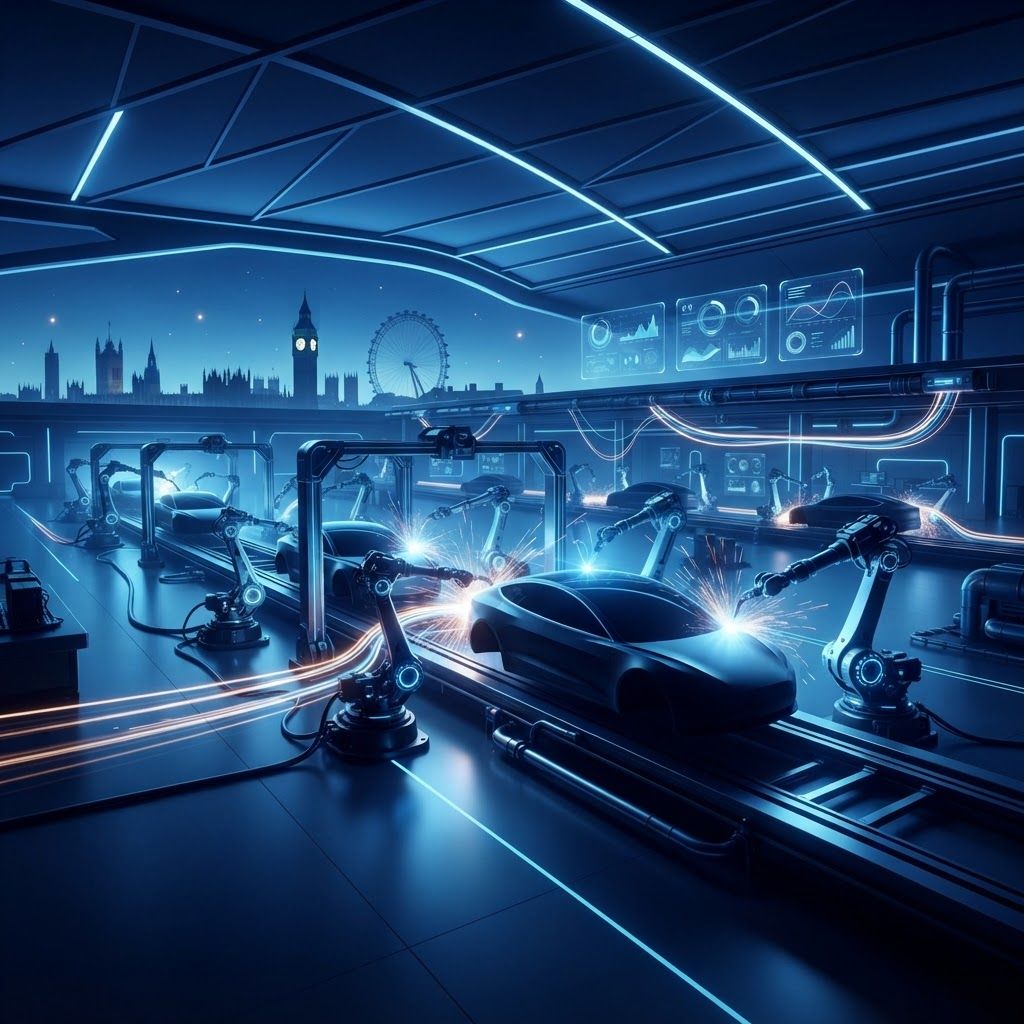
Automotive Britain and the Westminster Connection
Westminster has an unusual relationship with the automotive industry. It is a borough of restricted parking, congestion charging and ultra low emission requirements, yet it contains some of the most prestigious car showrooms in Europe and serves as the political and regulatory centre where vehicle policy is written. Manufacturers maintain a presence here for retail, corporate representation and engagement with regulators.
The borough is also a demanding real world test environment. Vehicles operating in central London face constant stop start traffic, tight manoeuvring, strict emissions zones and intensive short journey use. These conditions favour electrified powertrains, compact dimensions and refined low speed drivability, and they increasingly shape which models manufacturers prioritise for the market.
How the British Automotive Sector Is Structured
British vehicle manufacturing spans high volume production, luxury and performance marques, specialist low volume builders and commercial vehicle producers. Alongside them sits an extensive supply chain of component manufacturers, engineering consultancies and motorsport derived technology firms that support both domestic and international programmes.
Electrification has reorganised this landscape. Battery supply, power electronics, thermal management and software have become central competencies, while traditional engine expertise is being redeployed towards hybrid systems and alternative fuels. Design and engineering consultancy remains a genuine British strength, with development work undertaken here for manufacturers worldwide.
1. Jaguar Land Rover
Jaguar Land Rover is Britain's largest automotive manufacturer, producing luxury saloons and premium four wheel drive vehicles with a strong global following. Its differentiators include exceptional off road engineering heritage, refined interiors and a substantial investment programme in electrification. Its vehicles are among the most visible premium models on Westminster's streets.
2. Bentley Motors
Bentley Motors builds handcrafted luxury grand tourers and saloons that combine substantial performance with extraordinary interior craftsmanship. Its wood veneer, leather and metal finishing work is executed to a standard few manufacturers attempt. Bentley has committed to a fully electrified future while retaining the bespoke personalisation that defines its appeal to Westminster clientele.
3. Rolls Royce Motor Cars
Rolls Royce Motor Cars occupies the pinnacle of the luxury segment, producing vehicles renowned for silence, ride quality and virtually unlimited bespoke commissioning. Its coachbuild programme allows clients to specify genuinely unique vehicles. The introduction of fully electric models has demonstrated that near silent electric propulsion suits the brand's philosophy remarkably well.
4. Aston Martin Lagonda
Aston Martin Lagonda produces sports cars and grand tourers that balance dramatic design with genuine driving engagement. Its strengths include distinctive styling, hand finished construction and a motorsport programme that informs road car development. The marque maintains a strong retail presence in central London's luxury districts.
5. McLaren Automotive
McLaren Automotive applies Formula One derived engineering to road cars, with carbon fibre construction and advanced aerodynamics at the core of every model. Its differentiator is uncompromising focus on lightweight design and driver feedback rather than outright luxury. Its hybrid supercars demonstrate how electrification can enhance rather than dilute performance.
6. Lotus Cars
Lotus Cars built its reputation on lightweight engineering and exceptional handling, principles that continue to guide its transition into electric performance vehicles. It also operates a respected engineering consultancy serving other manufacturers. That dual role gives it unusually broad technical insight across the industry.
7. Morgan Motor Company
Morgan Motor Company hand builds distinctive sports cars using traditional craft techniques alongside modern engineering, including ash frame construction and bonded aluminium platforms. Its appeal lies in individuality and mechanical honesty rather than technological saturation. Each vehicle is effectively bespoke, produced in small numbers by a skilled workforce.
8. Caterham Cars
Caterham Cars produces the purest form of lightweight sports car, offering minimal weight, direct steering and an intensely mechanical driving experience. It remains one of the few manufacturers offering component vehicles for self assembly alongside factory built cars. Its enduring formula has changed remarkably little because it continues to work.
9. London Electric Vehicle Company
London Electric Vehicle Company manufactures the electric capable taxi that has become a familiar sight throughout Westminster, alongside light commercial vehicles. Its differentiator is designing specifically for urban duty cycles, with range extension, exceptional turning circle and durability for continuous daily service. Few manufacturers understand central London operating conditions more directly.
10. Nissan Sunderland
Nissan's Sunderland plant is one of Europe's most productive vehicle manufacturing facilities, building electric and conventional models alongside battery production capacity. Its significance lies in demonstrating high volume electric vehicle manufacturing at scale within the United Kingdom. Many electric cars operating in Westminster were built there.
Electrification and Clean Air Requirements
Westminster sits within London's ultra low emission zone and congestion charging area, which strongly influences vehicle choice. Fully electric vehicles avoid emission charges and produce no tailpipe pollutants, making them increasingly practical for residents, businesses and fleets operating primarily within the capital.
Charging remains the principal constraint. Many Westminster properties lack off street parking, so drivers depend on on street charging points, lamp post chargers and commercial rapid hubs. Fleet operators should analyse duty cycles carefully, since vehicles returning to a depot overnight can often charge more cheaply and reliably than those relying on public infrastructure.
Considerations for Fleets and Businesses
Total cost of ownership matters more than purchase price. Electric vehicles typically cost more initially but offer lower energy cost per mile, reduced servicing requirements and favourable tax treatment for business users. Residual values, insurance, tyre wear and charging infrastructure investment should all feature in any comparison.
Light commercial operators face additional considerations including payload, load volume and range under load. Manufacturers now offer credible electric vans suited to central London delivery patterns, and many businesses find that realistic daily mileage is well within capability once measured rather than estimated.
Choosing Wisely
Select a vehicle around actual use rather than aspiration. Assess dealer and service network accessibility, warranty terms, battery health guarantees and software update provision, which increasingly determines how a vehicle ages. For luxury purchases, personalisation options and build slot availability may influence timing significantly.
British automotive manufacturing continues to combine engineering ambition with genuine craft. For Westminster drivers and fleet managers, the practical challenge is matching that capability to the specific demands of operating in one of the most tightly regulated urban environments in the world.
Want your brand featured in front of decision-makers? Publish a guest post or get a link insertion in our guides through AAMAX's guest post and link insertion service.
Helpful Links
 SponsoredAAMAX — Full-Service Digital Agency
Write for Us
Share your expertise with our readers. We welcome guest contributions from industry specialists.
Pitch your idea

