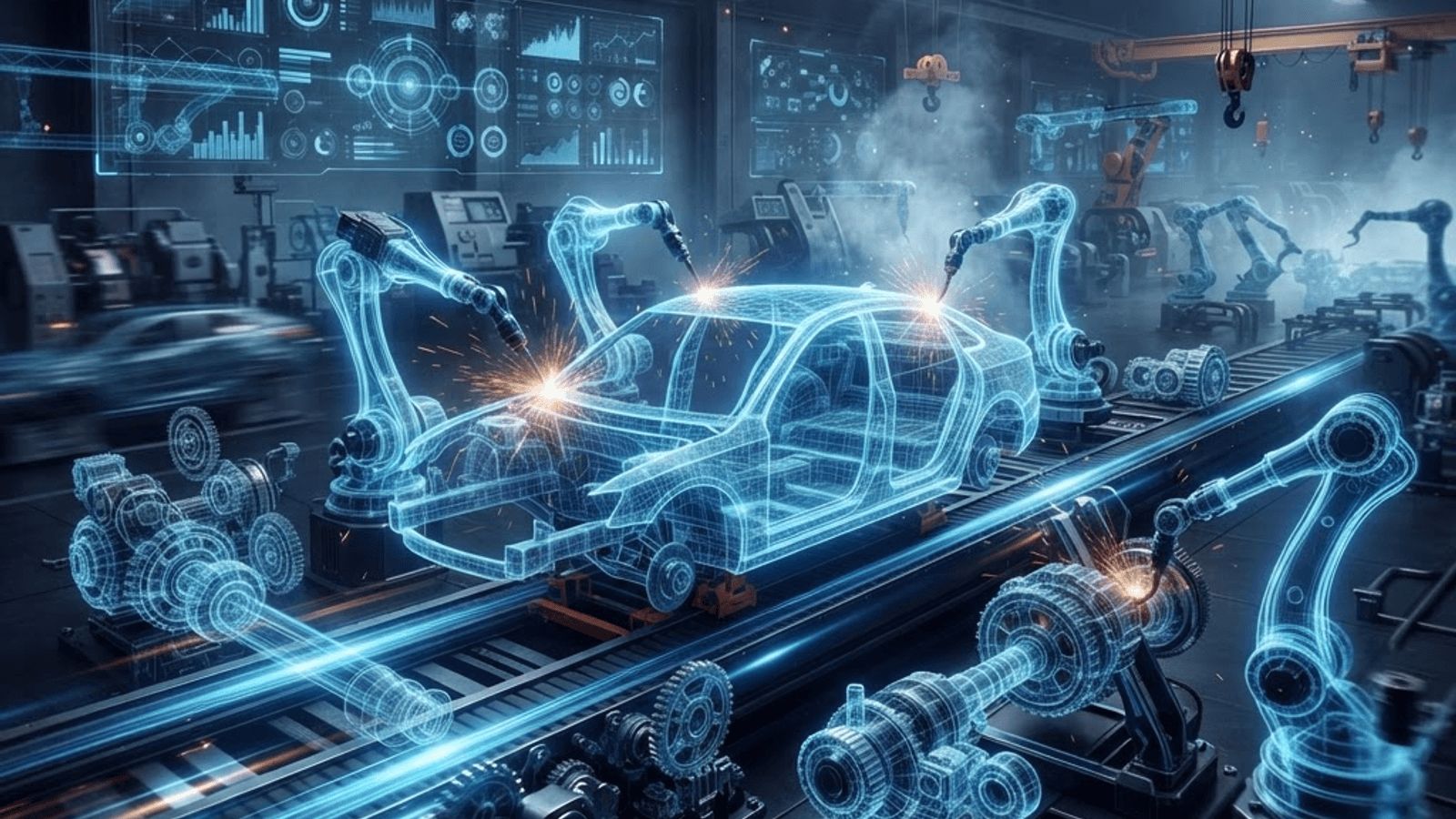
Automotive Engineering in Welwyn Hatfield
Hertfordshire has long been a quiet powerhouse of British automotive engineering, and Welwyn Hatfield sits comfortably within that tradition. While the borough is not home to a mass-market vehicle assembly plant, it hosts an ecosystem of component manufacturers, specialist fabricators, motorsport suppliers and electrification engineers whose output reaches vehicle programmes across the UK and Europe.
The borough's position on the A1(M) corridor makes it logistically attractive for just-in-time supply relationships. Add proximity to the motorsport valley cluster to the west and the research capability at the University of Hertfordshire's automotive and aerospace engineering departments, and the result is a location that punches well above its weight in technical capability.
What Modern Automotive Manufacturing Demands
Automotive supply is among the most demanding manufacturing disciplines. IATF 16949 certification is effectively the entry ticket for tier-one and tier-two work, bringing with it requirements for production part approval processes, advanced product quality planning, measurement systems analysis and statistical process control. Firms that hold it have proven they can deliver consistency at volume rather than excellence in a single sample.
Beyond certification, buyers look for dimensional capability. Automotive tolerances are unforgiving, and suppliers need coordinate measuring machines, documented gauge repeatability studies and the discipline to stop a line when a process drifts. Material traceability matters too, particularly for safety-critical components where a batch recall must be scoped precisely.
Ten Automotive Manufacturers Making an Impact
1. Hatfield Automotive Engineering is one of the borough's most established names, machining transmission and suspension components to tier-two specifications. Multi-axis CNC capability and in-house metrology allow the firm to hold tight tolerances across long production runs.
2. Welwyn Vehicle Systems focuses on electrical architecture: wiring harnesses, junction boxes and connector assemblies. The company has adapted well to higher-voltage EV platforms, investing in insulation testing and high-voltage safety training.
3. Comet Motorsport Fabrication serves race and performance clients with tubular chassis work, roll structures and bespoke bracketry. Rapid turnaround is the defining feature; a design agreed on Monday can be in a workshop by Friday during a race season.
4. Herts Precision Castings supplies aluminium and magnesium castings for lightweight structural applications. Lightweighting remains one of the most reliable routes to efficiency gains, and the firm's investment in simulation-led gating design has reduced porosity defects substantially.
5. Birchall Drivetrain Components produces gears, shafts and splined components with heat treatment and grinding performed in house. Controlling the full thermal and finishing sequence internally gives the business unusually tight control over final geometry.
6. Shire Park Electric Mobility represents the borough's electrification story. The company builds battery module assemblies, thermal management plates and power distribution units, working closely with vehicle integrators on packaging constraints.
7. Old Hatfield Trim and Interiors specialises in low-volume interior components: moulded trim, upholstery sub-assemblies and bespoke finishing for restoration, conversion and small-series vehicle projects.
8. Panshanger Brake and Chassis manufactures braking hardware and chassis mounting components. Safety-critical work of this nature requires exhaustive documentation, and the firm's traceability systems are frequently cited by auditors as exemplary.
9. Welwyn Garden Tooling Works sits upstream of the supply chain, producing press tools, jigs and fixtures used by other automotive manufacturers. Tooling quality ultimately determines part quality, making this an unglamorous but decisive link in the chain.
10. Ellenbrook Commercial Vehicle Solutions completes the list with conversions and body-building for vans and light commercial vehicles, including refrigerated units, welfare vehicles and specialist service bodies.
Electrification and the Local Supply Chain
The transition to electric powertrains has redistributed value across the automotive supply chain. Components tied to internal combustion, such as exhaust systems and fuel delivery hardware, face structural decline. Conversely, demand is growing for busbars, high-voltage connectors, battery enclosures, thermal plates and power electronics housings.
Local manufacturers that anticipated this shift have fared best. Several have retrained machinists on aluminium-intensive work, invested in friction stir welding or adhesive bonding capability, and built relationships with battery integrators rather than engine programme managers. The firms that treated electrification as a distant concern have found the adjustment considerably harder.
Quality, Compliance and Supply Resilience
Automotive buyers increasingly assess suppliers on resilience as well as capability. The semiconductor shortage and subsequent logistics disruptions taught the industry that a single-source component can halt an entire programme. Manufacturers in the borough have responded by dual-sourcing raw materials, holding strategic safety stock and mapping their own sub-tier dependencies.
Environmental compliance is another growing consideration. Carbon reporting requirements now cascade from vehicle manufacturers down through the supply chain, and suppliers who can quantify the embodied emissions of a component have a genuine commercial advantage when tendering for new business.
Choosing an Automotive Manufacturing Partner
Begin with a clear technical specification including tolerances, materials, surface finishes and expected annual volumes. Vague requirements produce inflated quotes because suppliers price in uncertainty. Providing a well-defined drawing package almost always improves commercial terms.
Ask about capacity headroom. A supplier running at ninety-five per cent utilisation has no ability to absorb a demand spike or recover from a machine breakdown. Ask too about the escalation path when something goes wrong, because in automotive it eventually will, and the quality of the response matters more than the promise it never happens.
Final Thoughts
Welwyn Hatfield's automotive manufacturers offer depth across machining, fabrication, electrical systems and emerging electrification technologies. The borough's engineering culture, logistics position and skills pipeline continue to support a competitive local supply base. For buyers willing to engage technically and build long-term relationships, the region remains a strong place to source.
Want your brand featured in front of decision-makers? Publish a guest post or get a link insertion in our guides through AAMAX's guest post and link insertion service.
Helpful Links
 SponsoredAAMAX — Full-Service Digital Agency
Write for Us
Share your expertise with our readers. We welcome guest contributions from industry specialists.
Pitch your idea