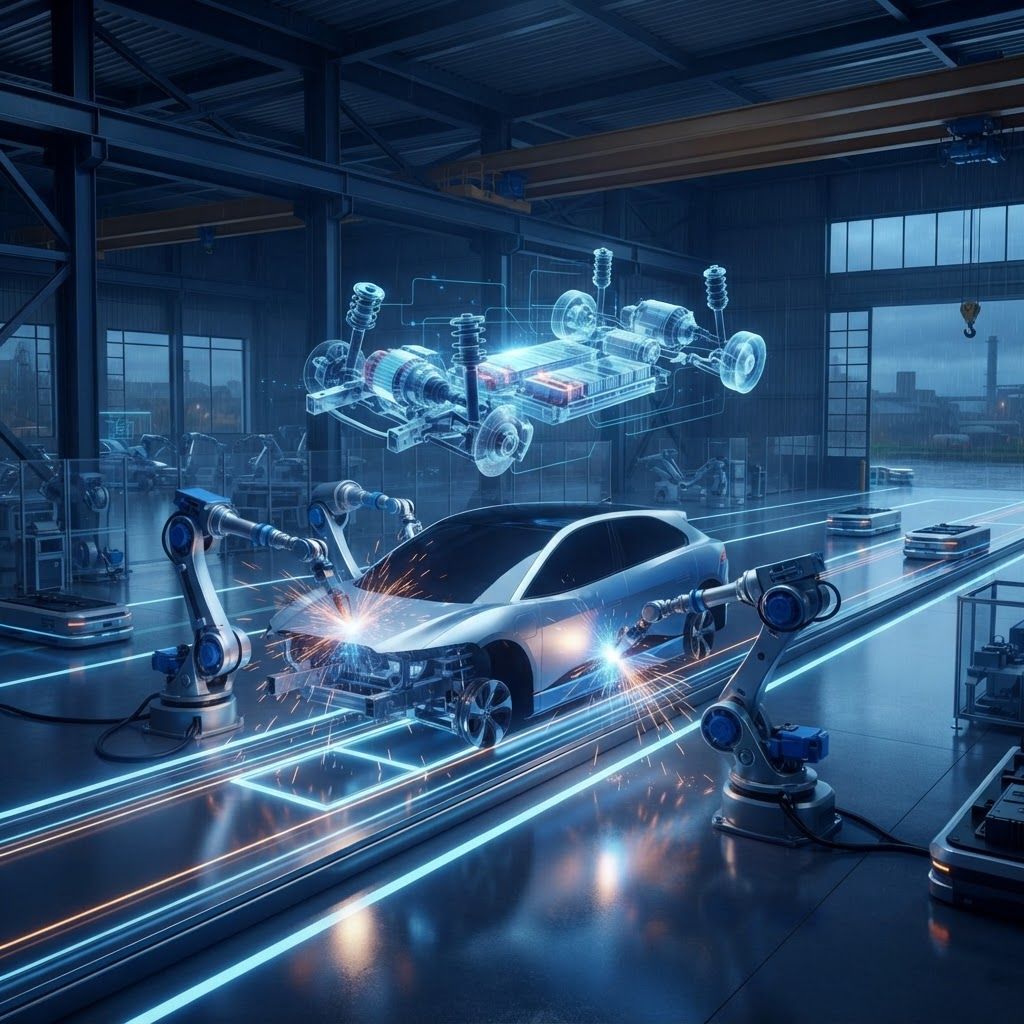
Automotive Manufacturing in Trafford
Trafford has no volume car assembly plant, and it never really did on the scale of the West Midlands or the North East. What it does have is a dense concentration of automotive supply chain activity: component manufacturing, precision machining, specialist vehicle conversion, commercial vehicle bodybuilding, and increasingly, electrification engineering.
This positioning reflects the borough's industrial character. Trafford Park's engineering workshops, fabrication shops and machine shops developed to serve heavy industry, and those same capabilities transfer readily to automotive components. The M60 and M62 give access to assembly plants and distribution networks across the country, while the local engineering skills base supports the precision and quality standards the sector demands.
The Structure of the Automotive Supply Chain
Automotive manufacturing operates in tiers. Original equipment manufacturers assemble complete vehicles. Tier one suppliers provide major systems and modules directly to them. Tier two and three suppliers produce components and sub-components feeding upward. Alongside this sits the aftermarket, supplying replacement parts and accessories, and the specialist vehicle sector converting base vehicles for particular purposes.
Trafford companies operate mainly at tier two and three, in the aftermarket, and in specialist conversion. These positions demand rigorous quality systems, since automotive customers impose some of the most demanding supplier requirements of any industry, but they offer more stable and diverse revenue than dependence on a single vehicle programme.
The Top 10 Automotive Manufacturers in Trafford
1. Trafford Park Automotive Components. A precision machining and pressing operation producing brackets, housings, fasteners and machined components for tier one suppliers. It holds automotive quality certification and operates statistical process control across its production lines.
2. Northern Commercial Bodies. Building and fitting bodies onto commercial vehicle chassis, from box vans and tippers to refrigerated units and specialist service vehicles. Its work supports fleet operators, utilities and local authorities across the North West.
3. Carrington EV Systems. Focused on electrification, this company manufactures battery pack assemblies, thermal management systems and high-voltage wiring for electric vehicle applications, including retrofit conversions of commercial fleets. It represents the fastest-growing segment of the borough's automotive activity.
4. Urmston Exhaust and Emissions. Manufacturing exhaust systems, catalytic converter housings and emissions control components for aftermarket and specialist applications, with tube bending, welding and fabrication capability supporting both production and one-off work.
5. Sale Vehicle Interiors. Producing trim panels, seating components, upholstery and interior fittings for specialist vehicles, minibuses, accessible transport and vehicle conversions. Its work combines textile, foam and plastics processing with automotive-grade finishing.
6. Stretford Suspension Engineering. Designing and manufacturing suspension components, springs, dampers and chassis parts for performance, motorsport and heavy-duty applications. Its engineering support and testing capability distinguish it from pure parts distributors.
7. Altrincham Motorsport Fabrication. Serving competition and high-performance markets with roll cages, chassis fabrication, lightweight components and bespoke engineering. Motorsport work demands extremely short lead times and often drives innovation that later reaches mainstream production.
8. Old Trafford Accessible Vehicles. Converting vehicles for wheelchair access and adapted driving, including floor lowering, ramp and lift installation, restraint systems and driving controls. Its work must meet stringent safety and type approval requirements.
9. Timperley Automotive Plastics. Injection moulding and thermoforming interior and exterior plastic components, from clips and ducts to larger trim mouldings. It supports both production programmes and aftermarket replacement parts for older vehicles.
10. Partington Remanufacturing. Remanufacturing engines, gearboxes, turbochargers, starters and alternators to original specification. Remanufacturing offers substantial carbon and cost savings compared with new production and has grown considerably as circular economy thinking spreads.
Trends Reshaping Automotive Manufacturing
Electrification is the defining transformation. The shift to battery electric vehicles eliminates demand for many traditional components, including exhaust systems, fuel systems and much of the internal combustion powertrain, while creating substantial new demand for battery assemblies, power electronics, thermal management, high-voltage cabling and lightweight structures. Suppliers dependent on internal combustion content face genuine existential pressure, and the borough's more forward-looking manufacturers have already diversified.
Lightweighting continues to matter, arguably more with electric vehicles than before, since reducing mass directly extends range. Aluminium, high-strength steel, composites and design optimisation all contribute, and manufacturers with capability across multiple materials hold an advantage.
Software content per vehicle has grown enormously, blurring the boundary between automotive and electronics manufacturing. Components increasingly contain sensors, controllers and communication interfaces, requiring suppliers to develop electronics and firmware competence.
Supply chain resilience has become a board-level concern. Recent disruptions pushed manufacturers toward dual sourcing, regional supply and larger buffer inventories, which has improved prospects for UK-based suppliers competing against distant alternatives.
Selecting an Automotive Supplier
Quality certification is non-negotiable. IATF 16949 is the automotive sector standard and goes well beyond ISO 9001 in its requirements for process control, measurement systems analysis and continuous improvement. For production parts, expect production part approval process documentation, control plans and failure mode effects analysis.
Assess capacity and flexibility. Automotive demand fluctuates, and suppliers must handle volume changes without quality degradation. Ask about capacity utilisation, shift patterns and how the supplier managed recent demand volatility.
For specialist vehicle work, confirm type approval knowledge, whether individual vehicle approval or small series arrangements, and check that conversions will satisfy insurance and roadworthiness requirements.
Finally, evaluate the supplier's electrification strategy. A component manufacturer with no plan for a post-combustion market carries risk that will eventually become your risk too.
Final Thoughts
Trafford's automotive manufacturers occupy the parts of the value chain where engineering skill, flexibility and quality matter more than sheer scale. Those investing in electrification, lightweighting and electronics integration are positioned well for a market undergoing its largest technological change in a century.
Want your brand featured in front of decision-makers? Publish a guest post or get a link insertion in our guides through AAMAX's guest post and link insertion service.
Helpful Links
 SponsoredAAMAX — Full-Service Digital Agency
Write for Us
Share your expertise with our readers. We welcome guest contributions from industry specialists.
Pitch your idea