

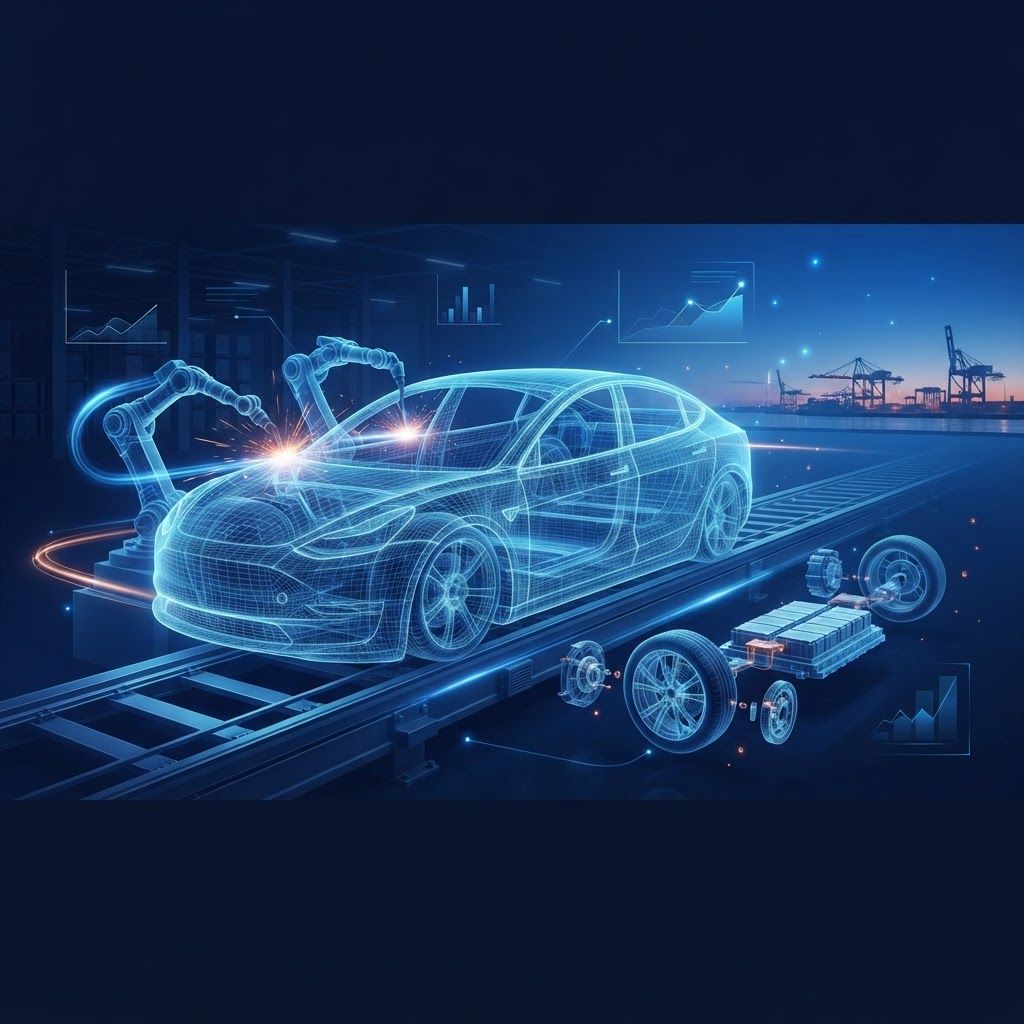
Thurrock's Role in the UK Automotive Sector
Thurrock does not host a major vehicle assembly plant, yet it occupies a genuinely important position in British automotive activity. The Port of Tilbury and London Gateway handle substantial volumes of vehicle and component movement, and the borough's extensive distribution estates support parts warehousing, aftermarket supply and fleet operations. The concentration of haulage, logistics and construction businesses locally also creates significant demand for commercial vehicles, trailers, specialist bodywork and fleet servicing.
This means the automotive companies most relevant to Thurrock are not necessarily those with local factories, but those whose vehicles, components and dealer networks serve the borough's economy. Commercial vehicle manufacturers in particular deserve prominence, since heavy goods vehicles, vans and materials handling equipment are core operational assets rather than consumer purchases here.
How the Sector Is Structured
Automotive manufacturing divides into passenger vehicle producers, commercial vehicle manufacturers, component suppliers ranging from tier one systems integrators down to specialist part makers, and bodybuilders who convert chassis into tippers, curtainsiders, refrigerated units and specialist vehicles. Aftermarket parts distribution and remanufacturing form a further substantial segment.
For fleet buyers, the relevant considerations differ markedly from private motoring. Whole life cost, payload capacity, residual value, service network density, uptime guarantees, telematics integration and driver comfort all outweigh list price. As electrification advances, charging infrastructure requirements and realistic operational range under load become decisive.
1. Ford
Ford has one of the deepest connections to Essex and the Thames corridor of any manufacturer, with a long industrial history in the region and continuing engineering and powertrain operations. The company remains the dominant supplier of light commercial vehicles in the UK, and its vans are ubiquitous across Thurrock's trades, logistics and service businesses. Its transition toward electric commercial vehicles is significant for local fleet planning.
2. Jaguar Land Rover
Jaguar Land Rover is Britain's largest automotive manufacturer, producing premium vehicles with substantial UK engineering and assembly operations. Its vehicles move in significant volume through UK ports for both import of components and export of finished cars, and its supply chain reaches deep into domestic component manufacturing and logistics services.
3. Nissan
Nissan operates one of the highest-volume vehicle plants in the UK and has invested heavily in electric vehicle and battery production. Its scale makes it a major user of inbound component logistics and outbound vehicle distribution, and its electric models have been influential in normalising battery vehicles within UK fleets.
4. Toyota
Toyota manufactures vehicles and engines in the UK and is widely recognised for manufacturing excellence and hybrid powertrain leadership. Its production system has shaped manufacturing practice far beyond automotive, and its hybrid commercial and passenger vehicles remain popular with fleet operators seeking emissions reduction without full charging infrastructure investment.
5. Leyland Trucks
Leyland Trucks manufactures commercial vehicles in the UK, producing trucks used extensively across British distribution and construction. Heavy goods vehicles are fundamental operating assets for Thurrock's haulage and logistics sector, and domestic truck manufacturing supports a substantial network of dealers, servicing operations and parts supply within reach of the borough.
6. Alexander Dennis
Alexander Dennis is the UK's leading bus and coach manufacturer, producing single and double deck vehicles including battery electric and hydrogen models. Public transport vehicles serving Thurrock and the wider Essex and London network draw on this capability, and the company's zero-emission bus production is central to regional transport decarbonisation.
7. Wrightbus
Wrightbus manufactures buses including hydrogen fuel cell and battery electric models, and has been influential in advancing zero-emission public transport in the UK. Its vehicles are relevant to regional transport authorities upgrading fleets, and its hydrogen work aligns with estuary hydrogen infrastructure ambitions.
8. Don-Bur
Don-Bur designs and manufactures trailers and commercial vehicle bodywork including double deck trailers, curtainsiders, refrigerated units and aerodynamic designs. Trailer specification directly affects payload efficiency and fuel consumption for distribution operators, and double deck configurations in particular have transformed the economics of retail and parcel distribution from Thames Gateway warehouses.
9. Cartwright
Cartwright manufactures trailers, rigid bodies and temperature-controlled vehicles for the UK logistics industry, alongside fleet servicing and rental operations. Refrigerated transport is especially relevant to Thurrock, given the volume of chilled and frozen food distribution operating from the borough's cold storage facilities.
10. Dennis Eagle
Dennis Eagle manufactures refuse collection vehicles including electric models, supplying local authorities and waste management contractors nationwide. Waste and recycling operations form a notable part of the Thames Gateway industrial landscape, and electrified refuse vehicles represent one of the most practical heavy vehicle electrification cases given predictable urban duty cycles.
Electrification and Its Local Consequences
The transition to zero-emission vehicles is reshaping fleet decisions more rapidly than many operators anticipated. Light commercial vehicles are already viable electrically for urban and regional multi-drop work, with total cost of ownership frequently favourable once fuel and maintenance savings are counted. Heavy goods vehicles remain more challenging, though depot-based regional distribution is increasingly feasible.
The critical constraint is charging infrastructure and grid capacity. A distribution depot converting a substantial van fleet may require electrical supply reinforcement, and heavy vehicle charging demands connection capacity comparable to a small industrial process. This makes early engagement with the distribution network operator essential, and it increases the value of on-site generation and battery storage to manage peak import.
Operators should also consider used vehicle markets, since residual values for electric commercial vehicles are still stabilising, and residual assumptions materially affect lease pricing.
Practical Fleet Guidance
Start with duty cycle data rather than assumptions. Telematics records of daily mileage, load, stop frequency and dwell time reveal which vehicles can electrify immediately and which cannot. Trial vehicles in real operation before committing, since payload reduction from battery weight can materially affect productivity in weight-limited applications.
Service network density matters enormously for uptime. A slightly more expensive vehicle with a dealer and mobile service capability within short reach of the depot frequently outperforms a cheaper alternative requiring long recovery journeys. Ask manufacturers for documented uptime commitments and response times rather than general assurances.
Final Thoughts
Automotive relevance in Thurrock centres on commercial vehicles, trailers, specialist bodywork and the port logistics that move vehicles and components at scale. The manufacturers profiled here supply the vans, trucks, buses, trailers and municipal vehicles the borough's economy depends on. Fleet decisions should be driven by whole life cost, uptime capability and honest assessment of charging infrastructure requirements rather than headline purchase price.
Want your brand featured in front of decision-makers? Publish a guest post or get a link insertion in our guides through AAMAX's guest post and link insertion service.
Helpful Links
 SponsoredAAMAX — Full-Service Digital Agency
Write for Us
Share your expertise with our readers. We welcome guest contributions from industry specialists.
Pitch your idea

